Conradh na Gaeilge backs Irish unity at annual assembly
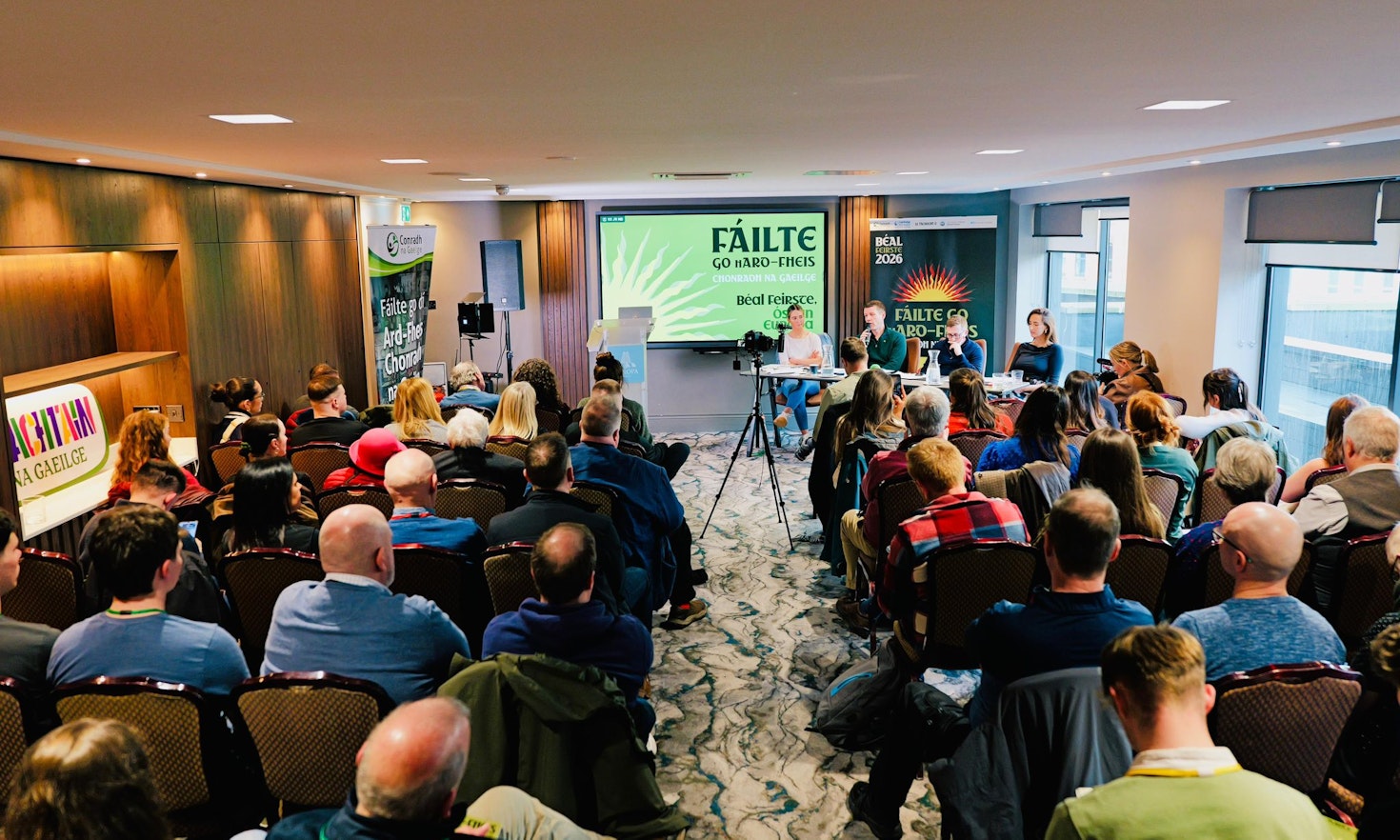
Conradh na Gaeilge (the Gaelic League) held its annual general meeting in Béal Feirste/Belfast over the weekend. Founded in 1893 to promote the Irish language, the organisation has long been central to language activism across Ireland. In a significant development, delegates voted to support Irish political unity – a position the organisation had not formally adopted in its 130-year history. The decision reflects both the growing momentum of the Irish-language movement, particularly in Northern Ireland, and wider political shifts on the island.
Conradh na Gaeilge (the Gaelic League) held its annual general meeting in Béal Feirste/Belfast over the weekend. The organisation, broadly comparable – though not identical – to the Basque movement Euskal Herrian Euskaraz in the Basque Country, was founded in 1893 to promote the Irish language.
The sociolinguistic position of Irish remains paradoxical. Although Irish has been the first official language of the Republic of Ireland for more than a century, it continues to occupy a minoritised position in both Northern Ireland and the Republic. As an official state language, Irish is also an official language of the European Union. Some observers wryly note that the language sometimes appears to receive more institutional attention in Brussels than in Baile Átha Cliath/Dublin.
In debates about minority language revitalisation, the Irish case has often been cited as a model not to follow. Many minoritised languages lack statehood and therefore do not benefit from the legal and institutional frameworks that can support language normalisation. There are, of course, small state languages with relatively modest speaker populations – such as Latvian, Slovenian or Lithuanian – but where a language is the primary language of the state, it is possible to conduct virtually all public life through it. Irish demonstrates that official status alone does not guarantee widespread societal use.
Against this backdrop, recent years have seen renewed mobilisation in support of Irish, particularly in Northern Ireland. This growth is closely linked to broader political developments and to the rising electoral support for Sinn Féin in both Northern Ireland and the Republic of Ireland.
Conradh na Gaeilge operates across the whole island and has a long organisational history. One notable feature of the assembly in Béal Feirste/Belfast was the high proportion of young participants. Younger activists are playing an increasingly prominent role within the organisation, bringing renewed energy and assuming leadership responsibilities. Many of them are graduates of gaelscoileanna – Irish-medium schools in which subjects are taught through Irish.
The most significant decision taken at the weekend meeting was the formal endorsement of Irish political unity. In its 130-year history, the organisation had not previously adopted such a position. The vote marks a notable moment in the evolving relationship between language activism and constitutional politics on the island of Ireland.
Note: This article gives the views of the author(s) and does not represent the position of the European Association of Daily Newspapers in Minority and Regional Languages (MIDAS) or Eurac Research.

Martxelo Otamendi
Martxelo Otamendi has been the President of the European Association of Daily Newspapers in Minority and Regional Languages (MIDAS) since 2025. Previously, he was editor-in-chief of the Basque daily newspaper Euskaldunon Egunkaria until its unjust closure in 2003. He then led its successor, Berria, the only daily newspaper published in Basque. Although he retired from this position in 2023, he continues to write for Berria.
Discover
Making research visible.
Find the connected experts, projects, publications, and research areas behind this blog post.
This content is licensed under a Creative Commons Attribution 4.0 International license except for third-party materials or where otherwise noted.