“In Greenland, a strong people stand up to Trump”
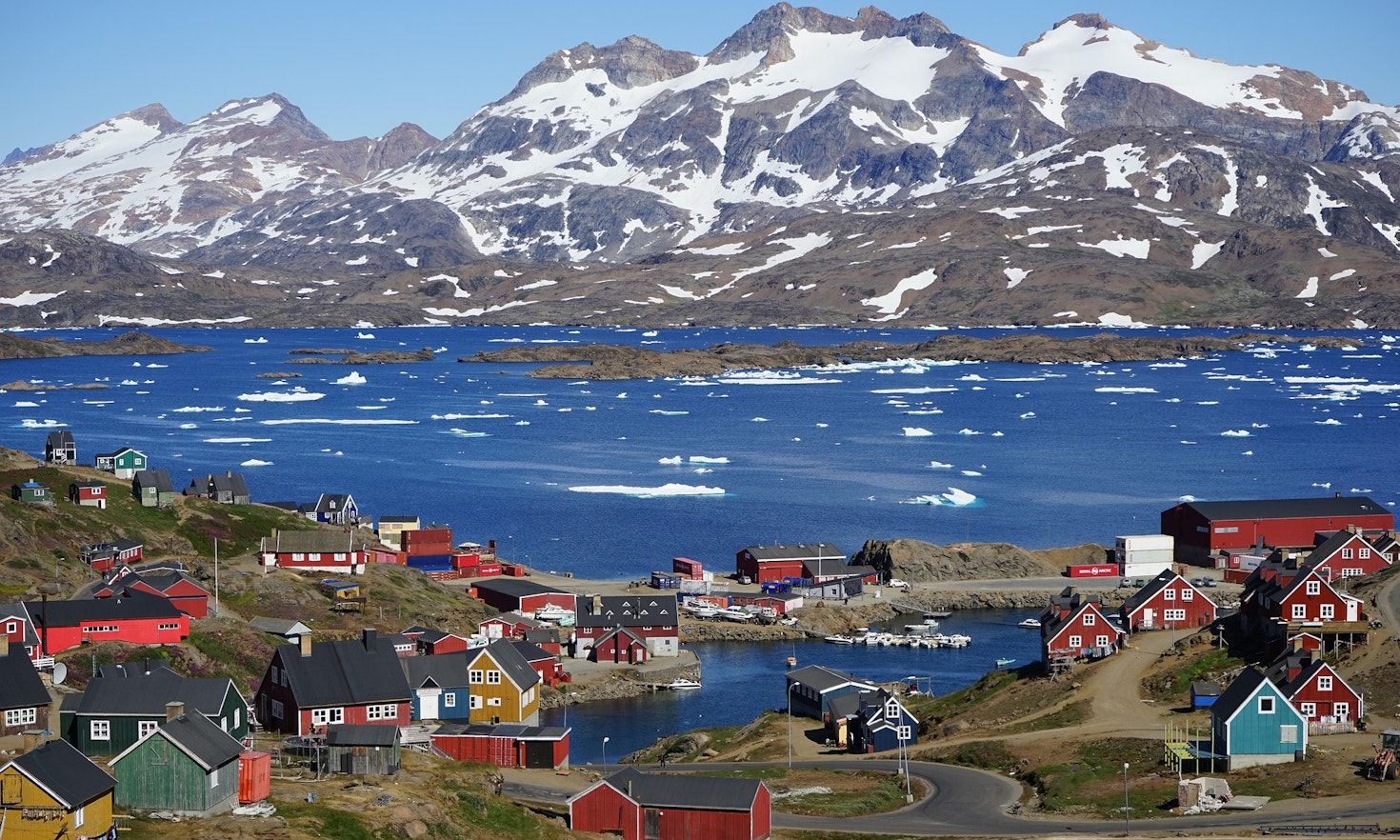
Der Nordschleswiger’s capital correspondent, Walter Turnowsky, was in Copenhagen this week. But in his thoughts, he was in Greenland, which he had had the privilege of getting to know over seven years. He has also been in touch with friends in Kalaallit Nunaat.
“There is a great deal of uncertainty in Nuuk at the moment,” my close friend Akitsinnguaq Olsen writes to me in a messenger message.
It is Wednesday afternoon, 14 January – just one hour before the Naalakkersuisut member (minister) for foreign affairs, Vivian Motzfeldt, and the Danish foreign minister, Lars Løkke Rasmussen, are due to meet their US counterpart Marco Rubio and vice-president J. D. Vance.
Many people in Nuuk find it difficult to concentrate on their work or even on everyday tasks. The television is on almost around the clock.
“Many colleagues report in the morning, almost in tears, how frightened they are. They have barely slept and are suffering from headaches and nausea,” the 55-year-old continues.
Akitsinnguaq Olsen in the centre of Nuuk
Credit: Private | All rights reservedAkitsinnguaq works as an interpreter at the Greenlandic parliament, the Inatsisartut. She herself tries to push the unease aside while at work. But I know my friend well enough to know that, beneath the surface, things are also simmering for her – her apparent calm is hard-won through iron discipline. And on the way home from work it becomes even harder.
“In shops, on the street and at bus stops, people talk about the terrible fears they have. A heavy and fearful atmosphere hangs over the whole city.”
Psychologist: Trump’s behaviour is intrusive
For more than a year now, people in Kalaallit Nunaat – the land of the Greenlanders – have had to endure inhuman pressure from Washington. Time and again, they have responded calmly and thoughtfully, but also firmly, to Donald Trump’s intrusions. They now hope that we in Denmark, Germany, Europe and the rest of what they see as a still reasonable world will support them more clearly.
The Kalaallit perceive the conduct of the US President as intrusive. This is confirmed by the psychologist Naja Lyberth in a Facebook post. Writing in English, she compares his behaviour to that of a person planning a sexual assault.
It is no coincidence that she uses this particular comparison. Lyberth has treated a large number of people suffering long-term consequences of sexual violence. She knows the strength people can develop when they work through trauma. She is therefore convinced that the Trump administration is severely underestimating the resilience of the Greenlandic people.
Protests against Trump
At a press conference on Tuesday, prime minister Jens Frederik Nielsen once again emphasised that the people of Greenland cannot be bought: “Greenland does not want to be owned by the United States. Greenland does not want to be controlled by the United States. Greenland does not want to be part of the United States.”
On 15 March last year, people in Nuuk and other cities took to the streets to demonstrate against Trump's plans. Proudly, they carried the Greenlandic flag, Erfalasorput, in their hands. They were the largest demonstrations Greenland has ever seen. Further protests are planned for Saturday.
Old traumas resurface
The reactions are also so strong because people in Greenland know what it means to live under foreign rule. The traumas of the colonial period still run deep today.
Denmark was not the “good” colonial power it often likes to see itself as. Psychologist Naja Lyberth can speak to this as well. “I no longer remember many details. But I remember the instruments,” she says in her characteristically calm voice in a 2017 radio documentary by the broadcaster DR.
At the age of 14, she was fitted with an intrauterine device – without her consent and without that of her parents. “The instruments felt like knives.”
Between 1966 and 1975, the then Danish health system fitted around 4,500 women with IUDs – in most cases, as with Lyberth, without asking. That amounted to half of all girls and women of childbearing age. Nowhere in the world did the birth rate fall as sharply during that period as it did in Greenland.
An artist’s interpretation
The artist Bolatta Silis-Høegh has addressed the forced contraception policy in an artwork consisting of miniature paintings of wombs. “In the current situation, we need to stick together, but also – and especially now – be able to talk about the difficult things,” she said at an artist talk on Tuesday evening. She does not see this as an attempt to drive a wedge between Greenland and Denmark, but rather the opposite: a step on the path towards reconciliation.
Bolatta Silis-Høegh with part of her work “Hun gik en tur”
Credit: Bolatta Silis-Høegh | All rights reservedColonial traumas can be passed down through generations – something that is now considered scientifically proven. This is why not only the so-called IUD campaign still plays a major role for people in Greenland. Events further back in history also remain present.
A situation like the current one can trigger retraumatisation. We would probably develop extreme fears if we were exposed to what the Kalaallit are experiencing now. For them, the resurgence of old traumas is added to this. That helps to explain the intense reactions in Nuuk that Akitsinnguaq describes.
Bolatta Silis-Høegh’s work “Hun gik en tur” consists of a series of miniatures.
Credit: Bolatta Silis-Høegh | All rights reservedThis is likely also clear to foreign minister Motzfeldt when she steps in front of the press together with Løkke Rasmussen after the talks with Rubio and Vance. Her first words are: “Asasakka nunaqqatikka nalunngilara malinnaasusi. Dear fellow countrymen and women, I know that you are following everything closely.”
“Never has ‘Asasakka nunaqqatikka’ moved me so deeply,” a woman writes shortly afterwards on Facebook. Many others agree.
An appeal for international solidarity
Akitsinnguaq Olsen writes to me that on Thursday her colleagues arrived at work smiling, singing and proud. They share the hope that Greenland will be able to play a more distinct role in the future.
“I hope that Greenland has gained a stronger, more independent voice in the talks. Of course, we must continue to work with Denmark, but also show how strong we Greenlanders are.”
At the same time, she is aware that she and her compatriots will have to continue to endure pressure for as long as Trump remains president of the United States. She therefore appeals to democratic states to stand together, because this is about more than Greenland alone.
“We cannot do without one another as long as an apparently ice-cold, narcissistic and power-obsessed person is president of the United States.”
Once again, as so many times before, I can only agree with my good friend.
This article gives the views of the author(s) and does not represent the position of the European Association of Daily Newspapers in Minority and Regional Languages (MIDAS) or Eurac Research.

Walter Turnowsky
Walter Turnowsky, born in 1964 in Klagenfurt, Austria, began his journalistic career at ‘Radio ANR’ and ‘TV Danmark Aalborg’, where he worked from 1997 to 2002. He was then head of department at the newspaper ‘Nordjyske’ until 2005. From 2005 to 2013, Turnowsky worked as a TV editor at ‘Sjællandske’. His professional career took him to Greenland in 2013, where he worked as an editor at ‘KNR’ until 2016. He then worked as a journalist at ‘Sermitsiaq.AG’ until 2020. Since 2020, Walter Turnowsky has been reporting as a correspondent in Copenhagen for ‘Der Nordschleswiger’.
Discover
Making research visible.
Find the connected experts, projects, publications, and research areas behind this blog post.
This content is licensed under a Creative Commons Attribution 4.0 International license except for third-party materials or where otherwise noted.
This blog is supported by the European Association of Daily Newspapers in Minority and Regional Languages (MIDAS). MIDAS was founded in 2001 to provide assistance to minority language newspapers and nowadays has members all over Europe. MIDAS serves as a platform for exchange, uniting minority language newspapers to present a collective voice to the European institutions.