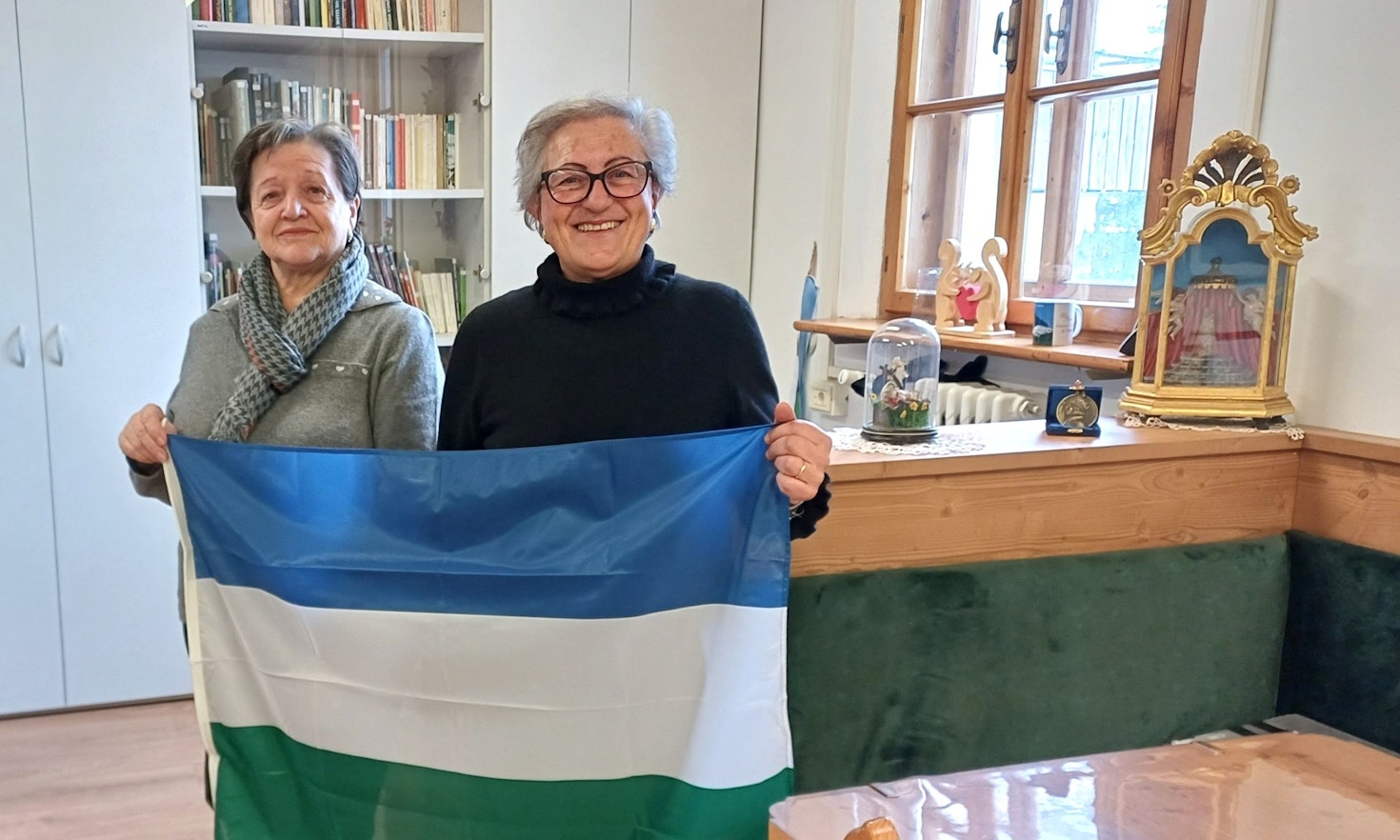
“Ladin flags draw attention to us”

Elsa Zardini, president of the Ladin organisation Union de i Ladis de Anpezo, criticises the Milan–Cortina 2026 Olympic organising committee for overlooking the Ladin community in Anpezo/Cortina d’Ampezzo. In this interview, she speaks about minority rights, linguistic decline and the impact of the Games on the Dolomites.
Danjel Radetič: Why are you disappointed with the Olympic organising committee?
Elsa Zardini: Because they have not acknowledged us at all. Not once have they mentioned that we are the oldest people in the Dolomites, that we have our own culture, our own language, our own traditions. Visitors coming from elsewhere would surely be interested in knowing who we are.
Radetič: As we arrived in Anpezo/Cortina d’Ampezzo we noticed many Ladin flags.
Zardini: Of course. Before the Games, we decided to draw attention to ourselves by displaying our flags. The green represents forests and meadows, white stands for snow, and blue for the sky. We distributed more than 500 flags among local residents. Our brothers and sisters in Val Badia, Fascia, Gherdeina and in Fodom, did the same. With these flags we welcome visitors, but we also remind them that we exist – and that we intend to remain here. We live in the Veneto region, yet we have nothing in common with Venice. From 1511 to 1918 we were under Austria. In 1923 fascism divided us between two regions and three provinces.
We have no protection whatsoever. We receive no funding for our institutions.
Elisa Zardini
Radetič: Is the situation of Ladins in Veneto the most difficult?
Zardini: Yes. We have no protection whatsoever. We receive no funding for our institutions. Fortunately, South Tyrol supports us, including our organisation.
Radetič: Before meeting you, we spoke to four young volunteers. They said they were locals but did not speak Ladin.
Zardini: In Cortina there are about 2,500 truly autochthonous inhabitants. Others moved here after the 1956 Winter Olympics. Over time there have been many mixed marriages, and in many cases Ladin has been abandoned. I myself married an Italian, but I always spoke Ladin with my children. Another problem is that Ladin is not taught in schools. Teaching it would help us preserve the language and would also allow newcomers to learn it. Unfortunately, many people here still fail to understand that national and linguistic communities are an important added value.
Radetič: A few years ago, there was an attempt to separate from Veneto.
Zardini: Yes, in 2007. In a referendum, nearly 80% of Anpezo’s residents voted to join the Province of Bulsan/Bozen/Bolzano. But Veneto does not want to let us go. We are, after all, a brand.
In recent days many people have noticed us because of the Ladin flags. A Japanese journalist approached me because he thought he had arrived in another country.
Elisa Zardini
Radetič: A few weeks ago, the Ladin skier Nikol Delago won a race in Trbiž/Tarvis/Tarvisio. Her interview in Ladin, published on the Facebook page of RAI Ladinia, attracted many hateful comments. How did you experience these attacks on the Ladin language?
Zardini: We were deeply saddened, because we fight every day for our language and culture. We have a weekly newspaper, La Usc di Ladins, and we persevere largely without public support. There is great ignorance in Italy when it comes to national minorities, even though others find us interesting. In recent days many people have noticed us because of the Ladin flags. A Japanese journalist approached me because he thought he had arrived in another country. I told him our story and he was keen to publish it. I have given interviews to the BBC; after you comes ZDF; we have hosted Catalan journalists from Barcelona, as well as Le Monde and Austria’s ORF. Sadly, there has been almost no interest from Italian journalists. I have spoken only to a reporter from the Turin daily La Stampa.
Radetič: Leaving minority issues aside, are you satisfied with the Olympic Games?
Zardini: Many people have come, but mainly athletes and coaches. There is no great influx of tourists. Moreover, the local company operating the cable car will lose five million euros because the ski area has been closed for competitions. Several major infrastructure projects have been carried out, damaging the natural environment. A new chairlift in Socrepes is being built on a landslide-prone site. Much of the work has been done in haste and rather superficially. Property prices have risen because of the Olympics. Young people cannot afford to buy homes, and the rest of us pay higher taxes. There is plenty of work, but overtourism is a huge problem. There are too many visitors, too much traffic.
Radetič: Can we end on a positive note?
Zardini: Our hope for the future comes from the medal won in curling by our local athlete Stefania Constantini. Look – the lady sitting next to me is her grandmother, Mariarosa Lorenzi. Stefania made us very happy by winning bronze. She gives us the energy to persevere. Slovenian Friends, do not worry – we will continue to endure. We will remain Ladins.
Note: This article gives the views of the author(s) and does not represent the position of the European Association of Daily Newspapers in Minority and Regional Languages (MIDAS) or Eurac Research.

Danjel Radetič
Danjel Radetič is a journalist at Primorski dnevnik, the daily newspaper of the Slovene minority in Italy.
Discover
Making research visible.
Find the connected experts, projects, publications, and research areas behind this blog post.
This content is licensed under a Creative Commons Attribution 4.0 International license except for third-party materials or where otherwise noted.