“MIDAS has an audience of millions”: Toni Ebner on the early years of MIDAS
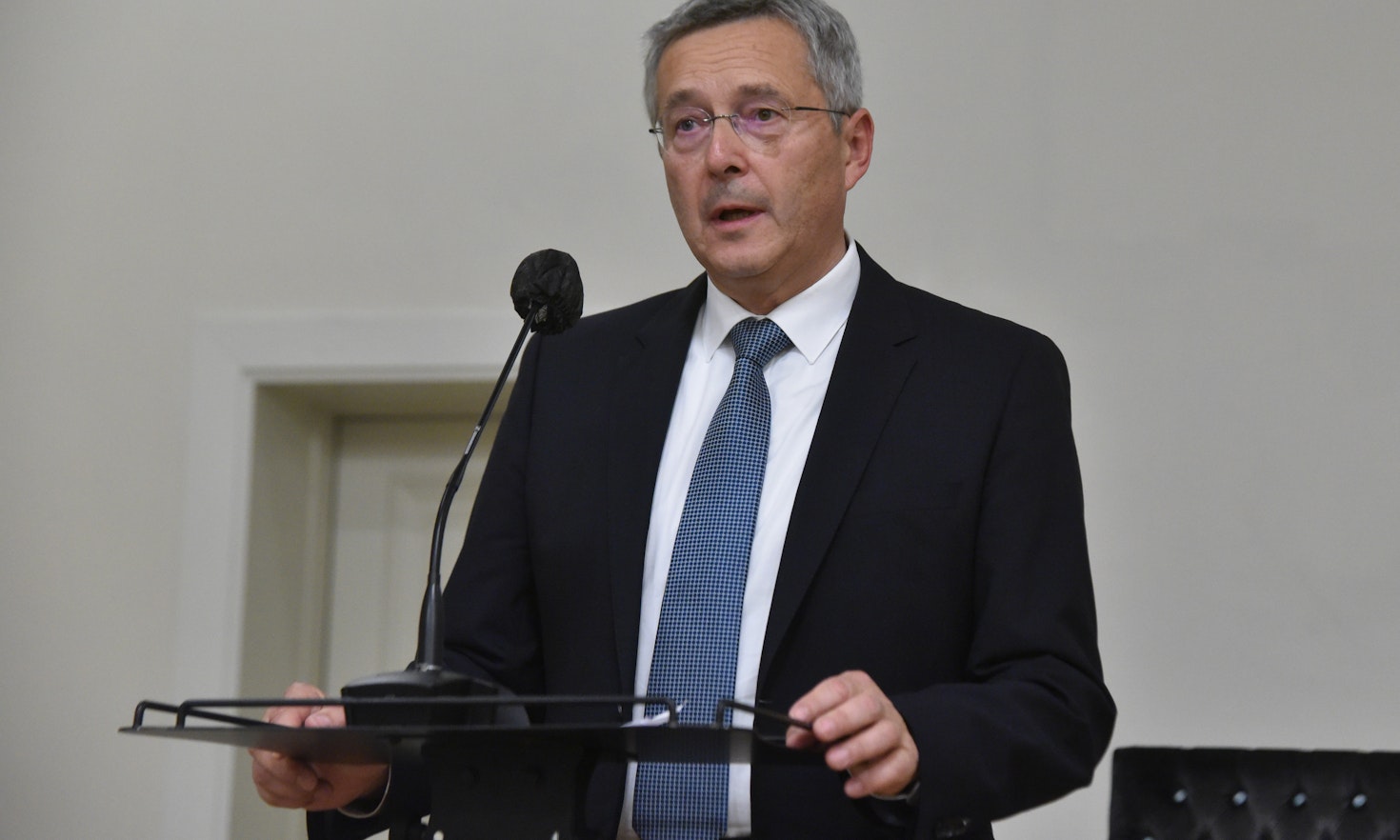
This year, three long-standing and distinguished figures stepped down from the MIDAS Governing Board: Bojan Brezigar, Toni Ebner and Edit Slezák. All three played a key role in shaping MIDAS since its foundation in 2001. Hatto Schmidt interviewed each of them.
About Toni Ebner
Toni Ebner, who later became editor-in-chief of the daily newspaper Dolomiten, gained his first experience in journalism and publishing as a schoolboy at Athesia, which was run by his father, the journalist and politician of the same name. After studying law in Innsbruck, he worked for the Austria Press Agency APA and the Salzburger Nachrichten. From 1995 until the beginning of 2025, he was editor-in-chief of the Dolomiten.
MIDAS (Hatto Schmidt): The aims of MIDAS were to lobby in Brussels, to exchange ideas, to collaborate and also to promote the recognition of minority issues and media in international organizations. Was MIDAS successful?
Toni Ebner: Mutual support was also very important. Yes, MIDAS has been very successful. If one daily newspaper has a problem and raises it, it carries some weight. But if they all raise the issue together in an association, then millions of voices come together, because the minority dailies together have an audience of millions. That is very important at the European level. We were heard in Brussels, but when there were problems with individual minorities, we were also heard in the respective nation states.
All this happened in Europe, so just think what could happen in other countries.
Toni Ebner
MIDAS: One example is the scandal around the closure of Euskaldunon Egunkaria in 2003 in the Basque Country.
Ebner: Euskaldunon Egunkaria alone would certainly not have been able to do anythingabout the confiscation of the newspaper, the imprisonment and torture of its staff. For the majority newspapers, it was only a marginal story, if at all! But then we took it up. Each member of MIDAS sent a letter of protest to the Spanish ambassador in their country. The Dolomiten also wrote to the Spanish ambassadors in Vienna and Berlin. We all imformed the press agencies. Dolomiten contacted the Italian ANSA, the Austrian APA and the German dpa. This created a critical mass, transforming the scandal into a significant event. All the media then covered it, because we also wrote to all the editors-in-chief of the major national newspapers. I wrote to the Italian, Austrian and German editors-in-chief. So suddenly the whole story exploded and pressure was put on Spain. It certainly had the effect of making the Spanish authorities’ actions a disaster. The legal proceedings came to nothing. But what remains is that the people who tortured the editor-in-chief, who tortured the administrative director, who beat the staff, have never been prosecuted, and I think the confiscation of the newspaper has still not been lifted. All this happened in Europe, so just think what could happen in other countries.
MIDAS: There are other examples, such as the Italian daily La Voce del Popolo in Croatia, which got into trouble.
Ebner: Yes, MIDAS was able to prevent the imminent end. Luis Durnwalder, the President of South Tyrol at the time, helped a lot. The privatization of La Voce del Popolo revealed major economic problems. It was not used to being a profitable publishing house, having lived on state subsidies. When privatization came, the crisis was huge. We tried to intervene with the Italian minister for Italians abroad to see if he could help. But we got this answer: ‘I won’t give anything to the Italians in Istria/Istra because the good ones fled after the war and those who stayed are communists’. I then went to Durnwalder and asked him: ‘Luis, what would you say if the German minority in Italy helped the Italian minority in Croatia?’ ‘We’ll do it immediately,’ he replied, and unbureaucratically released a considerable sum of money. This saved La Voce del Popolo.
MIDAS: You had the idea for the Otto von Habsburg Prize. Has it given MIDAS more visibility?
Ebner: Yes, definitely, because Otto von Habsburg is a synonym for Europe. He was already advocating for European unification while the Second World War was still raging in Europe. At that time, he had already written the first papers and developed proposals. Otto von Habsburg is a testimony to the European idea like few others, apart from Robert Schumann. And Otto von Habsburg was not only a European, he was also a journalist all his life. Not only did he write books, but he also contributed newspaper articles, commentaries and essays. He was an excellent writer. The two elements that make sense for MIDAS came together. And for many Europeans – whatever their political persuasion – Otto von Habsburg is a role model: he has supporters from the conservatives to the Greens. That’s why he was the ideal person. He himself was enthusiastic about the prize. He didn’t just come to represent, but every time he attended a General Assembly, he not only presented the award, but also participated. He was of the opinion that the European Association of Daily Newspapers in Minority and Regional Languages has a very important role to play because the dailies reach people and as multipliers they can do a lot for the European idea.
MIDAS: Otto von Habsburg was very popular. At the MIDAS General Assembly 2007 in Kolozsvar/Klausenburg/Cluji-Napoca he was surrounded by people and practically held court.
Ebner: And how he was adored by ordinary people! I remember him being driven through a village in a carriage. The women curtsied and the men tipped their hats. It was impressive how important he still was, even though he never held an office that would have done justice to his birth.
In February 2006, MIDAS representatives met with European Commission Vice-President Franco Frattini (sixth from the left) for talks in Brussels. Toni Ebner (third from the left) was also present at the meeting.
Credit: MIDAS | All rights reservedMIDAS: Is there anything else you remember?
Ebner: The contacts with the European Commission, for example. I remember that of all the people we met from the European Commission, one who was always said to be against minorities was the one who stood up forus the most. That was Franco Frattini, the former Italian Foreign Minister. It was always said that he was a nationalist, that he had something against the South Tyroleans and so on. But in fact he was the only one who did a lot for MIDAS and opened a lot of doors for us.
MIDAS: Readers of traditional print media are getting older, younger people are not reading traditional media, costs are rising, from paper to staff, delivery is becoming more and more difficult, online is getting stronger and stronger, which is why the Dolomiten announced the principle of ‘online first’ a year ago. But no one has yet figured out how to make the necessary money from online journalism. Is there a future for serious journalism at all?
Ebner: There is. And I deny that young people don’t read print. We can see this in the example of the Dolomiten: in the last media analysis in 2024 we had 90,000 daily readers under the age of 25. These young readers exist. You just have to offer them what they are interested in.
MIDAS: What would that be?
Ebner: In the case of Dolomiten, it’s probably the sports coverage. We have a lot of sports clubs in South Tyrol, a lot of sports enthusiasts and athletes. They want to be reflected in the newspaper, in the form of results, match reports, photos and everything else. And the second point that plays an important role is volunteer work. The Dolomiten has always given a lot of space to fire brigades, bands, theatre groups, the ‘Schützen’ and choirs. Young people are there too, they find themselves there. And when readers find themselves in the paper, they will look at it and read it. Of course, we face strong competition online, but you have to make use of it. I dare say that our articles have never had as many readers as they do now, because we publish once in print, once in e-paper and once online.
After all, that is the original task of journalism: to write what the reader is interested in, not what we or our colleagues are interested in. That is what readers are prepared to pay for.
Toni Ebner
MIDAS: And how do you make money from journalism?
Ebner: We have found a solution in the Scandinavian model. It says that you don’t have to do anything other than practize good journalism that focuses on people and what interests them. After all, that is the original task of journalism: to write what the reader is interested in, not what we or our colleagues are interested in. That is what readers are prepared to pay for. And there are many areas to consider. You have to take into account young families and you have to recognize that society has changed. We have a lot of single households. We have an older generation that has to be taken into account. We have a lot of patchwork families and everything that goes with that. We have to take all that into account. If you do that, as the Scandinavian media show, you will be successful. In print and online. But if you don’t do it now and invest in it, you run the risk of missing the train, and once the train has left the station, it’s too late.
MIDAS: The way forward is online, especially for minority dailies, which tend to be based in remote areas. Der Nordschleswiger switched from print to online in 2021, and two Hungarian newspapers in Transylvania did the same earlier this year. Should or must MIDAS focus more on online media in the future?
Ebner: MIDAS has to move with the times. Times have changed, there is no longer just the classic print daily newspaper, there are other ways of publishing. You have to take that into account and be flexible. But you need clear guidelines. Why did we create an association of European dailies and not include weeklies? For one simple reason. If a minority is able to set up a daily newspaper, then it has a certain size and an organizational structure at a certain level that is stable and guarantees that the minority concerned deals with its own language and culture on a daily basis. That is the crucial factor. In principle, it is not important what kind of medium it is. It can be radio, television or print, but it can also be online.
The MIDAS journey: A European history

Together with many others, Bojan Brezigar, Toni Ebner and Edit Slezák have played a decisive role in shaping MIDAS since its foundation in 2001. As a token of gratitude and in anticipation of the association's 25th anniversary in 2026, MIDAS has published the booklet "The MIDAS journey: A European history". Through brief texts and images, it offers a retrospective look at the association's history. The above interview is featured in the booklet.

Hatto Schmidt
Hatto Schmidt was born and raised in Baden-Württemberg, Germany. He studied history and political science in Freiburg and Tübingen, and then spent 33 years working as a journalist for the daily newspaper Dolomiten, which is published in South Tyrol. He has dealt with questions and problems of national minorities for many years.
Discover
Making research visible.
Find the connected experts, projects, publications, and research areas behind this blog post.
This content is licensed under a Creative Commons Attribution 4.0 International license except for third-party materials or where otherwise noted.

This blog is supported by the European Association of Daily Newspapers in Minority and Regional Languages (MIDAS). MIDAS was founded in 2001 to provide assistance to minority language newspapers and nowadays has members all over Europe. MIDAS serves as a platform for exchange, uniting minority language newspapers to present a collective voice to the European institutions.