Porr Remains DFDR Chairman - New Election at the Democratic Forum of Germans in Romania
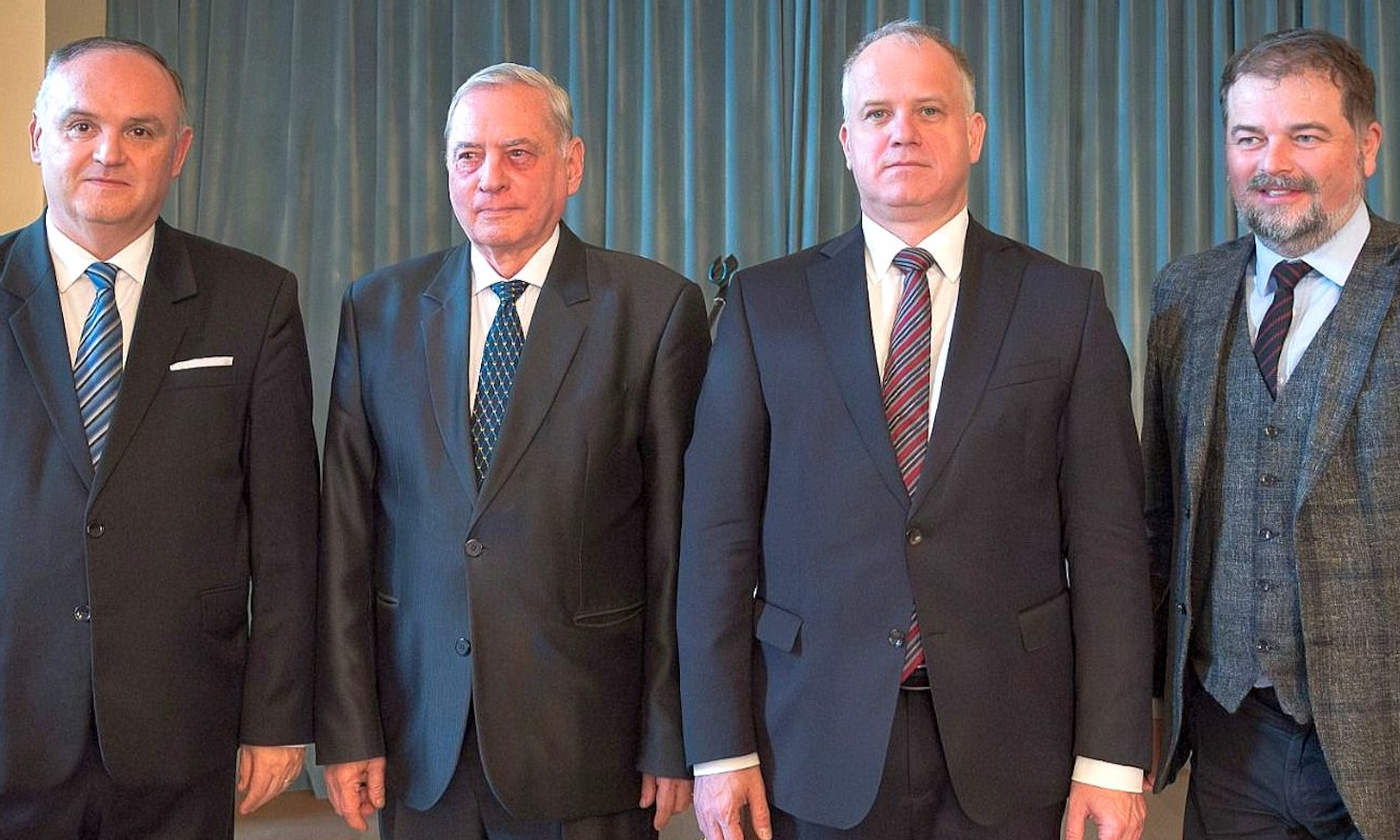
Dr Paul-Jürgen Porr (74) has been re-elected as Chairman of the Democratic Forum of Germans in Romania (DFDR). A Transylvanian Saxon from Mediasch, the retired specialist and lecturer in internal medicine and gastroenterology has been president of the Association of Germans in Romania since 2013. The association was founded during the revolution at the end of 1989 and also represents the Germans in Romania politically. As one of 18 recognised national minorities, the Germans in Romania are entitled to a seat in parliament under the Romanian constitution, even if they do not achieve the required number of votes for a mandate. MP Ovidiu Ganț has represented the DFDR in parliament since 2004.
The forum is divided into the national forum and several regional forums (Altreich, Banat, Buchenland, Northern Transylvania, Transylvania and the Association of German Youth Organisations) as well as district and local forums. According to the 2022 census, around 23,000 Germans live in Romania, compared to 36,000 in 2011. The DFDR doubts this sharp decline and points out that it was not compulsory to state ethnicity and that filling out the online questionnaires was complicated, which may have distorted the results. In any case, the number of Germans in Romania has fallen dramatically over the last 100 years. According to the 1930 census, there were around 750,000 Germans in the country, making up four per cent of the total population. Although there was no expulsion of Germans after the Second World War, massive emigration gradually began. The reasons for this were the experiences of the deportation of tens of thousands to forced labour in Ukrainian mines and in Siberia after the end of the war, many of whom did not return at all and others returned sick and miserable. The effects of the socialist system also made many people want to leave their homeland. From 1970 onwards, this emigration was encouraged by Germany through the payment of bounties to Romania. In 1989 there were still 200,000 Germans living in Romania, in 2002 there were only 60,000.
The Germans in Romania are not a homogeneous community. There are several groups whose ancestors lived in their respective settlement areas long before the foundation of the Romanian state and moved there at different times and for different reasons. Most Germans live in Transylvania and Banat; these areas belonged to the Hungarian half of the Habsburg monarchy until 1918 and were only then annexed to Romania. These and other territorial gains doubled Romania's area and population; the country was transformed from a relatively homogeneous nation state into a multi-ethnic state.
The Transylvanian Saxons were summoned to the land in the Carpathian Arc by the Hungarian king in the middle of the 12th century. They were to protect the border to the east against warlike raids and develop the country economically with their more progressive methods. In return, they were granted far-reaching autonomy, the oldest surviving version of which is the Golden Charter of 1224, the so-called Andreanum. In 1930, almost 240,000 Transylvanian Saxons were counted.
The Banat Swabians were settled in depopulated areas of the former Hungarian kingdom after the Turks were driven back in the 18th century. They are a subgroup of the Danube Swabians and live in the far west of present-day Romania. At the same time, the Bergland Germans, miners and metallurgists from Styria (Austria), moved into the area. The number of Germans in Banat totalled around 280,000 in 1930.
The Sathmar Swabians were also settled in the north-west of what is now Romania in the 18th century. They were largely Magyarised between 1848 and 1918. In 1930, a good 30,000 people still belonged to this group.
Zipser Saxons can be found in the very north of Romania. From the second half of the 18th century, their ancestors moved from their settlement areas in present-day Slovakia to the Maramures, south-west Bukovina and Carpathian Ukraine, but also to the Banat Mountains. Figures on the size of the community are not known.
In the so-called Old Kingdom, in the old Romanian principalities of Moldavia and Wallachia (which have been united as Romania since 1859), there are also merchants, craftsmen and intellectuals who speak German, especially in the cities, including the capital Bucharest, who are connected in church congregations and associations.
The Resettlement Agreements of 1940
The dictatorships of the interwar period and the catastrophe of the Second World War had serious consequences for the Germans in what was then Romania. For example, Germans in Bukovina, Bessarabia and Dobruja lost their homes in 1940 as a result of resettlement agreements between Hitler and Stalin. The Germans in Bukovina (Buchenland) had come to the country after this region fell to the Habsburg Empire in 1775. After the First World War, Bukovina was annexed to Romania. In 1930, around 75,000 people living there declared themselves to be German. In accordance with the agreement of 5 September 1940 between the German Reich and the Soviet Union, they were resettled in occupied territories in Poland or the German Reich. Only a few were able to avoid this or returned to their homeland after the end of the war. After the Second World War, Bukovina was divided between the Soviet Union (now Ukraine) and Romania. During the interwar period, Bessarabia also belonged to Romania, but was reunited with the Soviet Union after the Second World War. Today it is divided between Ukraine and Moldova. German farmers settled there in the first half of the 19th century; they are part of the group known as Black Sea Germans. In 1930, around 81,000 people declared themselves to be German. They were also affected by the resettlement in 1940. In 1930, around 12,000 Germans lived in Dobruja, between the lower reaches of the Danube and the Black Sea. They had settled there after 1840. They were also brought ‘home to the Reich’ in 1940, as Nazi propaganda put it at the time.
Similar resettlement actions were carried out at this time with the Baltic Germans, Volhynian Germans, Germans from Galicia and the Gottschee. The best known of these actions, however, was probably the so-called ‘Option’ of 1939, as a result of which the South Tyroleans were supposed to leave their homeland in order to solve a festering problem between the two fascist regimes in Italy and Germany. The project was only partially realised. The model for all these resettlement agreements was the Treaty of Lausanne from 1923, which legalised the forced population exchange between Turkey and Greece, most of which had already taken place. It is known that Adolf Hitler followed these events closely; he later referred to them in his policies.

Hatto Schmidt
Hatto Schmidt was born and raised in Baden-Württemberg, Germany. He studied history and political science in Freiburg and Tübingen, and then spent 33 years working as a journalist for the daily newspaper Dolomiten, which is published in South Tyrol. He has dealt with questions and problems of national minorities for many years.
Discover
Making research visible.
Find the connected experts, projects, publications, and research areas behind this blog post.
This content is licensed under a Creative Commons Attribution 4.0 International license except for third-party materials or where otherwise noted.

This blog is supported by the European Association of Daily Newspapers in Minority and Regional Languages (MIDAS). MIDAS was founded in 2001 to provide assistance to minority language newspapers and nowadays has members all over Europe. MIDAS serves as a platform for exchange, uniting minority language newspapers to present a collective voice to the European institutions.