A border no more? The European Capital of Culture 2025 between Tito and the tricolore
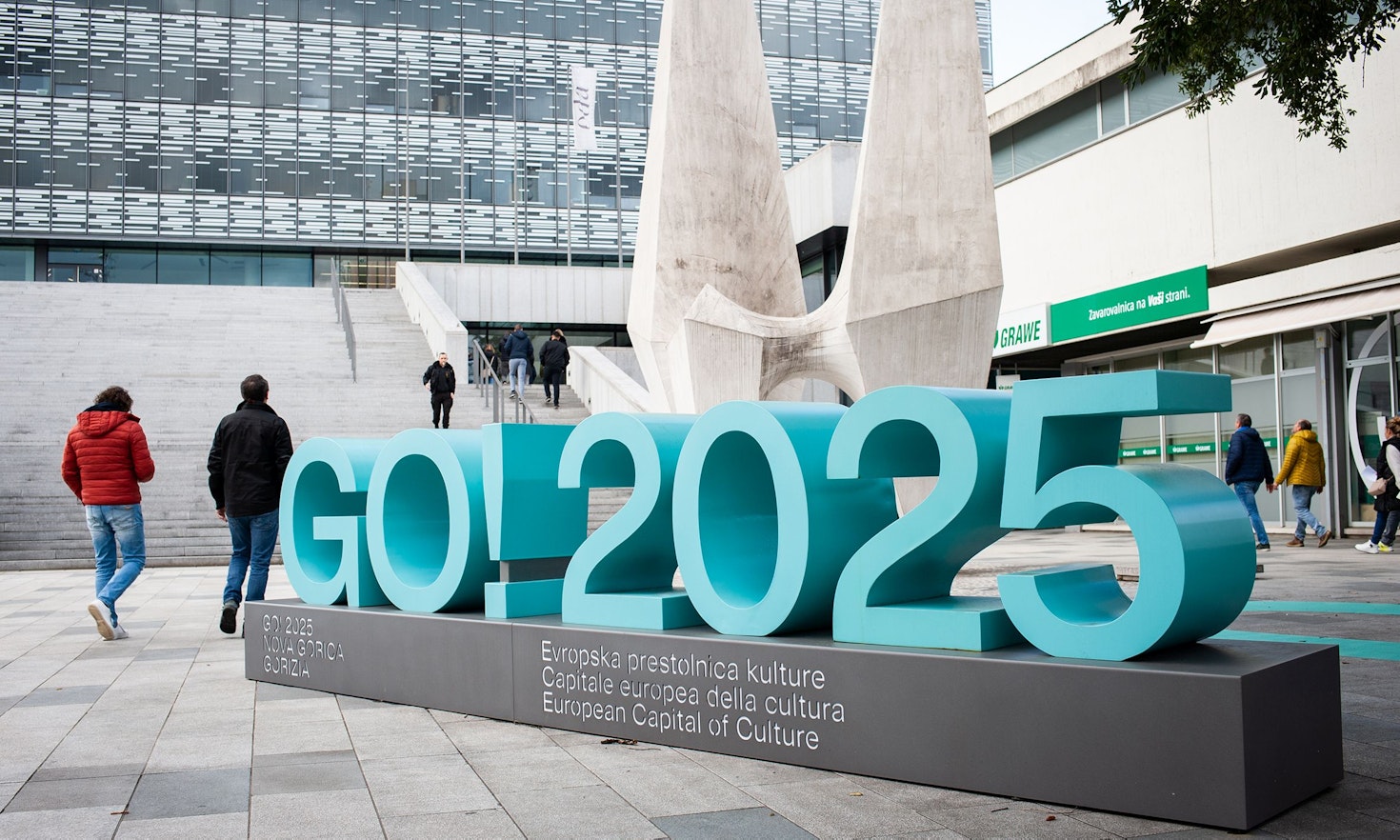
Once a Cold War fault line, Nova Gorica and Gorizia are reuniting as GO! 2025 – a European Capital of Culture that celebrates life beyond borders. But while culture builds bridges, old scars and new provocations reveal how fragile unity can be.
Cultural capital: Impressions from ‘GO! 2025’ in Gorizia and Nova Gorica – Longing for a life without borders
The line on the ground is not red, and according to the organisers of the cultural capital ‘GO! 2025’, it should be crossed as often as possible, because it is no longer meant to divide, but to unite: The line on the forecourt of the Transalpina railway station marks the border between Nova Gorica (Slovenia) and Gorizia (Italy). However, the names of the square still emphasise the division: the Italian side is called Piazza Transalpina, while the Slovenian side is called Trg Evrope (Europe Square).
The organisers of ‘GO! 2025’ want to build on the fact that today the border line is only visible but no longer tangible. And they are passionate about their cause. Vesna Humar, State Secretary at the Ministry for Slovenians Abroad, cannot hold back her tears when she talks about the joy she felt when the city was awarded the title of European Capital of Culture 2025 (alongside Chemnitz). Humar is a journalist by profession and has been involved in the initiative from the very beginning, as has artistic advisor Neda Rusjan Bric. She emphasises that as soon as the idea of applying for the title of Capital of Culture arose in Nova Gorica, the suggestion was made to bring in the Italian neighbours, as it was clear that only such a cross-border idea would have a chance.
‘GO! Borderless’ is the motto of the diverse and colourful cultural programme of the Capital of Culture, and its turquoise colour is omnipresent in both cities: on posters at the roadside, on event notices and even on city buses. ‘GO!’ can be interpreted as an English command to ‘let's go,’ but it also stands for the first letters of the two twin cities; both also have GO on their car number plates.
Gorizia/Gorica and Nova Gorica are to be connected without borders, even though there is much that separates them, not just the border. The Italian twin can look back on a long history: the city was first mentioned in a document in 1001. For centuries, multilingualism was part of everyday life: Italians, Slovenes, Jews, Friulians and Germans lived in the city, which is called Gorica in Slovenian and Görz in German. Nova Gorica, on the other hand, was only established after 1947, when the Allies drew the new border with a ruler, leaving most of the city to Italy but giving the Ferrovia Transalpina railway station – the Wocheiner or Karstbahn, built under Austrian rule – to Yugoslavia. To the east of this, today's Nova Gorica was built from scratch under socialist auspices.
Its inhabitants – today numbering around 13,000 – saw independence from Yugoslavia in 1991 as liberation and sought closer ties with Europe and neighbouring Italy. But there are always those who want to disrupt European integration, as demonstrated by Mount Sabotin (Sabotino in Italian), which overlooks the twin city to the north. It was one of the sites of the bloody battles fought in the First World War between Austria-Hungary and Italy on the banks of the river, which the Italians call Isonzo and the Slovenes Soča. In the sixth of these battles, Italy was able to capture the mountain. Today, the border between Italy and Slovenia meanders along the ridge of the mountain in often absurd twists and turns.
Even more absurd are the messages that can be seen on Sabotin, which, for some, cross the proverbial red line next to the border: in a clearing on the Slovenian side, the word ‘Tito’ can be seen. The 25-metre-high letters were formed from stones in 1978 and served propaganda purposes. After 1992, the inscription was changed several times, but since 2014, ‘Tito’ has been back on the mountain. As a counterpoint, so to speak, the green, white and red tricolour shines at night on an Italian barracks just a few metres away. ‘Tito’ cannot be overlooked, and the lettering is a constant annoyance for many on the Italian side. Now the local section of the ‘Fratelli d'Italia’ of Prime Minister Meloni want to have the words ‘Viva l'Italia’ formed in stones next to the tricolour.
‘Tito’ is so provocative that renowned journalist Gian Antonio Stella recently addressed the issue in the Corriere della Sera, emphasising that the cultural capital does not deserve this inscription and that it should be removed.
However, Stella also pointed out that a historical grievance must be redressed on the Italian side, which – not only for the Slovenes – represents a red line that has been crossed: For 101 years, Mussolini has been an honorary citizen of Gorizia, and he will remain so, because on 11 November 2024, the municipal council rejected a motion to revoke his honour with the votes of a coalition, which includes Forza Italia led by Mayor Rodolfo Ziberna, Fratelli d'Italia and the Lega that on national level is led by Deputy Prime Minister Matteo Salvini.
The border is today a great opportunity for cooperation, whereas 100 years ago terrible tragedies took place in the area, says Ziberna about cross-border cultural capital. He advocates multilingualism: everyone should at least have a passive knowledge of the other's language, Ziberna says. He himself speaks a few words of Slovenian.
Samo Turel, the mayor of Nova Gorica, is already further ahead: like many of his fellow citizens, he speaks almost perfect Italian. This is not something you learn at school in Nova Gorica, but from watching your neighbours' television. Turel's goal is to bring the two cities together as far as possible. The Capital of Culture is just the beginning, he says; culture knows no boundaries and can help to extend the process of growing together to economic and social areas. There is still a lot to do before passive language skills become a reality, says Turel. Sometimes the citizens are already further ahead than the politicians: because Italian is not taught in schools in Nova Gorica, some Slovenian families send their children across the border to Italian schools. Multilingualism is also the goal of those Italian families in Gorizia who enrol their children in a Slovenian minority school. However, this is at the expense of mother-tongue instruction and is a source of considerable concern for the minority.
Rodolfo Ziberna (left) and Samo Turel
Credit: Primorski Dnevnik Carlo Sclauzero | All rights reservedMinority schools exist not only in Gorica/Gorizia and Trst/Trieste, but also in other municipalities in the settlement area of the Slovenian minority. Their protection is based on State Law No. 38 of 2001. The municipalities in which the Slovenian minority lives are listed in a decree issued by the President of the Autonomous Region of Friuli-Venezia Giulia; there are 32 in total. However, not all areas where Slovenes live are included in the list.
This is a disadvantage for the minority, which ultimately numbers only 53,000. Although the exact number is not known. ‘They don't want to be counted for historical reasons,’ says Igor Devetak, editor-in-chief of the Slovenian-language daily newspaper Primorski Dnevnik, published in Trst/Trieste. The minority itself estimates its numbers at 80,000.
Devetta estimates that 15 per cent of Gorizia's 33,000 inhabitants are Slovenian. However, this is hardly noticeable. The place-name signs are in Italian only, even though Gorizia is listed as a ‘Slovenian’ municipality – but bilingualism in public spaces only applies to a peripheral district and four neighbourhoods that lie entirely outside the city; with most of the city excluded. And while numerous monuments and busts in the centre of Gorizia commemorate Italian soldiers, cultural figures and politicians from the ongoing struggle for interpretive sovereignty, Slovenian is hard to find: only where Slovenian institutions have their headquarters are there corresponding inscriptions. Signs on public buildings are in Italian only, including at the town hall, which the Fratelli d'Italia can confirm at any time with a glance from their headquarters, just a stone's throw away.
But something seems to be changing, not openly visible, but tangible in the everyday lives of citizens. ‘When shopping, we no longer pay attention to which country we are in,’ says Samo Turel, especially since prices and salaries have converged: ‘We look at the brand, the quality and the price, and buy here and there.’ This also applies to flats, which are considerably more expensive in Nova Gorica: some young Slovenian families even cross the border and buy property in Gorizia, where it feels like every third house has a ‘Vendesi’ (for sale) sign from a real estate agent hanging on it.
Young people no longer seem to have the border in their minds: ‘When my daughter crosses the border, she says she's going to a street or a bar; she doesn't say she's going to Slovenia,’ says Igor Devetak. And Neda Rusjan Bric emphasises that ten years ago, Slovenian was not heard on the streets of Gorizia. ‘Today, it's completely normal, even for the minority.’
This is precisely the goal of the Capital of Culture initiative: to contribute to the flowering of the cultures of the Member States, while preserving their national and regional diversity and at the same time bringing the common cultural heritage to the fore, thus providing the basis for an ever closer union among the peoples of Europe.
Those who are awarded the title can look forward to EU funding. For example, two infrastructure projects that would otherwise probably not have been possible were realised as part of ‘GO 2025!’: a cycle and pedestrian bridge over the Soča/Isonzo river near a local recreation area and an underpass connecting Nova Gorica directly to the Europe Square in front of the Transalpina railway station, where the border line on the ground and a museum in the station building commemorate the times when Gorizia and Nova Gorica were separated by a border.
However, that border was never as hermetically sealed as the Berlin Wall, for example: it consisted only of a low wall with a fence about one metre high on top. Nevertheless, ‘there were deaths, yes,’ says historian Kaja Širok, ‘but above all, the separation of families was dramatic.’ Grandparents could no longer see their grandchildren, lovers were separated, jobs were lost. It was only a few years after the border was drawn that an agreement was reached to allow visits: passports allowed residents to cross the border, explains Širok, who wrote her dissertation on the border area. In the border museum in the station, there is a newspaper article from the 1970s describing how citizens from Nova Gorica bought up all the bread and brooms available in Gorizia on a public holiday – commodities that were in short supply in the socialist system at the time. Looking at the development that both cities have undergone since then, there is growing hope that the resurgence of nationalism everywhere is not a long-term trend, but that in future, red lines will no longer be crossed, and instead the border line on the ground in front of the Transalpina railway station will be crossed as often as possible.
Kaja Širok
Credit: Hatto Schmidt | All rights reservedNote: This article gives the views of the author and does not represent the position of the European Association of Daily Newspapers in Minority and Regional Languages (MIDAS) or Eurac Research.
Hatto Schmidt
Hatto Schmidt was born and raised in Baden-Württemberg, Germany. He studied history and political science in Freiburg and Tübingen, and then spent 33 years working as a journalist for the daily newspaper Dolomiten, which is published in South Tyrol. He has dealt with questions and problems of national minorities for many years.
Discover
Making research visible.
Find the connected experts, projects, publications, and research areas behind this blog post.
This content is licensed under a Creative Commons Attribution 4.0 International license except for third-party materials or where otherwise noted.
This blog is supported by the European Association of Daily Newspapers in Minority and Regional Languages (MIDAS). MIDAS was founded in 2001 to provide assistance to minority language newspapers and nowadays has members all over Europe. MIDAS serves as a platform for exchange, uniting minority language newspapers to present a collective voice to the European institutions.