The Ladin school system: multilingual education in practice

The Ladin school system in South Tyrol is a distinctive model of multilingual education, in which German and Italian are used as equal languages of instruction alongside Ladin as a minority language. In this interview, linguist and teacher Maximilian Oberhollenzer explains how the system works in practice, what challenges it faces, and why schooling plays a crucial role in the preservation of Ladin.
Theresa Innerhofer Taschler: What exactly is the Ladin language?
Maximilian Oberhollenzer: Ladin is a Romance minority language spoken by around 30,000 people in the area around the Sella massif. This mountain range lies at the centre of five valleys: in the Province of Bulsan/Bozen/Bolzano these are Gherdëina/Grödner Tal/Val Gardena and Val Badia/Gadertal, in the Province of Trent/Trento Fascia/Val di Fassa, and in the Province of Belum/Belluno the areas around Ampëz/Cortina d'Ampezzo and Fodom/Livinallongo del Col di Lana. The population of these five valleys forms the Ladin language community.
Theresa Innerhofer Taschler: And where does the language come from?
Maximilian Oberhollenzer: Ladin is a Romance language, which is linked to the history of the Alpine region. Around 15 BC, the Romans advanced into the area, conquered it, and their Latin gradually mixed with the languages spoken there. This led to the emergence of Ladin, a form of Alpine Romance. Today, besides Ladin, there are two other Romance language communities that underwent a similar development: Romansh in the Swiss canton of Grischun/Grisons, and Friulian in Friûl/Friuli. Later on, Germanic tribes also moved into the Alpine region, which is why Germanic influences can still be identified in Ladin today. Ladin speakers and Germanic populations lived alongside each other for many centuries, and this has naturally left traces in the languages.
Theresa Innerhofer Taschler: What does the Ladin school system look like?
Maximilian Oberhollenzer: In the Ladin school system in the Province of Bulsan/Bozen/Bolzano, Ladin speakers benefit from a special form of education that does not exist in the other two provinces, Trent/Trento and Belum/Belluno. In South Tyrol, this is known as the paritetic school system. German and Italian are taught in equal measure. This means that half of all school subjects are taught in German and the other half in Italian. In addition, there are two hours per week of Ladin, and Ladin can also be used as a support language to explain content more clearly when needed. There are also special cases, such as the Montessori school section in Urtijëi/St. Ulrich/Ortisei, where teaching even switches between three languages. Mathematics, for example, is partly taught in Ladin, German and Italian, usually alternating every three days.
Theresa Innerhofer Taschler: How does this work in kindergarten?
Maximilian Oberhollenzer: In Ladin kindergartens, all three languages are used in equal measure. This can, for example, happen on a weekly basis: some kindergartens have a German week, during which the entire staff speaks German with the children. This is followed by an Italian week, and then a Ladin week.
Theresa Innerhofer Taschler: And in lower and upper secondary school?
Maximilian Oberhollenzer: From lower secondary school onwards, half of all subjects are taught in German and the other half in Italian, while Ladin continues to be taught for two hours per week. To give a concrete example: at the upper secondary school where I teach, mathematics, biology and chemistry are taught in German, while business administration, law and physical education are taught in Italian. Thanks to this equal distribution of languages across subjects, both languages have the same status.
Theresa Innerhofer Taschler: The Italian- and German-language school systems in South Tyrol are structured differently.
Maximilian Oberhollenzer: In a German-language school in South Tyrol, Italian is taught only as a language subject for about four hours a week, while all other subjects are taught exclusively in German. In Italian-language schools, it is exactly the other way around. The key feature of the Ladin school system, as already mentioned, is that both languages are used not only as subjects in their own right, but also as languages of instruction in other subjects. There is another special feature at upper secondary level: in the final school-leaving examination, the first written exam is taken in the main language of the school. In a German-language school, this means a written exam in German. In Ladin schools, however, students can choose between Italian and German for the first written exam, depending on which language they feel more comfortable with.
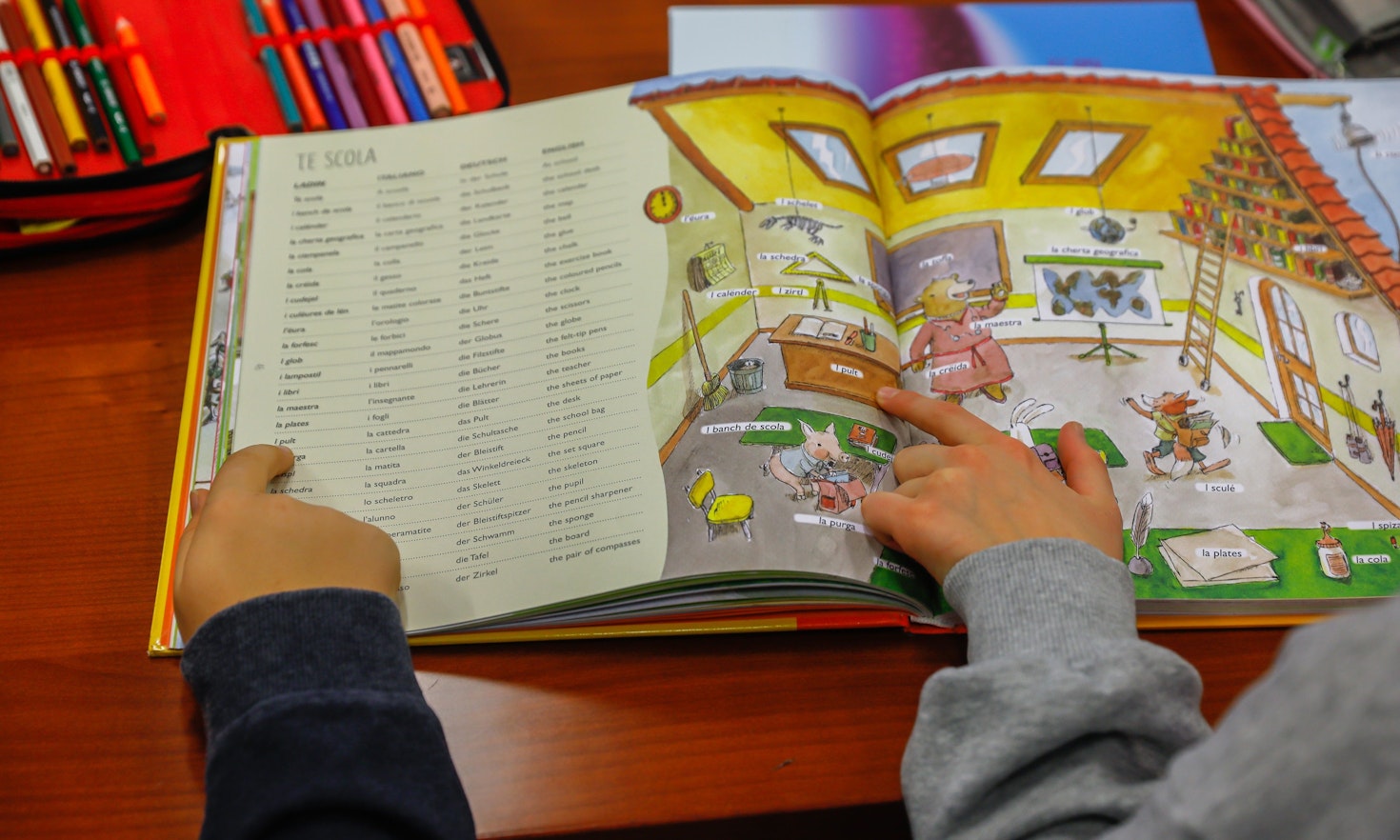
Ladin schools use multilingual teaching materials to teach languages.
Credit: LPA/Direziun scolines y scores ladines | All rights reservedTheresa Innerhofer Taschler: In your view, what are the challenges of the Ladin school system? For example, are there enough Ladin textbooks?
Maximilian Oberhollenzer: One distinctive feature of the Ladin minority is certainly that there is no other state or region where Ladin is the majority language. In German-language schools in South Tyrol, there is no problem with textbooks, because there is a wider German-speaking area outside South Tyrol – Germany, Austria or Switzerland. This means that German-language schools in South Tyrol can draw on teaching materials developed in those countries. With Ladin, things are more complicated, because the language is limited to this specific area and to around 30,000 speakers. Producing teaching materials is therefore a major challenge. This task is handled by a department of the Ladin school authority and requires enormous effort. However, if we talk about minority protection, it is absolutely essential. Since Ladin has found a place in schools, the situation of the language has improved. Without this step, Ladin would probably be in a much worse position today.
It is important to stress that Ladin is the very foundation of the parity school system, and we can consider ourselves fortunate that our first language has a place in schools at all.
Maximilian Oberhollenzer
Theresa Innerhofer Taschler: In your opinion, are two hours of Ladin per week sufficient – especially for pupils who may not have a Ladin family background?
Maximilian Oberhollenzer: First of all, it is important to stress that Ladin is the very foundation of the parity school system, and we can consider ourselves fortunate that our first language has a place in schools at all. That said, two hours per week of first-language instruction is indeed very little – something that perhaps becomes clearer if we imagine a similar situation for German in South Tyrolean schools. Moreover, the subject “Ladin” does not consist solely of language teaching, but also includes Ladin culture and history. For pupils from a Ladin-speaking background, two hours per week may be enough to further develop existing language skills. For pupils from a different linguistic background, however, it is difficult, if not impossible, to acquire solid language competence in this way.
A challenge of modern times is that our society is becoming more heterogeneous. This is noticeable not only in cities such as Meran/Merano and Bulsan/Bozen/Bolzano, but also in rural areas. More and more people from different regions come together, and the later someone enters the Ladin school system, the more difficult it becomes. A concrete example from my own experience as a teacher illustrates this well. In the first year of upper secondary school, two pupils from Ukraine joined the class, and during the school year another pupil arrived from Peru. The two pupils from Ukraine spoke Ukrainian and Russian, and a little English. The pupil from Peru spoke only Spanish. For her, this meant having to learn four new languages within a very short time – German, Italian, English and Ladin. Even with the greatest effort on everyone’s part and with considerable linguistic talent on the part of the pupils, this represents an almost impossible challenge.
A major advantage, however, is completing the entire system from kindergarten through to the final school-leaving examination. By the end, pupils then have good knowledge of German, Italian and Ladin.
Maximilian Oberhollenzer
Theresa Innerhofer Taschler: That also sounds challenging for teachers.
Maximilian Oberhollenzer: For us as teachers, such situations can be extremely difficult and frustrating. In addition to the major challenge of ensuring the acquisition of the school languages and successfully conveying subject content in the respective language of instruction, there must ultimately be an assessment in every subject at the end of each school year. This means that pupils who have only just arrived suddenly have to study, for example, business administration in Italian and sit written tests in that subject. In such cases, the system can reach its limits. A major advantage, however, is completing the entire system from kindergarten through to the final school-leaving examination. By the end, pupils then have good knowledge of German, Italian and Ladin.
Theresa Innerhofer Taschler: Are there Ladin dictionaries or an established orthography?
Maximilian Oberhollenzer: Yes. The Ladin cultural institute Micurá de Rü, based in Val Badia, is also engaged in linguistic research. One of its main tasks has been – and continues to be – the compilation and continuous updating of Ladin dictionaries, both German–Ladin and Italian–Ladin, for the Gherdëina and Val Badia varieties. These dictionaries are now also available online and even as an app, which is very practical. In addition, there is a set of rules – a Ladin orthography and grammar. Work on this began relatively late, only from the mid-19th century onwards. Members of the clergy, who formed the educated elite of the time, engaged with the Ladin language and compiled the first grammar. The institute’s namesake, Micurá de Rü, published the first Ladin grammar.
Theresa Innerhofer Taschler: What training pathways exist for Ladin teachers?
Maximilian Oberhollenzer: As mentioned earlier, the Ladin school system at primary level is particularly complex, because teachers have to teach their subject in different school languages. This requires a rich subject-specific vocabulary. For teachers working in Ladin kindergartens and primary schools, there is a Ladin section of the Faculty of Education at the Free University of Bulsan/Bozen/Bolzano. Just as in later teaching practice, the degree programme there is also trilingual. One third of the courses are taught in Ladin, one third in Italian and one third in German. It is crucial that staff in the Ladin primary sector receive solid training and are able to meet these demands.
Ladin, too, has to move with the times. If Ladin had stood still 100 years ago, it would be difficult to talk about contemporary issues today.
Maximilian Oberhollenzer
Theresa Innerhofer Taschler: Have you noticed changes in the use of the Ladin language, particularly among younger generations?
Maximilian Oberhollenzer: Absolutely – this happens in every language, both minority languages and so-called “major languages”. Differences between older and younger generations are most noticeable in vocabulary, as some parts disappear while others are added. In the past, Ladin was mainly used in agricultural and artisanal contexts. As a result, there are many specialised terms, for example for agricultural tools. Many of these terms are no longer familiar to younger generations. They are no longer used, and as the objects themselves disappear, the words that designated them often disappear as well. On the other hand, the world is changing, and new technological developments are emerging. These developments also need to be named. Ladin, too, has to move with the times. If Ladin had stood still 100 years ago, it would be difficult to talk about contemporary issues today. That is why I do not see these linguistic changes as something negative. We often engage in purist debates about language, focusing on an idealised, supposedly pure form of a language, insisting that it must be exactly like this and must remain so. But a language has to be flexible in order to be used at all. That would be the ideal – and that is exactly what happens in reality.
Note: This article gives the views of the author(s) and does not represent the position of the European Association of Daily Newspapers in Minority and Regional Languages (MIDAS) or Eurac Research.

Theresa Innerhofer Taschler
Theresa Innerhofer Taschler is a pupil at the Social Sciences, Languages and Arts Upper Secondary School in Meran/Merano, where she is currently in her fourth year. In 2026, she had the opportunity to complete a two-week placement at the Center for Autonomy Experience (Eurac Research), where she also became familiar with the work of MIDAS.

Maximilian Oberhollenzer
Maximilian Oberhollenzer works as a Junior Researcher at the Institute for Applied Linguistics at Eurac Research. As part of the COMPLeTT project (COMpetënzes Plurilinguistiches Ladin Tudësch Talian), he focuses on multilingualism in Ladin lower secondary schools in Gherdëina/Gadertal/Val Gardena and Val Badia/Gadertal. During his studies in linguistics and the teaching subjects German and history at the University of Innsbruck, he devoted his master's thesis in linguistics to the most recent changes in Ladin vocabulary. Alongside his research, he teaches German and history at the Ladin upper secondary school WFO ITE Raetia in Urtijëi/St. Ulrich/Ortisei.
Discover
Making research visible.
Find the connected experts, projects, publications, and research areas behind this blog post.
This content is licensed under a Creative Commons Attribution 4.0 International license except for third-party materials or where otherwise noted.