The nightingales and their desire for peace
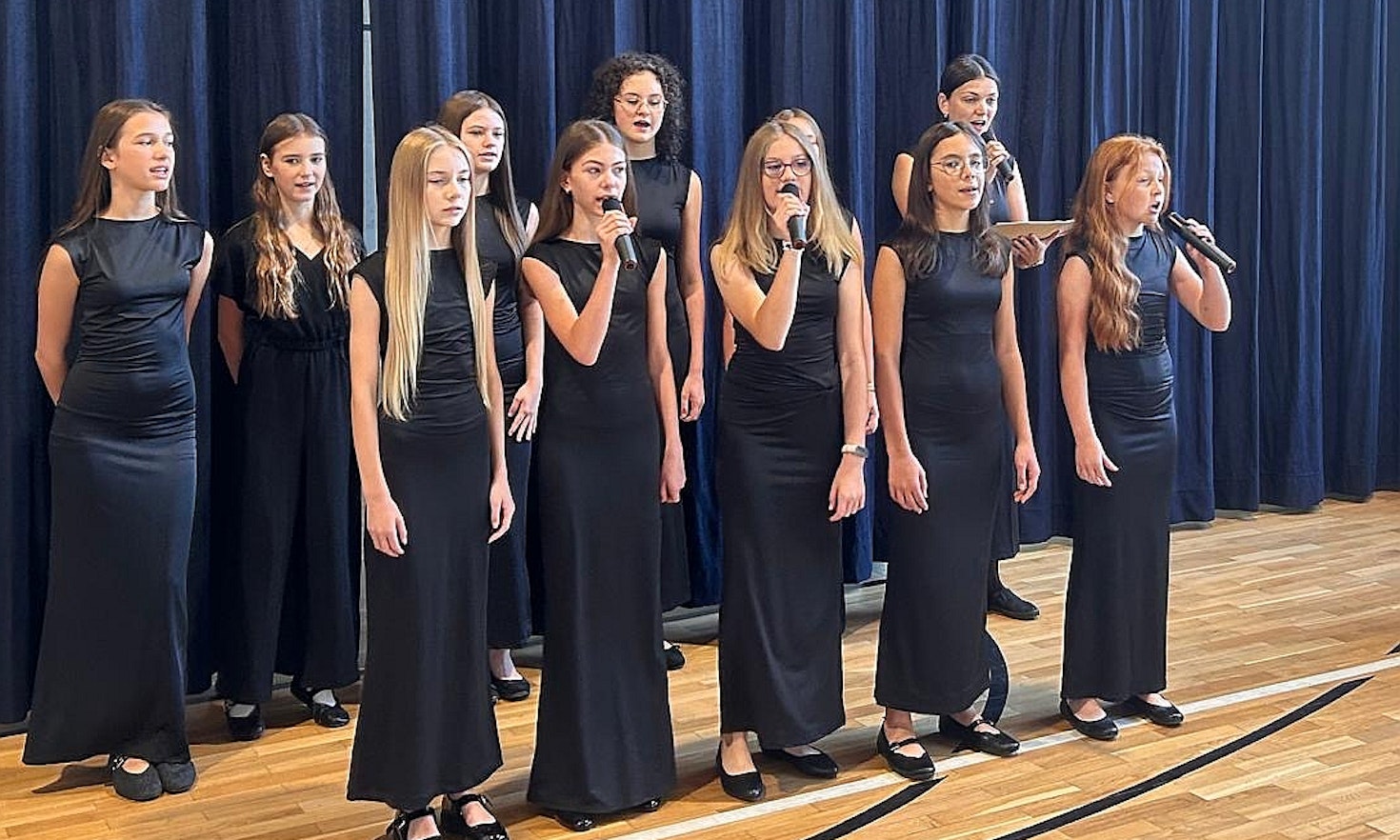
‘We want peace on earth,’ sings the girls' choir of the private bilingual school in Gosławice to welcome the reporter. The choir is called “Goslowiki”, a name that refers to the place name and the Polish word ‘słowik’, which means nightingale. The ‘nightingales’ are the figurehead of the school in Gosławice, which in turn is a beacon of hope for the German minority in Upper Silesia, as such educational institutions can be counted on the fingers of one hand.
‘We have six hours of German language lessons, and we also try to keep German in mind during the other lessons,’ explains Martina Osuchowski, chairwoman of the Creative Education Association, which runs the institution. It's impossible to miss: on the stairs, on the walls, on the shelves with the teaching materials – German words and their Polish equivalents can be seen everywhere. Fifty-five children are introduced to the German language in kindergarten, and 92 pupils attend the eight-year primary school, where they learn in both languages.
German and Polish are always in view.
Credit: Hatto Schmidt | All rights reservedThe majority of the children have hardly learned any German in their families. There is a good reason for this: after the end of the Second World War, when the Nazis' racial fanaticism, which culminated in the Holocaust against the Jews and mass atrocities against Poles, other nationalities and dissidents, was finally brought to an end, millions of Germans fled their homeland or were expelled, and under the subsequent communist regime, everything German was banned. Similar to what the fascists in South Tyrol had done, even names were polonised; not even gravestones were spared. Two generations of the minority thus grew up without the German language. ‘But people still have a German identity,’ emphasises Bernard Gaida, long-time chairman of the Association of German Social and Cultural Societies in Poland, the umbrella organisation of the German minority.
The state education system is of little help: three hours of German are taught in its schools, provided that enough parents submit a corresponding application. However, these lessons take place in addition to the normal timetable and therefore also during off-peak hours when the other pupils are already free. The learning success is correspondingly moderate. After primary school, there is practically no more German teaching in the public school system.
‘Even those parents who no longer speak German themselves often want their children to learn the language,’ explains Martina Osuchowski. Her school tries to fulfil this wish in a special way: here, German is used in all subjects. This presents quite a few difficulties, starting with the teachers. In Poland, there is no teacher training in minority languages.
Not all of our 25 teachers speak German but they all try to incorporate German into their lessons.
Matrtina Osuchowski
The school also demands a lot from the teachers in addition to the language: lessons are taught according to the principles of Montessori education, which means that all teaching materials have to be produced in-house – in Polish and German. The teachers invest far more time and effort than in state schools, especially as additional activities in sport, music and dance are offered alongside the eight-hour school day.
Martina Osuchowski, Bernard Gaida and Sylvia Biesieda
Credit: Hatto Schmidt | All rights reservedFinding a building is a major challenge for any private school operator. Although the public sector provides buildings for such purposes, they are dilapidated and require a great deal of money to renovate. The state does not contribute to this. ‘It is only possible thanks to funds from the German Ministry oft he Interior and with the help of loans,’ says Bernard Gaida.
In order to service the loans and cover the costs, private operators have to charge school fees. This is also the case at the bilingual school in Raschau/Raszowa, which opened 16 years ago and is a pioneer in bilingual education and Montessori pedagogy. The school is run by the association ‘Pro Liberis Silesiae’ (For the Children of Silesia). The fees also include the cost of the school bus, because ‘the children come from all over the area, from up to 40 kilometres away,’ says the association's chairwoman, Margarethe Wysdak. However, she adds that the fees are reasonable.
The association was founded 17 years ago for a specific reason: ‘In the 1990s, investments were made in infrastructure rather than education. That was a mistake that continues to have an impact today’, says Wysdak, criticising the politicians of the time, including those from the German minority.
In the 1990s, investments were made in infrastructure rather than education. That was a mistake that continues to have an impact today.
Margarethe Wysdak
The school of the ‘Pro Liberis Silesiae’ association in Raschau.
Credit: Hatto Schmidt | All rights reservedAt her school, great efforts are made to teach the children the German language. ‘The way the lessons are taught and how German is used depends on the subject’, explains teacher Sabina Prokop: ‘Familiar topics are introduced in German, but if something new is added, it is first explained in Polish. However, German is used in every lesson’, Prokop emphasises. German is also used a lot for repetition. ‘It always depends on the teacher', says Wysdak.
In Raschau, too, the demands on teachers are high. Theatre meetings and a song festival are organised, there is a summer talent lab, art projects and, during the holidays, the Klein-Raschau children's play town. In addition, there are regular student exchanges with schools in Budyšin/Bautzen in Sorbia, Kaltern in South Tyrol, Fünfkirchen/Pècs in Hungary, Prague and Mainz.
‘Some teachers have given up because of these high demands but the teachers who are here are convinced!’
Margarethe Wysdak
One example is a young woman from a village further away. As a child, she wanted to attend this bilingual school, but her parents refused because they feared the hardships of transporting her to school. ‘Now she is fulfilling her dream and working for us as a teacher, even though she is still in the middle of her studies’, says Barbara Loch, the heart and soul of the school.
It remains to be seen whether the young woman has found a secure job for the future. ‘The whole EU is shrinking, Poland even faster, and the population in the Opole region even more so’, says Margarethe Wysdak; there, the birth rate is already below one child per woman. This will have consequences: ‘We must expect schools to be closed in the future.’ It is a matter of the survival of the minority.
For this reason, Bernard Gaida believes that the objectives of international agreements must also be supplemented: ‘The European Charter for Regional or Minority Languages talks about preserving minority languages, but for many minorities, it's a question of revival.’
The climate in Poland does not seem favourable for this. In recent years, anti-German and anti-Ukrainian tendencies have increased significantly, says Gaida. In parliament, care is taken to ensure that minorities do not gain too many rights, ‘and in the Commission for Minorities, there are more guardians against minorities than advocates.’
The driving forces behind the bilingual school in Raschau: (from left) Barbara Loch, Sabina Prokop and Margarethe Wysdak.
Credit: Hatto Schmidt | All rights reservedThe minority is only visible to a limited extent. Raschau and Goslawitz have bilingual place-name signs, as do 31 other municipalities and 357 localities throughout Poland. The district capital of Oppeln (in Polish Opole), on the other hand, has none; there are also no inscriptions, signposts or other references in German – even though the city of 130,000 inhabitants is the centre of the German minority, with many of its institutions based there.
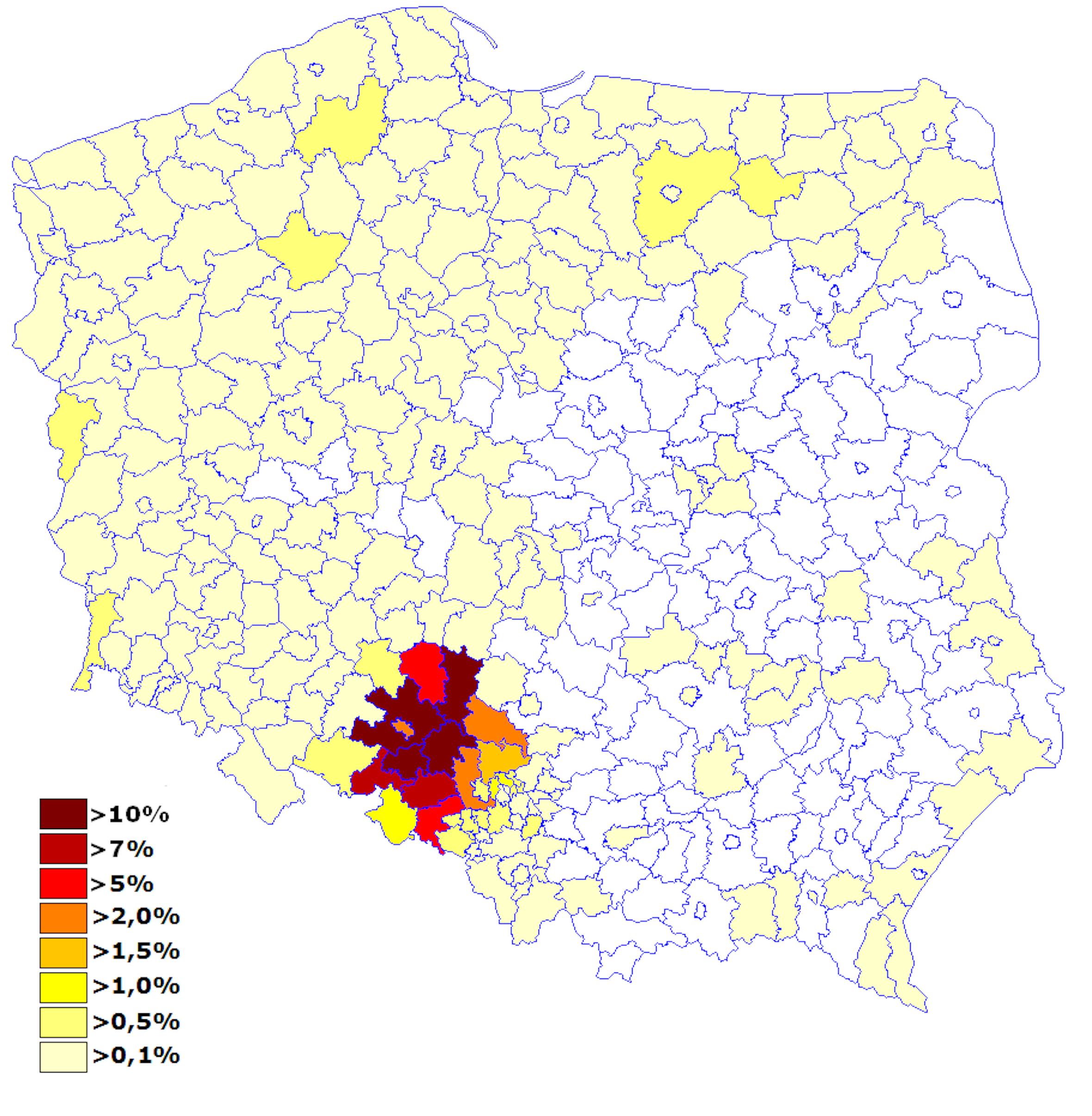
A town is given a bilingual place name sign if the minority makes up at least 20 per cent of the population and the local council decides to do so. ‘20 per cent is a high threshold,’ says Rafal Bartek, the current chairman of the umbrella organisation of the German minority, explaining: "On the tenth anniversary of the Minority Act, an amendment was introduced that provided for ten per cent. However, President Andrzej Duda vetoed this," explains Bartek. For places where the minority is weaker, there is a loophole: a referendum can be held there; if the result is positive and the local council agrees, bilingual place name signs can also be erected here.
German plays hardly any role in the authorities, although according to the Minority Act it can be used as an auxiliary language in dealings with local authorities – but only where the 20 per cent mark is exceeded. The municipality in question must also apply for entry in a state register before German can be used in official business.
Twenty-two municipalities are entered in this register. In practice, this option is not used anywhere. This is not only because there is almost no bilingual staff anywhere. It is primarily because members of the German minority – for the reasons mentioned above – generally speak Polish better than their mother tongue, which is why it would be somewhat pointless to contact the municipal administration in German. At a higher level, in the administrative district or even at state authorities, the use of minority languages is not permitted at all.

Percentage of the German population in Poland in 2021.
Credit: By Mietek00 - Own work, CC BY-SA 4.0, https://commons.wikimedia.org/w/index.php?curid=170596022 | All rights reservedDemocracy is not guaranteed to us forever, and neither is the minority language. We must fight for them relentlessly
Rafal Bartek
Rafal Bartek
Credit: Hatto Schmidt | All rights reservedSo, are the prospects bleak for the German minority? ‘Democracy is not guaranteed to us forever, and neither is the minority language,’ says Rafal Bartek, ‘we must fight for them relentlessly.’ That is what Bartek, Bernard Gaida, Martina Osuchowski, Margarethe Wysdak and all their allies are doing: so that future generations of ‘nightingales’ can also express their desire for peace.
Germans in Poland
The German minority estimates its membership at between 300,000 and 350,000. Around 220,000 live in Upper Silesia, where there are communities with over a quarter of German residents. However, Germans also live in other parts of Poland, such as Lower Silesia, Warmia-Masuria, Pomerania and other regions. In addition to the German minority, eight other national and four ethnic minorities are officially recognised.
German and Silesian
The German language is no longer an everyday language anywhere in Upper Silesia. In families, the Silesian dialect is mostly spoken, a Polish dialect interspersed with many German words. The German Silesian dialect, which was spoken mainly in Lower Silesia until 1945, died out at the end of the war. The discrepancy in the size of the minority between the data from the 2021 census (just under 150,000 members throughout Poland) and the minority's own estimate (up to 350,000 members) is due, among other things, to the emergence of a ‘Silesian regional identity’ and the anti-German sentiment fuelled by the PiS party: Those who identify as Silesians do not have to choose between Polish or German identity. The ‘Union of the Silesian People’ movement attempted to gain recognition as a national minority, but this was rejected by Polish courts and also by the European Court of Human Rights
The minority as a means of pressure
For the 2022/23 school year, the PiS-led Polish government reduced the number of German lessons from three to one; the number of lessons for other minority languages remained unchanged. With this blatant discrimination, Warsaw wanted to put pressure on Berlin to recognise Poles living in Germany as a minority. However, these Polish groups do not meet the definition of a national minority. Further pressure was to be exerted by Poland's demand for reparations payments of 1.3 trillion euros for the damage caused by the Nazi regime in Poland during the Second World War. The new Polish government under Donald Tusk, which took office in December 2023, reversed the reduction in German lessons as one of its first measures – but it had already done considerable damage.

Hatto Schmidt
Hatto Schmidt was born and raised in Baden-Württemberg, Germany. He studied history and political science in Freiburg and Tübingen, and then spent 33 years working as a journalist for the daily newspaper Dolomiten, which is published in South Tyrol. He has dealt with questions and problems of national minorities for many years.
Discover
Making research visible.
Find the connected experts, projects, publications, and research areas behind this blog post.
This content is licensed under a Creative Commons Attribution 4.0 International license except for third-party materials or where otherwise noted.
This blog is supported by the European Association of Daily Newspapers in Minority and Regional Languages (MIDAS). MIDAS was founded in 2001 to provide assistance to minority language newspapers and nowadays has members all over Europe. MIDAS serves as a platform for exchange, uniting minority language newspapers to present a collective voice to the European institutions.