


The paradox of language equality: rethinking discrimination through the Basque university entrance examination controversy
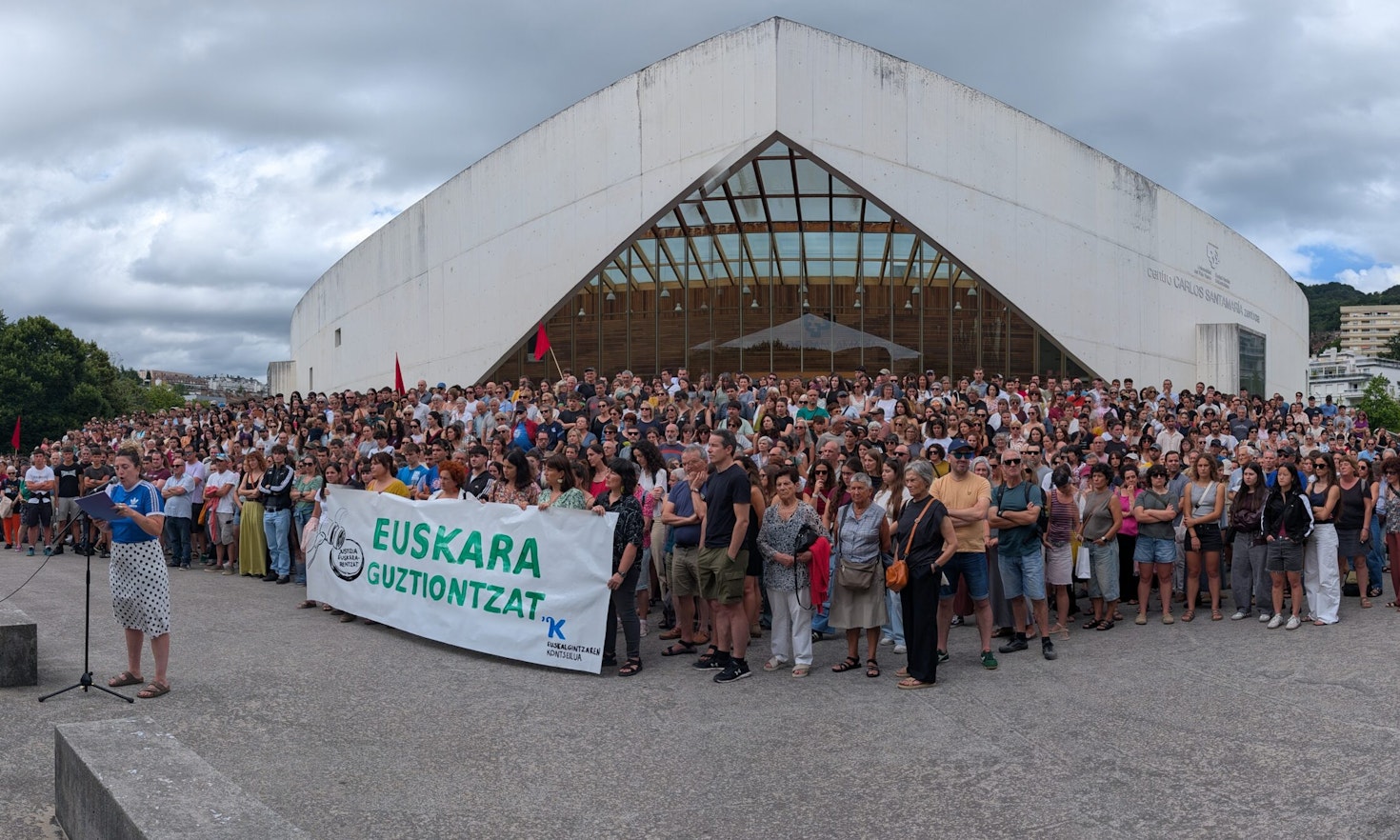
This article examines the 2026 controversy surrounding the Basque language component of the university entrance examination (USaP) as a revealing case of contemporary tensions over linguistic equality. It argues that the public debate shifted away from the longstanding failure of parts of the education system to ensure expected competence in Basque towards questioning the legitimacy of its assessment. At the heart of this shift lies an inversion of the discriminated subject, through which the structural inequality affecting Basque receded from view.
In recent years, public debates surrounding the Basque language have increasingly shifted from discussing how to advance language normalization to questioning the legitimacy of the policies designed to achieve it. As argued elsewhere, judicial challenges to language requirements in public employment and restrictions on institutional language planning have progressively narrowed the scope for public intervention in support of Basque. Recent events suggest that this dynamic has entered a new and particularly significant arena: education. This shift is especially relevant because the Basque education system has long been regarded as the cornerstone of the language normalization process.
It is within this crucial arena that a new controversy erupted in June 2026. Low marks obtained by a group of students in the Basque language component of the university entrance examination (USaP) triggered a dispute in which the assessment process was publicly questioned and the conflict rapidly reached the courts.
The significance of the USaP controversy lies in the shift in the perspective that took place as the debate unfolded. As attention increasingly centred on questioning the legitimacy of the assessment itself, a more fundamental educational question was pushed into the background: why, after years of schooling, were some students failing to achieve the Basque-language competence that the education system itself is expected to provide? This shift did more than redirect the debate. It also produced a striking inversion in who came to occupy the position of the discriminated subject and, with it, in how discrimination itself came to be understood. Tracing these two interconnected shifts provides the central thread of this article and offers a revealing lens through which to examine contemporary understandings of linguistic equality, educational policy and minority language rights in the Basque Country.
Beyond the examination room: when assessment becomes a political question
The controversy began in June 2026, when the results of the Basque University Entrance Examination (USaP) were released. A group of students, most of them from Model A schools (where Basque is taught as a subject but is not used as the language of instruction) received very low marks, including zero grades, in the Basque Language and Literature examination. The results prompted protests from affected students and families and quickly attracted considerable media attention.
What might initially have remained a dispute over assessment soon followed a different path. Before the ordinary review procedures had concluded, some families turned to the courts, requesting precautionary measures so that the Basque language grade would not affect university admission while their cases remained unresolved. The courts granted the request on an interim basis, citing the urgency of the admissions timetable and suggesting that the anonymity of the examination process might have been compromised. The University of the Basque Country (EHU) firmly rejected this allegation, maintaining that examinations were anonymised through a coding system and that examiners could identify neither students nor their schools. While appealing the judicial decision, the university was required to reserve places for the students concerned.
By then, the controversy was no longer simply about whether individual examinations had been marked correctly. Media coverage, public reactions and judicial intervention had progressively placed the examiners, the examination boards and the university's assessment procedures themselves under scrutiny. For the students who obtained judicial protection, the immediate effect was particularly significant: the academic consequences of their Basque language grades were temporarily suspended for university admission. At the same time, the controversy increasingly came to be framed around the possibility that students’ exams were unfairly corrected.
The evidence published afterwards, however, challenged some of the central assumptions on which the controversy had been built. After analysing the complete examination dataset, the EHU concluded that the results in Basque were not statistically exceptional when compared with other subjects: its average remained above several core disciplines, while Physics recorded both a higher proportion of zero grades and a substantially lower average. Crucially, the university's analysis found no evidence that Model A students had been systematically disadvantaged in the marking process. By the time these data emerged, however, the controversy had already travelled far beyond the examination room.
Chronicle of a failure foretold: language models and educational evidence
As the USaP controversy escalated, a fundamental question was left out of the debate: why, after more than a decade of schooling, had some students failed to acquire the level of Basque proficiency that the education system itself is expected to provide?
Answering this question requires stepping back from the events of 2026. Since the restoration of democracy, education has been a central instrument of Basque language revitalisation. The system of A, B and D language models was established with an explicit public objective: that students should complete compulsory education with an effective command of both official languages1. Yet the models provide radically different levels of exposure to Basque. In Model A, Spanish is the language of instruction and Basque is taught as a subject; Model B uses both languages; and in Model D, Basque is the main language of schooling.
For decades, research has shown that these differences matter. The pioneering EIFE studies found that Model D students achieved substantially higher Basque proficiency than those in Model B, while Model A consistently produced the weakest results. Crucially, the greater exposure to Basque provided by Models B and D did not result in any appreciable disadvantage in Spanish. As Jim Cummins argued in his preface to the EIFE study, this left the educational rationale for Model A increasingly difficult to sustain: teaching Basque almost exclusively as a subject produced poorer outcomes in Basque without generating compensatory gains in Spanish. He therefore advocated progressively transforming Model A towards forms of bilingual education offering greater exposure to Basque.
Successive studies and external evaluations by the Basque Institute for Educational Evaluation and Research (ISEI-IVEI) have continued to confirm this diagnosis. A significant proportion of students in Model A (and, to a lesser extent, Model B) still fail to reach the bilingual competence formally established as an educational objective, while Model D systematically produces higher levels of Basque proficiency without measurable disadvantage in Spanish.
Seen against this accumulated evidence, the USaP controversy looks rather different. The surprising fact was not that some students educated through the model offering the least exposure to Basque encountered difficulties in an examination assessing that competence. What is striking is how quickly the debate moved away from a problem documented for decades: instead of asking why the education system continued to produce such unequal linguistic outcomes, the controversy increasingly focused on the assessment itself and on the consequences of failing it.
When privilege speaks the language of discrimination
At the heart of this shift in the debate lies a striking inversion of the discriminated subject. Basque and Spanish do not enter the education system from equivalent historical and social positions. Basque has long occupied a structurally subordinate position, shaped by unequal histories of political power, institutional recognition and social prestige. The policies developed over recent decades to promote its transmission, extend its public presence and strengthen its role in education respond precisely to this historical imbalance. This is important because language policy does not operate in a socially neutral environment or intervene between languages that enjoy equal conditions. Minority language policies operate within linguistic orders already structured by unequal relations of power, recognition and prestige, and seek to address the consequences of those inequalities for the transmission, public presence and social value of minoritised languages. Their purpose, therefore, is not to create a privileged position for Basque or its speakers, but to counter the structural disadvantages that have historically constrained the language and to create the conditions for greater substantive equality with the socially dominant language.
Treating Basque and Spanish identically, as though they enjoyed equivalent social, institutional and sociolinguistic positions, does not necessarily guarantee equality; on the contrary, it may leave existing inequalities intact and allow the dominance of the majority language to operate as an apparently neutral status quo.
Laura Sainz Gomez
In this context, the inversion of the discriminated subject also rests on a particular understanding of what constitutes discrimination. Treating Basque and Spanish identically, as though they enjoyed equivalent social, institutional and sociolinguistic positions, does not necessarily guarantee equality; on the contrary, it may leave existing inequalities intact and allow the dominance of the majority language to operate as an apparently neutral status quo. From this perspective, discrimination may lie precisely in failing to recognise that formally equal treatment can have profoundly unequal effects when applied to languages that do not stand on equal footing. This is the rationale underlying policies specifically designed to protect, promote and revitalise Basque, including the prominent role assigned to education: not to confer preferential treatment upon a particular language or its speakers, but to counter an existing structural disadvantage and create the conditions in which substantive linguistic equality might become possible.
From this perspective, requiring competence in a minoritised language within institutions that have explicitly committed themselves to its promotion is not an exceptional burden imposed on otherwise equal terms; it is part of the very mechanism through which existing linguistic inequalities are addressed and substantive linguistic equality is pursued. It is precisely here that the USaP controversy becomes apparent: the question of why the education system continued to produce unequal linguistic outcomes receded, while the expectation that students acquire and demonstrate competence in the minoritised language increasingly became part of the controversy itself.
Note: This article gives the views of the author(s) and does not represent the position of the European Association of Daily Newspapers in Minority and Regional Languages (MIDAS) or Eurac Research.

Laura Sainz Gomez
Laura Sainz Gomez is a predoctoral researcher at the University of the Basque Country (UPV/EHU), where she is enrolled in the PhD programme Education: School, Language and Society, and a member of the DREAM research group. Her academic background is in education, multilingualism and Basque linguistics. Her research interests include multilingualism, language attitudes, acculturation orientations, Basque language normalisation and minority language policies. Her doctoral research explores the use of students’ full linguistic repertoires in Basque-medium classrooms, situating these practices within broader processes of Basque language normalisation and minority language revitalisation, as well as the policy and ideological frameworks that shape them.
Discover
Making research visible.
Find the connected experts, projects, publications, and research areas behind this blog post.


This content is licensed under a Creative Commons Attribution 4.0 International license except for third-party materials or where otherwise noted.








 My cookie preferences