


The Pope in Barcelona: Catalan language and visibility in the spotlight
This article was produced within the MIDAS Training Programme. In June 2026, Linda Koleszárová, a journalist at the Slovak Hungarian-language daily Új Szó, spent a week at the editorial office of the Catalan-language newspaper VilaWeb in Barcelona. During her stay, she explored different aspects of Catalan language, culture and identity.
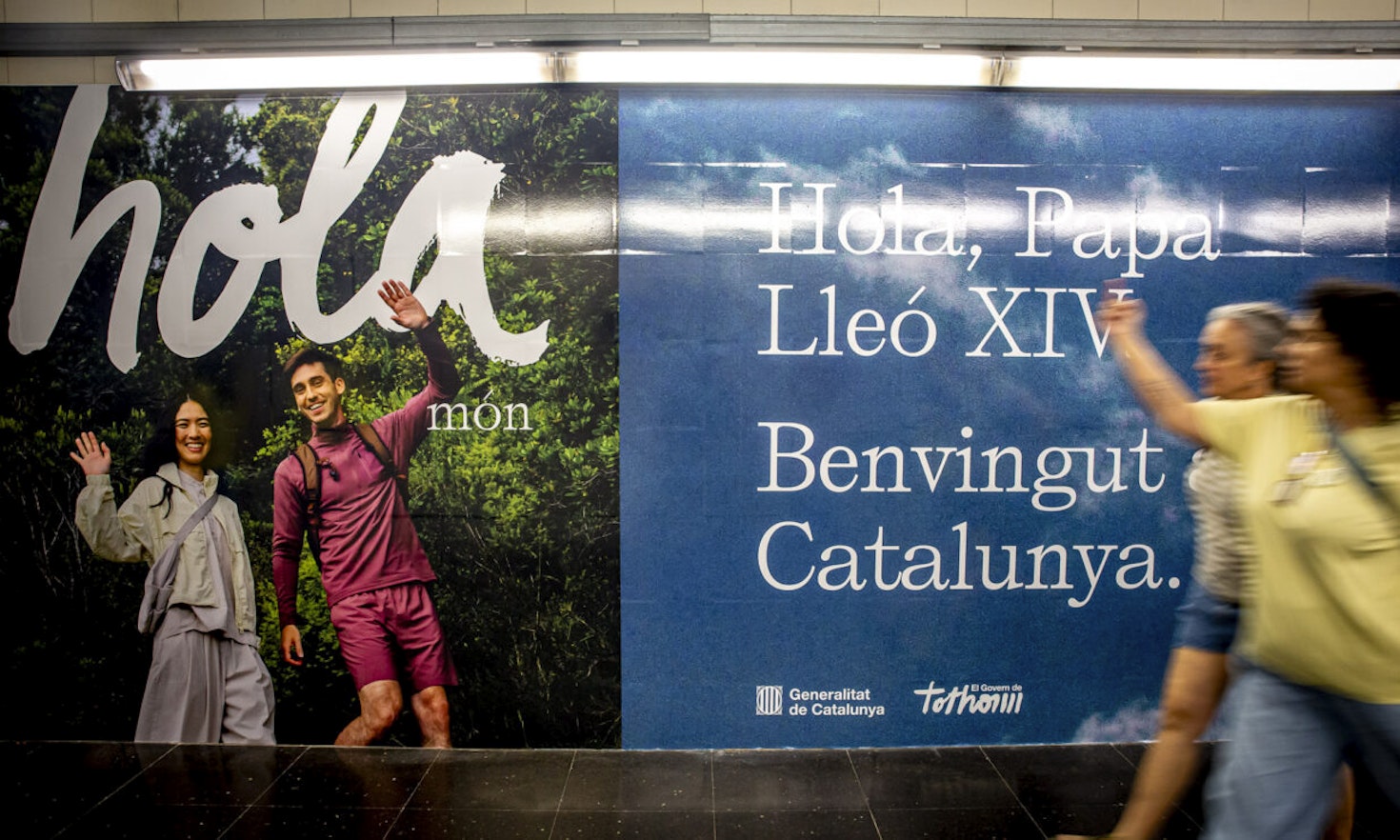
On 9 June, Pope Leo XIV arrived in Barcelona. While the two-day visit focused on the legacy of Antoni Gaudí and the Sagrada Família (Basilica of the Holy Family), the event became a topic of discussion in Catalan public life not only because of its religious and cultural significance. In the weeks leading up to the visit, another issue also came to the forefront in the local media: what role would the Catalan language and identity play during an event attracting global attention?
According to the official programme, the central venue of Pope Leo XIV’s visit was the Sagrada Família in Barcelona. The event was closely linked to the centenary of Antoni Gaudí’s death and to another milestone in the basilica’s construction: the inauguration of the 172.5-metre-tall Jesus Christ Tower.
Widely regarded as the world’s most famous unfinished church, the Sagrada Família welcomes millions of visitors every year and is one of the most recognisable symbols not only of Barcelona but of Catalonia as a whole. Gaudí’s work is considered an integral part of Catalan cultural heritage, making the papal visit an important moment for the international visibility of Catalan culture.
Both Catalan institutions and the Church viewed the visit as a historic occasion. Local authorities introduced extraordinary security measures, thousands of police officers were deployed to secure the events, and significant traffic restrictions were put in place across Barcelona.
The debate was not about the Pope
In the days leading up to the visit, another topic received considerable attention in the Catalan media. The debate did not concern the Pope himself, nor the necessity of the visit, but rather the linguistic composition of the official programme.
The Catalan-language news outlet VilaWeb published a detailed analysis comparing the programme with Pope Benedict XVI’s visit in 2010. The newspaper concluded that the role of the Catalan language in the current programme was more limited than it had been sixteen years earlier.
According to the editors, while there were Catalan-language speeches, prayers and liturgical elements, most of the key ceremonial moments took place in Spanish. Catalan media considered it particularly symbolic that the blessing of the Jesus Christ Tower – one of the highlights of the visit – was conducted exclusively in Spanish.
For many Catalans, the issue was not simply the proportion of language use but the symbolic message conveyed by an event of such significance.
There was no single Catalan position
It is important to note that there was no single dominant viewpoint within Catalan society.
Many Church representatives and believers argued that the language debate paled in comparison to the religious importance of the visit. They pointed out that the Pope’s presence itself represented recognition of Gaudí’s legacy and the work of the Catalan Catholic community.
Others believed that the language issue was a legitimate concern but that a religious event should not be excessively politicized. In their view, multilingual liturgy is a natural feature of an event that carries both international and state-level dimensions.
Meanwhile, organizations working on language rights and several Catalan opinion leaders emphasized the long-term importance of symbolic representation. In their view, the presence of the Catalan language is not merely a cultural matter but an expression of the fact that the Catalan community constitutes a European national community with its own political and social reality.
Lessons for a minority community
For Hungarian readers in Slovakia, following this debate was particularly interesting. Although there are significant differences between the situation of Catalans and that of the Hungarian minority in Slovakia, certain issues are surprisingly similar.
The public use of language, symbolic presence, institutional visibility, and cultural representation are all topics familiar to minority communities across Central Europe. It is therefore no coincidence that the debate unfolding in the Catalan media resembled discussions that regularly emerge within the Hungarian public sphere in Slovakia.
Thanks to MIDAS – the European Association of Daily Newspapers in Minority and Regional Languages – I had the opportunity to spend a week in Barcelona at the editorial offices of VilaWeb. Conversations with local journalists and editors made it clear that, in Catalan public life, the language question extends far beyond linguistics. For many people, language is one of the most important forms of political and collective self-expression.
This also explains why the linguistic composition of a papal visit’s programme could become the subject of public debate.
More than a religious event
By the end of the visit, it had become clear that the international media were primarily focused on the breathtaking architecture of the Sagrada Família, Gaudí’s legacy and the Pope’s messages. In Catalonia, however, many people were also paying attention to another question: to what extent Catalan language and identity were visible before the eyes of the world.
The debate itself demonstrated that questions of linguistic and cultural representation remain far more than purely cultural issues in twenty-first-century Europe. For many communities, they continue to be among the most important expressions of identity, recognition and visibility.
Note: This article gives the views of the author(s) and does not represent the position of the European Association of Daily Newspapers in Minority and Regional Languages (MIDAS) or Eurac Research.
Linda Koleszárová
Linda Koleszárová is a journalist at Új Szó, the Hungarian-language daily newspaper in Slovakia.
Discover
Making research visible.
Find the connected experts, projects, publications, and research areas behind this blog post.


This content is licensed under a Creative Commons Attribution 4.0 International license except for third-party materials or where otherwise noted.








 My cookie preferences