


Valencian floods one year later: cultural wars could also kill
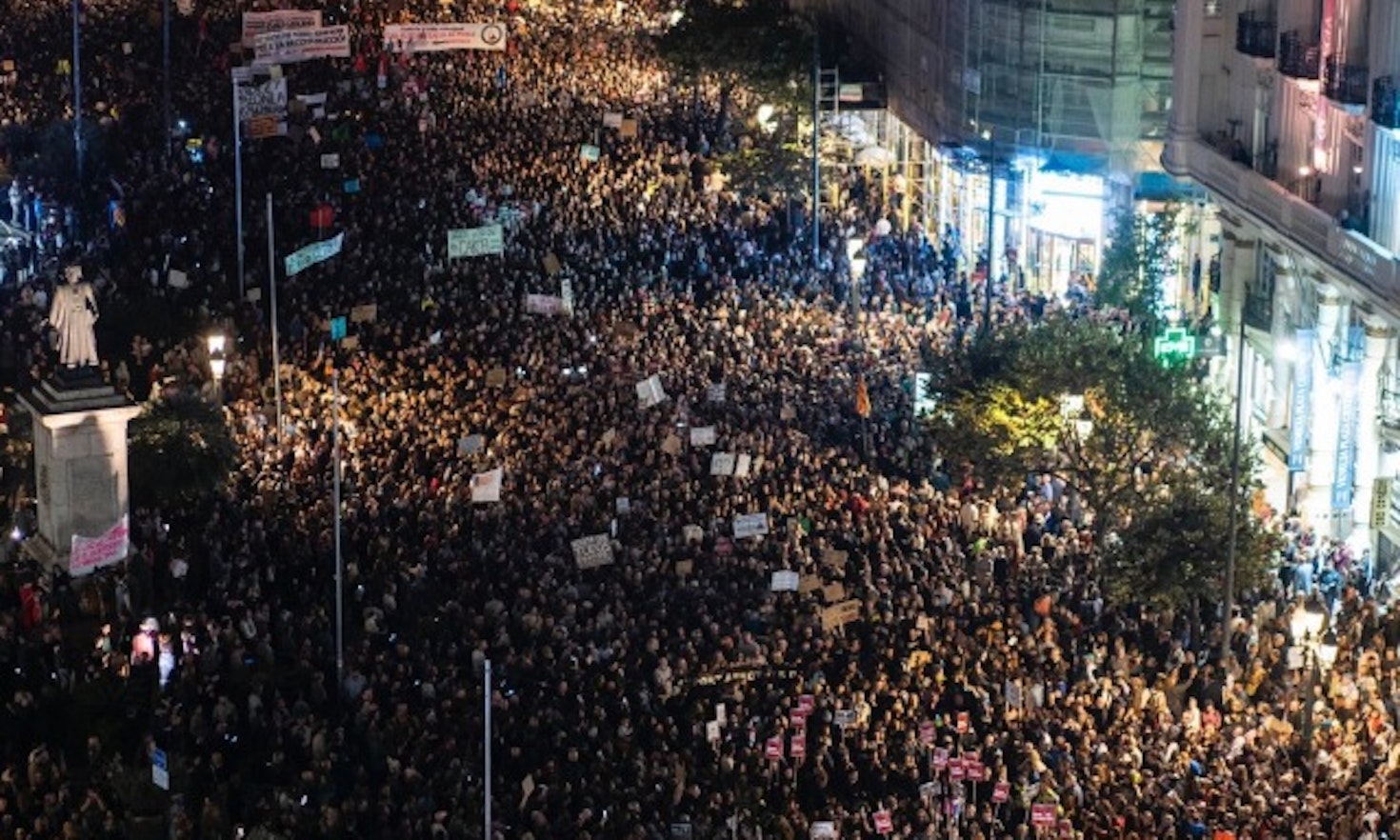
One year after the floods that killed 230 people in Valencia, accountability is still absent. Carlos Mazón remained in power for a year, rewriting the official narrative, allowing opaque reconstruction contracts tied to corruption, tightening political control over public media, and turning language and culture into weapons under PP-Vox rule. Despite mass protests and ongoing judicial investigations, he resigned only after being publicly confronted by victims. As Valencian language, culture, and broadcasting are systematically undermined, even emergency alerts were delayed due to linguistic censorship. This article argues that these cultural wars corrode public trust, deform democratic institutions, and, in moments of crisis, cost lives.
Last year, I explained how Valencians were left defenceless after decades of political nepotism and institutional decay. Until just a few weeks ago, almost nothing had changed: for an entire year, the president of the Generalitat Valenciana was still the same politician who had presided over the worst disaster in recent Valencian history. Carlos Mazón remained in office while systematically evading accountability. He issued statement after statement, each time reshaping the official version of events in an effort to dilute responsibility. The narrative reached one of its most disturbing points when a military officer later appointed to the Valencian executive publicly blamed the victims themselves, accusing them of having “failed to self-protect.
For an entire year, Carlos Mazón avoided resigning. One reason was structural: remaining in office long enough guaranteed him a lucrative post-presidential income. Under current rules, he would be entitled to around €75,000 per year after leaving politics. This created a perverse incentive, staying in power regardless of the social cost.
Meanwhile, a local judge has kept digging to uncover what truly happened. The magistrate has denounced an ongoing “defamatory campaign” against her, one she describes as tainted with “atrocious sexism". Her only “crime” has been doing her job. At the same time, the post-disaster reconstruction turned into a multi-million-euro business, once again managed without transparency.
The Mazón administration directly awarded €18.2 million in contracts to an entrepreneur facing a request of 16 years in prison for corruption, using “emergency” procedures that bypassed public tenders. Another €3.9 million contract for repairing a damaged dam was awarded to a construction company linked to Gürtel’s corruption scandal. Again, reconstruction did not follow principles of transparency or public interest. It followed political loyalty.
In April 2025, the European People’s Party (EPP) held its congress in Valencia. Mazón was expected to play a central role, and the Partido Popular (PP) publicly assured that he “would have the place that corresponds to him". Yet under sustained pressure from victims’ associations and continuous street protests, he ultimately withdrew from public prominence and declined to participate.
Peaceful demonstrations had taken place almost every month since the flood, often drawing thousands. One of the early ones escalated into a major confrontation, when King Felipe VI, Queen Letizia, Prime Minister Pedro Sánchez and Mazón visited the devastated town of Paiporta. Residents hurled mud, shouted “murderers,” and demanded resignations. Official vehicles were vandalized, two bodyguards were injured, and Sánchez was forced to leave. The Spanish King broke the security cordon to speak with protesters, some of whom were later identified as far-right extremists. A far-right militant later claimed responsibility for the attack, and Vox even offered legal support to the perpetrators.
While Mazón remained in office, public funding for culture and language suffered a severe blow: the budget for the Acadèmia Valenciana de la Llengua (AVL) was slashed by around 25 %, while the Madrid-based Fundación Toro de Lidia continued to receive €300,000 annually to promote bullfighting. Month after month, the budget for Valencian language and culture continues to shrink.
Public broadcasting did not escape the purge. Journalists at À Punt denounced systematic pressure and editorial manipulation, eerily reminiscent of the old Canal 9. The political takeover of À Punt was effectively coordinated by PP and Vox. In October 2025, when a massive protest against Mazón filled the streets, the public broadcaster censored the demonstrations and instead aired archival bullfighting footage from 1997, featuring the former Valencian Vice President Barrera as the torero, a chilling echo of Francoist television. Journalists themselves protested, calling it an attack on press freedom and on the Valencian public’s right to know.
One of the most symbolic fronts of the political battle has been linguistic. In 2025, politicians reopened the populist debate over whether the city’s name should officially be written as València or Valéncia. The form València, based on Catalan/Valencian toponymy, had been normalized under previous governments, a decision the PP had already challenged in court in 2017. In 2025, however, PP and Vox formally agreed to change the official name to the bilingual, closed-accent form Valéncia. Linguists warned that such matters belong to academic and legal institutions, not to political bargaining. Yet this move was part of a broader cultural war relentlessly promoted by Vox.
The symbolic tone of this offensive had already been set in 2023, when a Vox councillor covered the accent in València with a Spanish flag. While Vox presents itself as the true protector of Valencian culture, its representatives vote to remove Valencian cities from their historical linguistic domain and its ministries now issue official communications only in Spanish. By turning linguistic normalization into a political battlefield and branding it as “too complicated,” they push citizens toward abandoning Valencian altogether in favor of Spanish.
The assault on Valencian identity had tangible repercussions. Ferran Torrent returned the Premi de les Lletres Valencianes, awarded to him the previous year by Mazón, denouncing the institutional humiliation of the Valencian language. Yet even these symbolic gestures and repeated lies were not enough to force Mazón from office. The breaking point came during the official remembrance ceremony for the flood victims, when families publicly confronted and insulted him in front of King Felipe VI and the national television audience.
On 3 November 2025, following a prolonged and chaotic saga over his absence and actions during the emergency, Carlos Mazón finally stepped down as President of the Generalitat Valenciana, one year and five days after the floods that killed 230 people. Yet he kept his parliamentary seat, maintaining his legal immunity.
Instead of calling early elections, PP and Vox opted for an internal succession to avoid electoral accountability. Juanfran Pérez Llorca became the new internal president, backed by Vox. The power structure remained intact. At the same time, PP assigned Mazón the role of spokesperson for the Parliamentary Commission on Regulations, adding a €634 monthly stipend. His office as ex-president was also reopened in Alacant with advisers, vehicle and public budget. On 29 November 2025, more than 200 social and victims’ organizations marched again under the slogan “Mazón a presó” (“Mazón to jail”), demanding real justice and accountability. They refuse to let the memory of 230 victims be silenced by political deals and media manipulation.
The latest revelation before this publication came on 4 December 2025. During the emergency itself, the ES-Alert warning was reportedly delayed because officials demanded linguistic changes to the message, arguing that the original wording “sounded too Catalan.” Today, they claim to have “solved” the problem. Emergency alerts are now issued only in English and Spanish, effectively eliminating Valencian from life-saving public communications.
Valencian and Catalan are historically the same language, though the two names carry different political identities. That distinction has been deliberately weaponized by Spanish politics as a divide-and-conquer tool. I personally use a more local Valencian variety because it feels closer and more natural to my way of speaking. Language choice belongs to personal and cultural life, not to political warfare. Yet the same officials who now reject “Catalan-sounding” forms were using norms closer to standard Catalan only a few years ago.
The obsession with changing a single accent while people were drowning without warnings exposes the moral bankruptcy of those in power. These cultural wars are not symbolic. They erode trust, sabotage public communication, and, in moments of extreme risk, cost lives. Catalanophobia is also Valencianophobia, and it kills. When cultural battles take precedence over public safety, death stops being an accident, it becomes a consequence.
Note: This article gives the views of the author and does not represent the position of the European Association for Daily Newspapers in Minority and Regional Languages (MIDAS) or Eurac Research.
David Córdoba Bou
David Córdoba Bou holds a BA in Audiovisual Communication and a BA in Tourism Management from the Polytechnic University of Valencia. He writes about linguistic diversity and the identities of national minorities and indigenous peoples. He was nominated European Journalist of the Year in 2017 by Prix Europa.
Discover
Making research visible.
Find the connected experts, projects, publications, and research areas behind this blog post.


This content is licensed under a Creative Commons Attribution 4.0 International license except for third-party materials or where otherwise noted.









 My cookie preferences