


When language becomes security: Russian in Latvia’s public space as an exception?
A recent statement in the Latvian debate on the use of languages in public media suggests that Russian in the school system should remain permissible only by way of exception. Specifically, it may be used only to the extent necessary to counter propaganda and disinformation in matters concerning Latvia’s identity and the values promoted by the state.
At first glance, the formulation may appear technical, even temporary. In practice, it captures a deeper shift that has been unfolding over several years: the gradual redefinition of language policy from a field of minority accommodation into one increasingly shaped by security considerations.
This shift did not emerge overnight. Latvia has, since regaining independence, pursued a consistent strategy of strengthening the role of the Latvian language in public life. For many years, education has been a central element of this effort, and this was reflected in media coverage of the public debate on language use in education. Reforms affecting minority-language schooling, the transition toward Latvian as the primary language of instruction, and the recalibration of language requirements have all formed part of a longer trajectory aimed at consolidating a shared civic space.
In May 2025, the Latvian parliament voted to remove Russian from the list of languages available to study as a second foreign language in Latvian schools. While Russian has not been formally banned, it has been repositioned: it is no longer treated as one option among others within a multilingual framework, but as a language whose use is limited to private conversations at school.
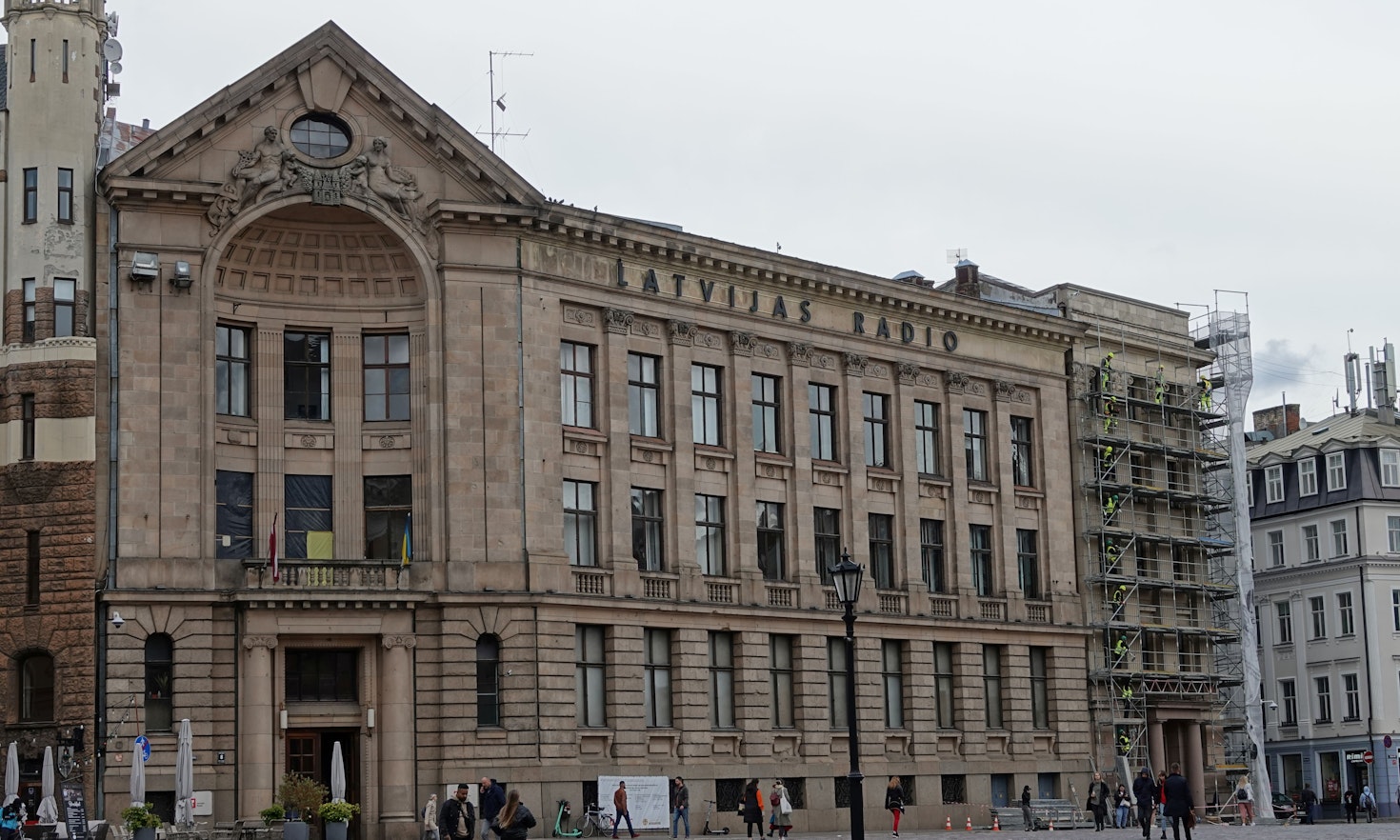
The shift toward dismantling the presence of the Russian language in public media was formalized in September 2023, when the parliament adopted a new national security concept. Although this was presented primarily as an action plan, it led to specific measures. Since 1 January 2026, Latvian Radio 4 has ceased to exist. It provided Latvia’s Russian-speaking audiences with a full range of information without requiring knowledge of Latvian, and its closure was justified by Latvian officials on the grounds that it had functioned as a tool for the promotion of a bi-communal society in Latvia.
This reorganisation can be interpreted in a broader geopolitical context. Since 2022, language policy in several Eastern European states has increasingly been discussed in relation to security. Russian is no longer seen solely as a means of communication or as part of the linguistic repertoire of a significant minority. It is also associated with informational influence, geopolitical pressure, and historical legacies that are now being actively contested. In this context, reducing the structural presence of Russian in education becomes part of a wider strategy of strengthening state resilience.
The language of “exception” matters here. In policy terms, exceptions are not neutral. They signal deviation from a norm, and in doing so, they define what the norm is. In this case, the norm is being rearticulated as a linguistic environment aligned with European integration, while Russian is framed as an outlier. The shift does not necessarily rely on prohibition. Instead, it reorganises the hierarchy of languages through administrative and curricular choices.
What is notable in the Latvian case is how this security-oriented reasoning is becoming embedded in routine governance. Earlier debates around language and security often carried an explicit tone of urgency. They were framed as responses to crises or external threats. The current approach is different. It translates these concerns into standard policy instruments.
Decisions about which languages are used in media or taught in school, and under what conditions, have long-term implications for patterns of information consumption. Language competence is one of the key factors shaping how individuals access news, entertainment, and public debate.
For younger generations, the practical effect may be a gradual shift away from Russian-language media. As proficiency declines or becomes less widespread, the incentives to engage with Russian-language television, online platforms, or print media are likely to diminish. At the same time, increased emphasis on EU languages may facilitate greater integration into broader European media spaces. Over time, this could contribute to a reorientation of the informational sphere, aligning it more closely with Western European sources and discourses. This process is not unique to Latvia, but the Latvian case illustrates it in a particularly clear form.
At the same time, the move raises questions that cannot be reduced to security considerations alone. Latvia remains a society with a substantial Russian-speaking population. For many, Russian is not a foreign language but a primary or heritage language. Thus, at least part of this audience will continue to seek Russian-language informational and cultural content and may turn to sources produced outside Latvia. In other words, this creates greater space for content originating in Russia. Such material remains easily accessible online, not necessarily in the form of direct propaganda, but through softer forms of influence, including cultural attachment and musical preferences.
What the current developments suggest is not a simple shift from multilingualism to monolingualism. Rather, it is a move toward a more selective form of multilingualism, in which languages are differentiated not only by their communicative value but also by their perceived political implications. In such a framework, some languages are promoted as gateways to integration and opportunity, while others are constrained due to their association with risk.
For observers of media and minority language dynamics, this development deserves close attention. In Latvia, the process is still unfolding. Its long-term consequences will depend on how policies are implemented and how communities respond. What is already clear, however, is that the language of “exception” marks a turning point. It signals that the question is no longer whether Russian has a place in the country’s public space, but under what conditions and with what justification that place can be maintained.
Note: This article gives the views of the author and does not represent the position of the European Association for Daily Newspapers in Minority and Regional Languages (MIDAS) or Eurac Research.

Hanna Vasilevich
Hanna Vasilevich, (Ph.D. in International Relations and European Studies, Metropolitan University Prague) is currently an incoming scholar at the Institute for Minority Rights of Eurac Research. Originally from Belarus, she was Senior Researcher at the International Centre for Ethnic and Linguistic Diversity Studies, Prague, Czechia, and taught at several Czech and German Universities. In 2012-2017, she worked at the European Centre for Minority Issues, responsible for the implementation of the ECMI Eastern Partnership Programme. She was a visiting research fellow at the Queen’s University Belfast and the Max Planck Institute for Social Anthropology. Since 2019, she has collaborated with the Max Planck Institute for Social Anthropology as a Member of the CUREDI project. She also provided her expertise within several projects commissioned, inter alia, by the OSCE High Commissioner on National Minorities and the Minority Rights Group Europe.
Discover
Making research visible.
Find the connected experts, projects, publications, and research areas behind this blog post.


This content is licensed under a Creative Commons Attribution 4.0 International license except for third-party materials or where otherwise noted.








 My cookie preferences