Where medieval German still survives

The Cimbrian language, a centuries-old German dialect spoken in parts of north-eastern Italy, is now severely endangered. In the Seven Communities on the Sleghe/Asiago plateau, only a small number of speakers remain, despite growing efforts to preserve the language through cultural initiatives, publications and language courses. Yet local activists and researchers believe that renewed interest among younger generations could still secure a future for the linguistic heritage.
“Boolkhent in de hòoghe Vüüronghe dar Siben Komòine” reads the sign near the Osteria all’Antico Termine. The inn lies between Trento and Vicenza, high in the mountains. As its Italian name suggests, the restaurant stands on a border. Today, this is where the Trentino-South Tyrol region ends and Veneto begins. Until the first world war, it marked the state border between Austrian Tyrol and the kingdom of Italy, and a little more than a century earlier it was the frontier between the Habsburg empire and Venice.
The tongue-twisting words on the sign belong to a German dialect and welcome visitors to the land of the Cimbrians in a dignified form steeped in historical patina: “Welcome to the high regency of the Seven Communities.”
Even the welcome sign is beginning to show its age.
Credit: Hatto Schmidt | All rights reservedBut why does this dialect exist in that part of Italy?
The area between the Adige and Brenta rivers, stretching almost to the gates of Verona, was settled from the 11th century onwards by people from the border region between Bavaria, Swabia and Tyrol. Of their once far more numerous settlements, only the Seven Communities, Lusérn and the Thirteen Communities in the Lessini mountains north of Verona remain today.
In the Seven Communities, whose main town is Slege/Asiago, a kind of peasant republic emerged that secured far-reaching autonomy under changing rulers, most recently Venice. Its economy was based on timber and charcoal production – the word “Cimbrians” probably derives from Zimmermann, the German word for carpenter – as well as cattle and sheep farming.
When the original “Reggenza” was dissolved in 1809 during the Napoleonic era, the decline of the Seven Communities had already begun. For decades, the population has shrunk because of emigration, but the number of speakers of the traditional dialect declined even more rapidly. As early as the beginning of the 18th century, two of the Seven Communities had abandoned the inherited language. In the end, only two communities still had speakers who had learned the dialect from their parents. This does not necessarily mean the extinction of the Cimbrian language. A number of Cimbrians are working hard to prevent that outcome. One of them is Giancarlo Bortoli, president of the Cimbrian Cultural Institute in Roana/Robaan, founded in 1973.
Giancarlo Bortoli, president of the Cimbrian Cultural Institute in Robaan/Roana.
Credit: Hatto Schmidt | All rights reserved“The institute carries out a wide range of activities,” Bortoli explains.
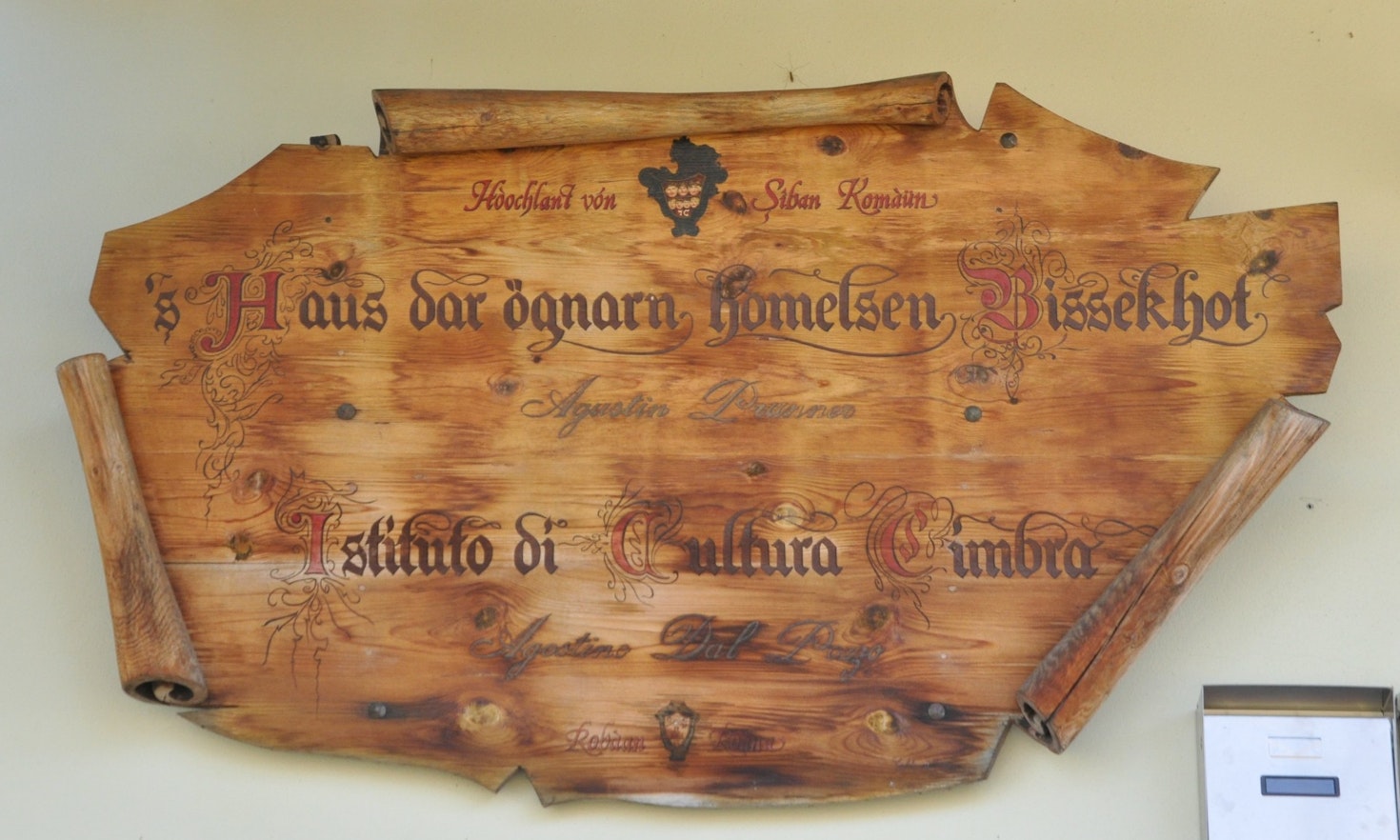
At the institute’s headquarters, the “Haus dar zimbrischen Bizzekhot Robaan” (House of Cimbrian Knowledge), there is a small museum displaying everyday objects from agriculture, crafts and domestic life, labelled in both Cimbrian and Italian.
The institute publishes the journal Quaderni di Cultura Cimbra and has produced countless historical studies, poetry collections, picture books and volumes of Cimbrian fables for younger readers. Most recently, a grammar and an extensive dictionary of the Cimbrian spoken in the Seven Communities have appeared. The “Bóartpuuch” (dictionary) can also be consulted online.
These publications are invaluable pillars supporting a language that has long been threatened with disappearance.
“In the recent past, we experienced two enormous ruptures,” says Giancarlo Bortoli. “During the first world war, our villages came under bombardment. Our people were evacuated to the Po valley.
There, when people heard our language, they said: ‘The Germans are coming.’ Our people were treated badly because of this, and so the older generation forbade children from learning Cimbrian.
Giancarlo Bortoli
That was the first major blow.”
The second came under fascism: Cimbrian – like German in South Tyrol – was banned.
Recent history has not treated the Cimbrians of the Seven and Thirteen Communities kindly either. Because they belong to Veneto, they enjoy virtually no minority protection, while their counterparts in Lusérn benefit from the autonomy of the Trentino-South Tyrol region, which protects and promotes the language.
This is one reason why, in May 2007, 94% of voters in the Seven Communities supported transferring the plateau from Veneto to the neighbouring autonomous region in a referendum, with turnout reaching 60%. Their demand, however, went unheard.
Today, the number of Cimbrian speakers connected to the small municipality of Lusérn, which has around 250 inhabitants including those who have moved away in recent years, is estimated at about 1,000. In the Seven Communities, by contrast, with a population of more than 20,000, the number of speakers is optimistically estimated to be only in the low hundreds.
A sociolinguistic study conducted in 2023 by the Società Filologica Friulana underlined how serious the situation has become. Seventy members of the Cimbrian community took part in an online survey on the state of the language, 30 of them over the age of 60. The result: Cimbrian in the Seven Communities is severely endangered, classified at level two on a six-level Unesco scale.
“Today, Cimbrian has practically acquired the status of a foreign language,” the study states.
Visitors still frequently encounter signs and trail markers with Cimbrian names, and village signs also carry additional plaques displaying the Cimbrian place names. In most cases, however, this use is aimed primarily at tourism. Restaurants attract customers with the slogan “Hìa izzet-zich Tzimbris!” (“Here one eats Cimbrian”), while mountain bikers can follow routes marked “Zimbarstaige”.
Beyond that, Cimbrian has disappeared from everyday life. Almost all respondents in the study regretted this development. Ninety per cent supported measures to protect and promote the language, while three-quarters even favoured teaching Cimbrian in schools.
The study argues that language-policy measures are urgently needed, but prospects appear limited: “Previous experiences with the Veneto region do not leave much room for hope, even though very little would be needed to give the language new momentum.”
To preserve what can still be preserved, the Cimbrian Cultural Institute is heavily involved in language teaching. Its courses are also attracting younger participants: last year, 20 people attended the beginners’ course and 10 enrolled in the advanced class.
The headquarters of the Cimbrian Cultural Institute in Robaan/Roana
Credit: Hatto Schmidt | All rights reserved“Young people are committed and energetic, both within the institute and in its activities,” says Giancarlo Bortoli. “That is why I am optimistic about the future. I say that Cimbrian will not die out simply because the old people die. It will continue precisely because there are young people. I think that in 10, 20 or 30 years there will be more speakers than today.”

Perhaps those young people will also complete a project left unfinished by the older generation by placing, beside the welcome sign at the Osteria all’Antico Termine, a second sign bearing the farewell greeting “Bar ségansich” – “Goodbye”. At present, no such sign exists.

Hatto Schmidt
Hatto Schmidt was born and raised in Baden-Württemberg, Germany. He studied history and political science in Freiburg and Tübingen, and then spent 33 years working as a journalist for the daily newspaper Dolomiten, which is published in South Tyrol. He has dealt with questions and problems of national minorities for many years.
Discover
Making research visible.
Find the connected experts, projects, publications, and research areas behind this blog post.
This content is licensed under a Creative Commons Attribution 4.0 International license except for third-party materials or where otherwise noted.