


Soft law and hard consequences: The EU-Tunisia Memorandum of Understanding

The expression “cash for migrants” has gained traction among critics of Europe’s migration outsourcing policies. These arrangements often involve cooperation with countries whose human rights records are questionable, through agreements that operate in a grey area of democratic oversight. What makes these agreements so distinctive? The Memorandum of Understanding signed between the European Union and Tunisia offers some insight into this issue.
On July 16, 2023, Ursula von der Leyen traveled to Tunisia, accompanied by her associates: Giorgia Meloni and Mark Rutte, Italian and Dutch prime ministers, both known for their anti-immigration discourse. The purpose of the trip was a meeting with Tunisian President Kais Saied to sign a new migration agreement. It took place in a particular context marked by a significant rise in departures from Tunisia. Indeed, the Libyan violent environment and Tunisia’s relative stability had turned the coastal cities of Sfax and Zarzis into major embarkation zones for large numbers of North African and Sub-Saharan migrants. In 2023 alone, the Italian coasts recorded more than 100,000 arrivals from Tunisia, surpassing Libya for the first time in ten years.
However, the host receiving the EU-Delegation had not waited for their meeting to tighten migration policy. As early as February of the same year, the Tunisian president had delivered a particularly violent speech targeting Sub-Saharan populations, accusing them of threatening the country’s Arab-Muslim values. A wave of repression followed, giving rise to spontaneous waves of violence carried out by emboldened residents as well as police deportations of hundreds of people into the desert without water or food. This scapegoating also constitutes an essential tool in the authoritarian consolidation that has characterized Saied’s mandate. On numerous occasions, he used it as a strategy to arrest opponents and justify his gradual dismantling of the rule of law and suspension of democratic freedoms.
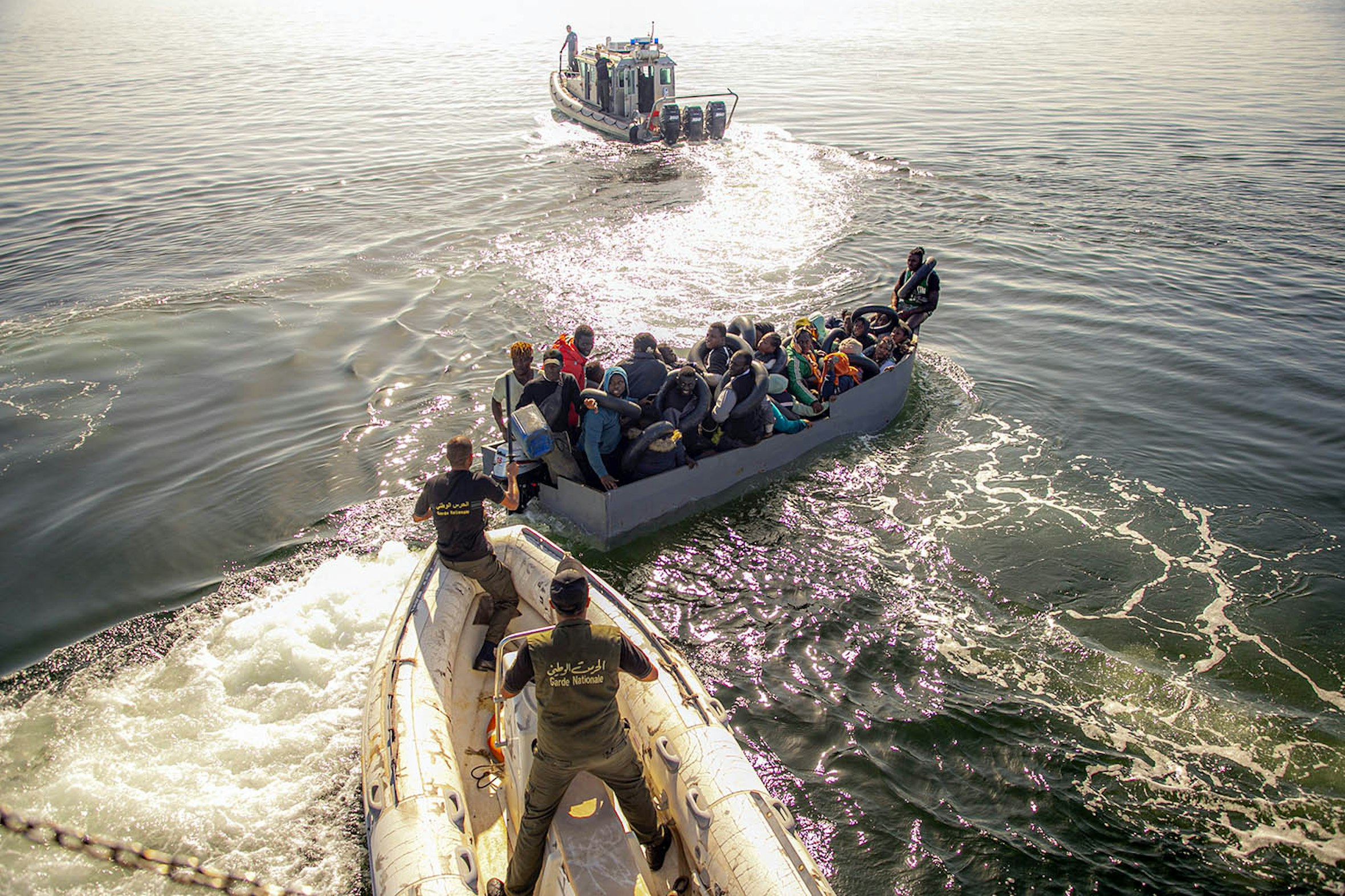
Interception of a migrants boat off the Tunisian coast by the national guard.
Credit: 2022 Anadolu Agency | All rights reservedYet this repressive climate did not seem to discourage the three visitors from engaging with Kais Sayed’s authoritarian regime. It seems to them that border protection appeared to matter more than the fundamental values of human rights protection to which they are nevertheless legally bound under the European treaties.
High figures, limited safeguards
The Memorandum of Understanding (MoU) signed that day promises Tunisia a financial package that could reach up to one billion euros: €105 million immediately from the EU budget, €150 million for migration through the EU Trust Fund for Africa, and up to €900 million in macro-financial assistance for development in the form of loans. To put these figures into perspective, this is equivalent to what Tunisia received between 2014 and 2020. The MoU, therefore, represents a spectacular multiplication of allocated funds. In exchange, Tunisia commits to strengthening border surveillance, accepting the return of its nationals expelled from Europe, and cooperating in the fight against smuggling networks.
But what the MoU does not contain is just as revealing as what it promises. No binding human rights clause appears in the agreement. No independent monitoring mechanism is provided to ensure that European funds are not used to finance abuses. No concrete legal migration pathway is established: vague references to “increased mobility” for Tunisians are not accompanied by any visa quotas, specified sectors, or operational guarantees.
Soft Laws: A familiar modus operandi
Similar agreements are a usual practice in European migration diplomacy. Since 2007, the EU has developed “mobility partnerships” with several countries, including Morocco (2013) and Tunisia (2014), each time promising an appealing triptych: economic development, visa facilitation, and circular migration in exchange for cooperation on readmissions and border control. However, research on the Moroccan and Tunisian cases demonstrates that readmissions, the European priority, increased dramatically, while visa issuance in return stagnated or even declined.
The 2023 MoU reproduces this pattern: vague promises of mobility in exchange for concrete commitments on control. The key to this asymmetry lies in the legal status of these agreements. The EU-Tunisia MoU is described as a “non-binding political declaration,” meaning that it escapes parliamentary ratification, judicial review, and any formal legal obligation. Unlike association agreements or international treaties, an MoU cannot be challenged before the Court of Justice of the European Union or the European Court of Human Rights. The commitments it contains are drafted in deliberately vague language - such as “integrated border management" - that creates neither measurable obligations nor sanctions in the event of non-compliance.
This reliance on soft law is not a technical accident but a deliberate strategy serving the interests of both parties. For the most anti-immigration EU Member States, it makes it possible to bypass the European Parliament, historically more attached to human rights than the Commission or national governments, and to avoid lengthy ratification procedures that could block the agreement. It also allows them to escape the legal obligation to apply the democratic conditionality clauses present in binding agreements: if Tunisia blatantly violates human rights, the EU is under no legal obligation to suspend anything because the MoU creates no binding legal duty.
For the most anti-immigration EU Member States, it makes it possible to bypass the European Parliament, historically more attached to human rights than the Commission or national governments, and to avoid lengthy ratification procedures that could block the agreement.
Emilien Miner
How to resist?
Faced with an architecture designed to escape all oversight, the spaces for resistance and contestation may seem limited. In November 2023, several political groups in the European Parliament referred the matter to the European Ombudsman, denouncing maladministration by the Commission in the negotiation of the MoU: absence of a human rights impact assessment, circumvention of parliamentary scrutiny, and lack of independent monitoring mechanisms. Although the Ombudsman cannot cancel the agreement, a finding of maladministration creates a precedent forcing the Commission to revise its practices for future agreements, notably by imposing systematic human rights impact assessments and stronger parliamentary oversight. The role of civil society is to closely monitor this type of investigation, provide additional evidence of violations, and ensure that the Ombudsman’s recommendations do not remain dead letters.
It is also important for civil society to continue formulating concrete demands for any future agreement, such as binding conditionality of funds on respect for human rights, free access to detention centers and border zones, and the inclusion of civil society in the design and monitoring of programs. Only coordinated mobilization can impose a restructuring of this system in which soft law produces very hard consequences for those who pay the price.

Emilien Miner
Emilien Miner is a doctoral researcher at the Faculty of Political and Social Sciences at Pompeu Fabra University and a Marie Skłodowska-Curie Fellow within the EuroMedMig Doctoral Network, and the coordinator of the GRITIM's Research Lab. He holds an MA in Human Rights and Democratization from the Global Campus of Human Rights and an MA in Migration Studies from Pompeu Fabra University. He has several years of experience working on human rights, gender, civil society and migration issues, both with grassroot NGOs and with the European Union. His areas of expertise include European migration policies, international migration governance, civil society, and externalization policies in North Africa. His current research examines the impact of the European Union’s externalization of migration policies on state structures, civil society, and migration dynamics in Tunisia.
Discover
Making research visible.
Find the connected experts, projects, publications, and research areas behind this blog post.


This content is licensed under a Creative Commons Attribution 4.0 International license except for third-party materials or where otherwise noted.








 My cookie preferences