


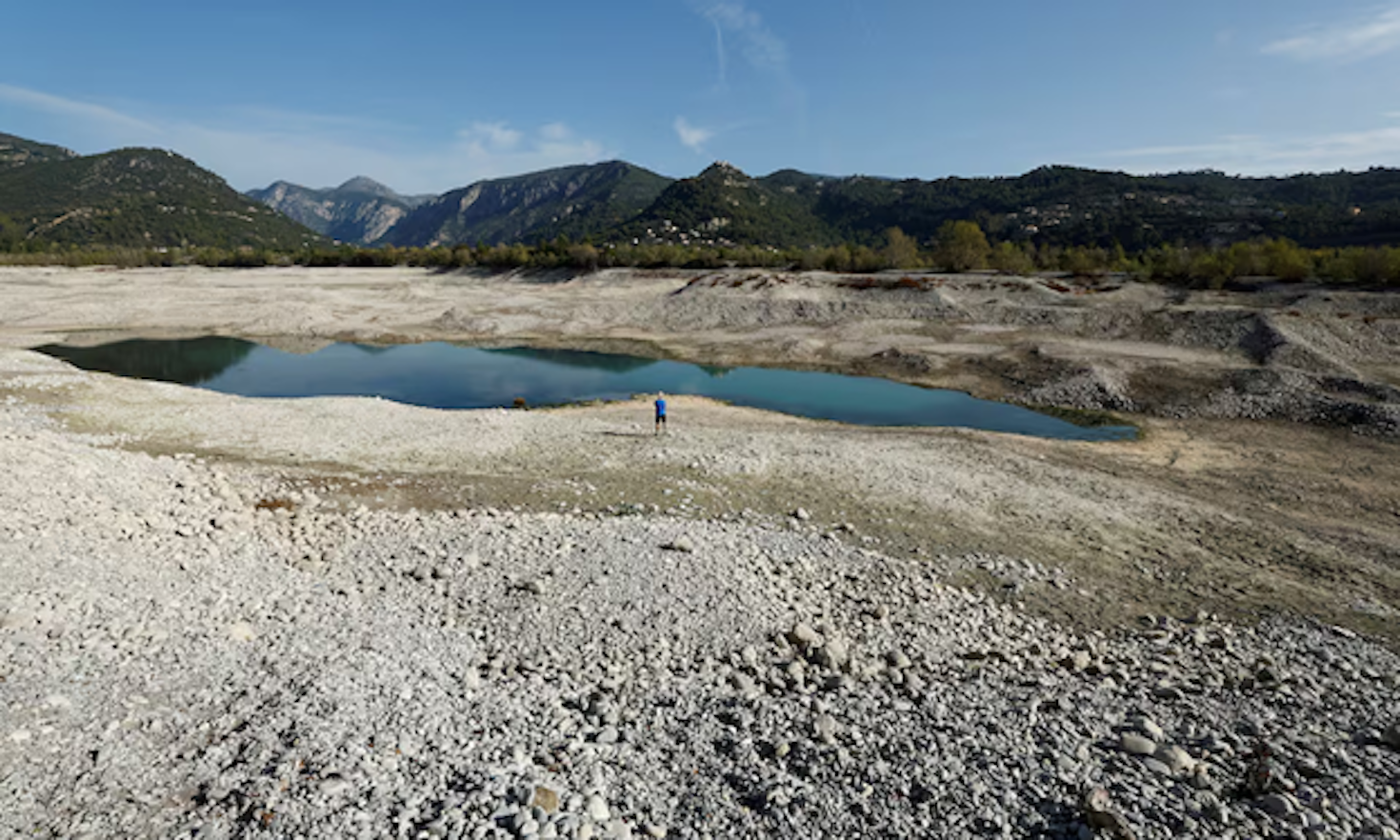
In 2022, Europe experienced its worst drought in two centuries, a stark reminder of how vulnerable our water systems have become. This unprecedented event should serve as a wake-up call for finally addressing the problems of droughts and water scarcity, which are increasingly becoming relevant for EU states. This year’s publication of the EU Water Resilience Strategy (WRS) is a step forward. But what does it mean in practice, and why should South Tyrol care?
First, let’s take a step back and explore what happened in 2022 and why we need to talk about it, and, more importantly, act on it.
2022 was characterized by an extreme meteorological drought, driven by persistent anomalous anticyclonic circulation, which lasted from December 2021 to August 2022. It left rivers running dangerously low, threatening water supply for agriculture, energy, fisheries, and public use (Faranda et al., 2023). Many EU countries, especially the Mediterranean and Balkan ones, experienced seasonal water scarcity conditions, with Water Exploitation Index plus (WEI+) values exceeding 20%.
The economic and social impacts were massive. The drought caused around $26 billion in insured losses, making it the second most expensive weather disaster in Europe, only surpassed by the 2021 floods in Germany and Belgium (~$46 billion) (Masters, 2023). In Italy, the drought emergency was officially declared for five northern regions (Emilia-Romagna, Friuli-Venezia Giulia, Lombardia, Piemonte and Veneto). Beyond agriculture and water supply, the crisis reduced hydro and thermo-electric power generation, as water reserves in northern Italy were only half of what had been observed in previous years.
The EU water policy picture
Until recently, drought and water scarcity had received limited attention in EU water management. In 2019, only half of the member states considered it a relevant issue, but this is changing (Publications Office of the European Union, 2023). This issue cannot be overshadowed anymore: 30% of the population in Europe is already experiencing water scarcity. The future is not going to be better, data predicts that water demand in Europe is expected to exceed available resources by 40% by 2030, and the cost of climate impacts related to water scarcity could reach €45.9 billion annually by 2050 (Del Peral, 2025).
EU water policy is primarily shaped by the Water Framework Directive (WFD, 2000/60/EC), which seeks to achieve “good status” for all water bodies and treats water as a heritage to be protected. Other directives, Drinking Water (DWD), Urban Wastewater (UWWTD), and Floods (FD), together with broader strategies such as the Climate Adaptation Strategy, the Biodiversity Strategy, the Green Deal, and the CAP, reinforce this framework. However, while issues like flooding have received substantial legislative attention, drought still lacks a dedicated, binding operational framework.
Efforts to address drought began with the 2007 EU communication on water scarcity and droughts, followed by the establishment of the European Drought Observatory (EDO) in 2008. By 2023, 12 member states had adopted drought management plans. Yet these initiatives remained largely non-binding and fragmented across sectors.
The 2022 drought finally catalyzed a renewed EU focus on water resilience. On June 4, 2025, the European Water Resilience Strategy (WRS) was published, building on the “Vision 2050” for a water-resilient Europe presented at the 2023 United Nations Water Conference. The strategy aims to safeguard the water cycle, ensure clean and accessible water for all, and foster a sustainable, resilient, and competitive water economy. It emphasizes efficient water use, nature-based solutions, and intersectoral cooperation, while supporting member states in developing drought and water scarcity indicators by publishing a technical guide for Drought Management Plans (DMPs) and organizing a biannual Water Resilience Forum.
But hold on, despite these advances, the strategy is not yet a full substitute for a dedicated drought directive. It lacks binding agreements, dedicated funding, and legal enforcement, relying primarily on governance tools and guidance. This is just the first step towards the acknowledgment of drought as a central challenge for Europe’s water security, but we need more to build a legally binding framework that addresses the problem properly and ensures effective European action on drought and water scarcity.
What’s the situation in South Tyrol?
While Europe debates resilience at the policy level, the impacts are already tangible in many regions like South Tyrol. The 2022 drought exposed how climate extremes can strain local water systems, making this Alpine province a case study for preparedness. Eurac Research’s monitoring using SPI (Standardised Precipitation Index) and SPEI (Standardised Precipitation Evapotranspiration Index) showed persistently negative SPEI‑6 values in spring 2022, evidence of a medium‑term water deficit affecting river flows and storage. The lack of precipitation was evident across the region: snow reserves were minimal, soil moisture dropped sharply, and river flows fell well below seasonal norms. Agricultural areas and hydropower production faced mounting stress, signalling that water scarcity was no longer a localized issue but a systemic challenge.
The drivers of this event were interconnected. Precipitation during winter and spring fell dramatically below average, leaving soils and aquifers depleted. High temperatures compounded the deficit, accelerating evapotranspiration and melting the already scarce snowpack, weeks earlier than normal. Snowmelt typically sustains summer flows; it's premature disappearance in 2022 removed this buffer, amplifying water stress.
By April, warning signs triggered action. The Permanent Observatory on Water Uses of the Eastern Alps River Basin District raised the severity level to “medium” on April 13. Days later, the provincial governor urged water conservation, targeting agriculture and private irrigation. These alerts foreshadowed a summer of restrictions. By June, Adige River flows were 24% below seasonal norms, and municipalities imposed local measures such as nighttime supply suspensions and bans on watering gardens.
The crisis peaked in July with a State of Water Emergency for the Adige basin. Ordinance WN/03-2022 introduced strict rules: irrigation of green spaces was banned during daylight hours, and overhead sprinkling in agriculture was prohibited between 10 AM and 6 PM unless drip systems or turn-based schedules were used.
The 2022 drought was not an isolated anomaly, but it reflects a broader trend of increasing variability and extremes, exposing the fragility of South Tyrol’s water system under the combined pressures of low precipitation, rising temperatures, and reduced snowpack: clear warning signs of climate change in alpine regions (Shrestha et al., 2026).
So how are these challenges addressed in South Tyrol?
To better understand how the province manages drought and water scarcity, we analyzed key provincial plans and policy documents related to water and other connected sectors, drawing on the policy mapping carried out within the Nexogenesis project.
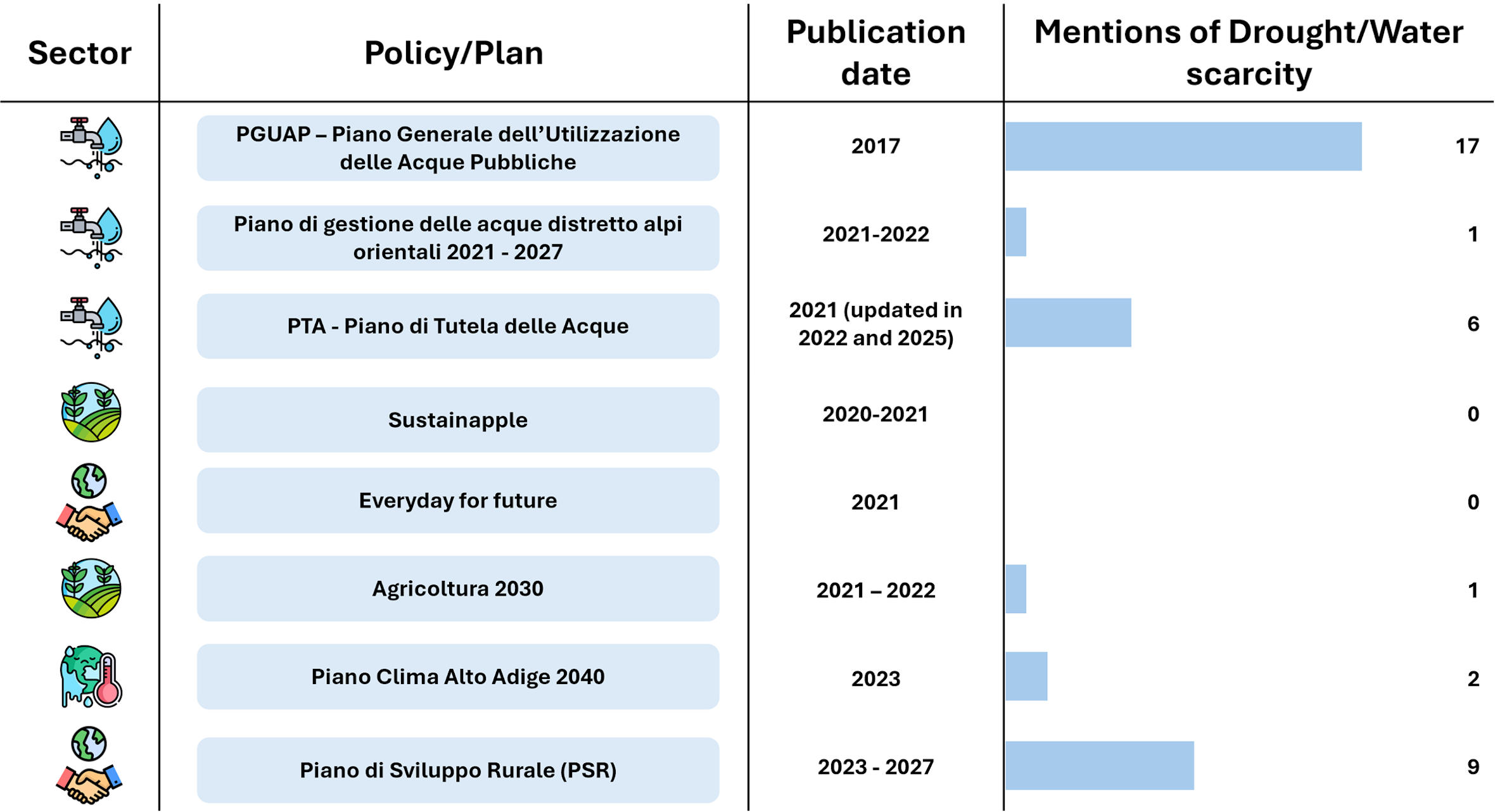
Our goal was to see whether specific strategies or measures exist to tackle drought and water scarcity, problems that are becoming increasingly frequent in South Tyrol, and are expected to intensify in the future. To make our findings easier to understand, we summarized them below, highlighting how often drought and water scarcity are mentioned in the reviewed documents.
Within this broader framework of drought governance, research plays a central role in strengthening drought management by generating the knowledge and analytical tools required for informed action. At Eurac Research, we work to enhance drought preparedness in South Tyrol and in the Alps by creating innovative water management solutions, also accounting for future climate change exacerbation. Our approach is systemic and cross-sectoral, combining monitoring, modelling, data integration, and stakeholder engagement to support forward-looking decision-making, and to foster knowledge exchange between research and practice. We develop multi-sectoral drought monitoring and forecasting tools tailored to Alpine regions (A-DROP), model current and future imbalances between water availability and demand across sectors in South Tyrol (NextWater_ST) and analyse textual data on drought impacts in the Italian Alps (DryAlps-IT). This work builds on our experience in European projects such as IMPETUS, Nexogenesis and the Alpine Drought Observatory, where we advanced integrated, stakeholder-oriented decision-support approaches. These approaches are regularly discussed with researchers, practitioners, and policymakers at events such as the Adige Water Fair.
Key Takeaways
1. Drought is largely overlooked
Drought and water scarcity are not major topics in most plans. Interestingly, the word “drought”, which refers to the natural phenomenon, is rarely used and replaced by “low-flow periods”. The most used term is “water scarcity”, referring to the unbalance between water availability and demand.
2. No dedicated sections on drought
None of the plans includes a dedicated section for drought and water scarcity with data, future projections, or potential socio-economic impacts. The topic is mostly addressed indirectly, often in connection with river ecological maintenance, electricity production, or irrigation.
3. Most plans predate the 2022 drought
Almost all documents were published before the 2022 drought and tend to treat drought as an occasional phenomenon rather than a systemic challenge. The notable exception is the Rural Development Plan (2023–2027), which appears to address drought more seriously, likely influenced by the 2022 event.
4. Types of measures included in the plans
- Normative measures (e.g. the respect of the Minimum Vital Flow and derogations for agriculture in drought-prone areas).
- Technical measures (e.g. drip irrigation and other low-water-use systems).
- Management measures (e.g. higher tariffs in water-scarce areas to reduce consumption).
The 2022 drought was a warning, not an anomaly. South Tyrol, like many Alpine regions, is increasingly exposed to climate extremes, and water scarcity is emerging as a systemic challenge rather than an occasional inconvenience. However, our analysis shows that current plans still treat drought as a secondary issue, with few dedicated measures or forward-looking projections. This is an area where improvement is both possible and urgent.
Enhancing water resilience locally is important not only for regional security but also as part of a broader European effort. The recently launched EU Water Resilience Strategy marks a positive step, yet its success will depend on how effectively guidance translates into concrete actions. South Tyrol can play a role by integrating drought preparedness into water management plans, adopting innovative solutions, and fostering cooperation across sectors and regions. Managing drought risk is not just a technical matter, it concerns communities, ecosystems, and economies. Taking proactive steps today will help ensure that future dry spells do not turn into emergencies.
Further readings:
- Biella, R. et al. (2024). The 2022 Drought Shows the Importance of Preparedness in European Drought Risk Management, EGUsphere [preprint].
- Biella, R. et al. (2025). The 2022 drought needs to be a turning point for European drought risk management. Natural Hazards and Earth System Sciences, 25(11), 4475–4501.
- European Commission (2025). European Water Resilience Strategy.
- Shrestha, S., Terzi, S., Zoccatelli, D., Zaramella, M., Borga, M., Galletti, A., Callegari, M., Dinale, R., Pittore, M., & Bertoldi, G. (2026). Retreating glaciers and snow cover are amplifying summer droughts in the Adige River Basin (Italy). EGUsphere.

Agnese Moroni
Agnese Moroni is a Junior Researcher at the Institute for Regional Development of Eurac Research. Her work focuses on environmental change and community resilience in mountain areas, contributing to the Interreg AS BeyondSnow project. She holds a MSc in Human Geography from the University of Amsterdam and a BA in Politics and International Studies from the University of Warwick.

Chiara Mioni
Chiara Mioni is a Junior Researcher at the Center for Climate Change and Transformation of Eurac Research, working on climate change adaptation and climate and disaster risk assessment. Her research aims to strengthen community resilience by exploring governance systems, policy frameworks, and institutional approaches to climate risk management and adaptation. She has an interdisciplinary background in political and social sciences applied to environmental and climate challenges. Chiara holds a Master of Science in Global and Local Studies from the University of Trento and a Bachelor’s degree in Political Science and International Relations from the University of Padua.
Discover
Making research visible.
Find the connected experts, projects, publications, and research areas behind this blog post.


This content is licensed under a Creative Commons Attribution 4.0 International license except for third-party materials or where otherwise noted.








 My cookie preferences