


Managing future crises in Bolzano/Bozen: the experience of a citizens’ jury
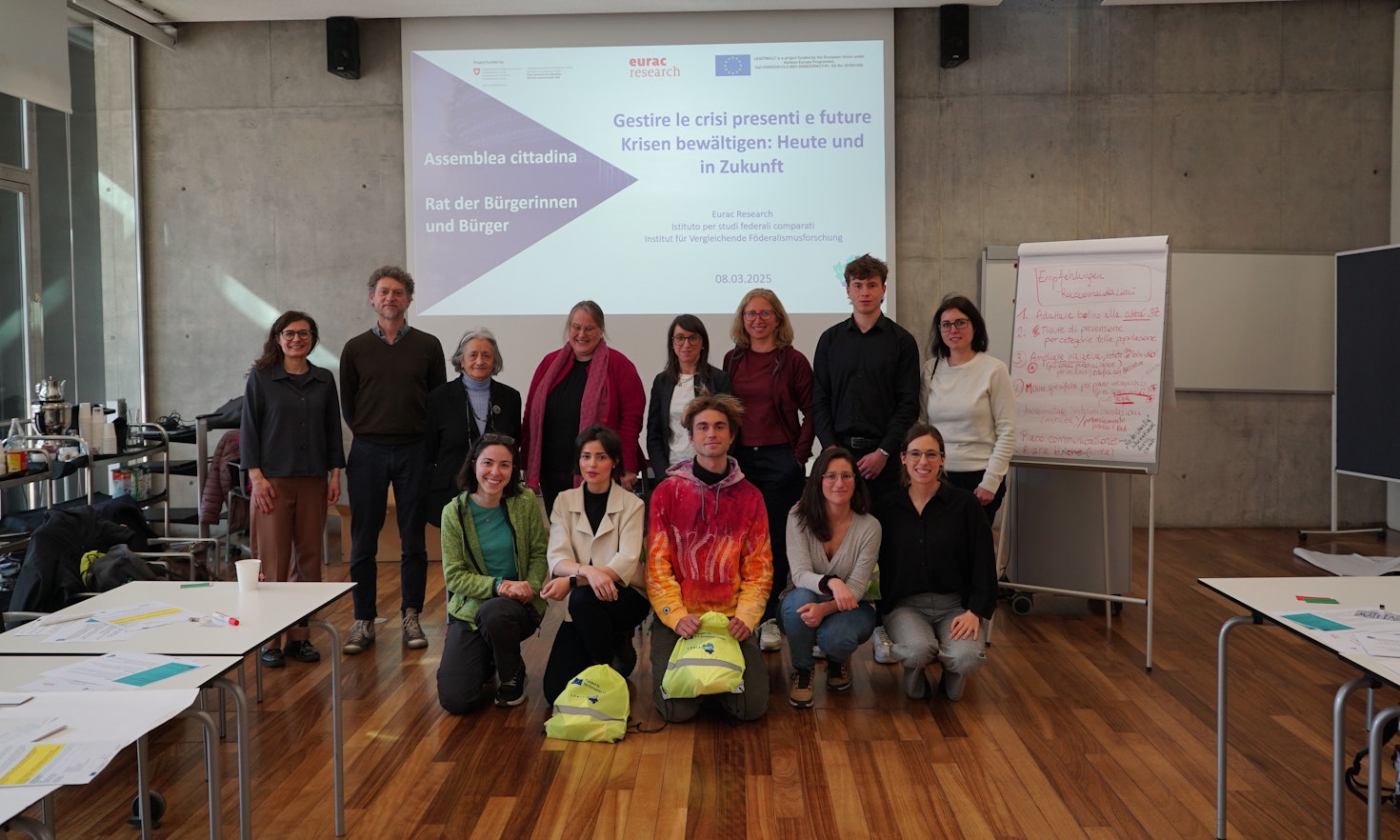
As part of the EU-funded LEGITIMULT project, the Eurac Research team organized a citizens' jury in Bolzano/Bozen on 8 March 2025 as a research activity. This initiative – along with three similar events in the pilot areas of Izola (Slovenia), Huldenberg (Belgium), and Bergen (Norway) aimed to engage citizens in a participatory democracy process to develop recommendations for managing current and future crises.
Citizens’ juries as democratic innovations
A citizens’ jury (CJ) can be considered a democratic innovation to the extent that it creates an opportunity to "reimagine and deepen the role of citizens in governance processes by increasing opportunities for participation, deliberation, and influence"1. In practice the term ‘democratic innovations’ (DIs) serves as a field and umbrella term aimed at rethinking the relationship between the State and society by increasing opportunities for civic participation. A citizens’ jury, alongside other democratic innovations like mini-publics, participatory budgeting, and collaborative governance, constitutes an additional democratic channel for citizens to participate beyond traditional forms of representation like elections or political parties which are the usual vehicles of mass participation.
In specific, a citizens’ jury is a participatory process of deliberation, in which a group of individuals elaborate some recommendations on a particular issue with the aim of influencing the policymaking of public authorities. The deliberative phase constitutes the core of the process, because it is there that citizens start contributing personal inputs to the discussion on the chosen topic of the CJ.
The citizens’ jury in Bolzano/Bolzano on crisis management
The CJ organized in Bolzano/Bozen focused on managing present and future crises and was conducted bilingually in both Italian and German. Titled "Gestire le crisi presenti e future" / "Krisen bewältigen: Heute und in Zukunft", it was organized with theoretical inputs coming from the project, which were adapted to the local context. A total of eight citizens showed up, despite previous confirmation of ten.
The selection of participants and their invitation occurred through three methods. The main method was a random sortition carried out through the statistical software of the municipality of Bolzano/Bozen which selected citizens based on age (18+), residency, and gender. The selected citizens were sent a paper letter with the invitation. Due to the low response rate this method was supplemented by an open call which was circulating both in an online version, and in print on bulletin boards of libraries, theaters, museums, bars, sports centers, civic centers, and shops. The combination of multiple methods proved efficient in reaching out to a variety of people from different age groups and social circles.
The event lasted a long morning of approximately six hours and was organized in different phases. After a general introduction on the topic of crisis management and the overall goals of the CJ, citizens delved deep into the topic through the theoretical inputs of three experts on the crisis-related aspects of "civic participation and trust", "risks", "local finance". These were presented as just a few of the many aspects public authorities need to consider when managing a crisis, like human rights and protection of minorities, respect for the rule of law, and the multi-level dynamics. After this experts’ input phase, the deliberative phase began consisting of three steps. The first, a brainstorming session where citizens were asked to agree upon a concrete crisis scenario for the city in 2030. Second, a discussion in which citizens could freely discuss the crisis scenario and identify key needs or issues. Third, a writing phase where citizens drafted concrete recommendations for the city council and other institutional or non-institutional actors. The last phase took place in plenary, where citizens presented their recommendations to the experts and a political representative from the municipality. They then voted on them according to their level of importance.
Citizens’ choice of the crisis scenario and recommendations
While the topic of the CJ was generally targeting present and future crises, it was the citizens who decided the concrete crisis scenario to work on. During the brainstorming phase, various crisis scenarios emerged, including overtourism, overload of healthcare facilities, and various types of climate crises. Among these, climate-crises scenarios were the ones perceived as more urgent by citizens. Divided into two groups of four each, they decided therefore to focus on the two crises scenarios of "heat waves" and "rising temperatures and water shortage".
Interesting to note is that despite the relatively short time allocated for the deliberative phase, both groups of citizens requested extra time for the discussion and came up with a total of ten precise recommendations. Among these, the two that received unanimous agreement as top priorities were: 1) the need for the creation of water reserves; 2) the proposal of introducing specific measures to combat heat in the municipal urban planning regulations (examples: increase green areas, install accessible drinking water points for everyone). Both were addressed to the municipality or the province of Bolzano/Bozen. Other recommendations, primarily aimed at the municipality, included: expanding existing initiatives for green areas and public spaces, creating new climate shelters, adapting risk detection and developing prevention measures for different age groups and population categories, and increasing restrictions on vehicle circulation.
Key takeaways for future similar DIs
These recommendations were presented to a political representative of the current municipal council and will also be presented to the new municipal council after the local elections in May 2025. In addition, they will be part of a comparative study alongside results from the other three pilot areas, as part of the LEGITIMULT research project. The first key takeaway is that it is fundamental to ensure the municipality's involvement in the follow-up. This, in fact, constitutes with no doubt the most important challenge of such a participatory process, and it is essential to avoid frustrating citizens' by not meeting their expectations and wasting their valuable time, trust, and resources.
The second key takeaway is the planning of a proper deliberation phase. It should be longer than the one originally planned 1.5 hours to allow for a deeper exchange between the citizens. Also, providing paper materials with data and other theoretical information could be useful.
To face the core challenge of participation fatigue, the third key takeaway is that using multiple channels and methods is crucial for reaching a wide variety of networks and circles. This would ensure that the notice of the event could reach not only those citizens that are regular participants to such events, but also citizens that are outside the usual networks and channels. This would also ensure greater heterogeneity among participants. Additionally, more diverse methods could be used at different stages of the sortition/invitation process to intervene as support in case one method fails.
Above all, it is important to properly define expected results and set realistic follow-up perspectives with citizens. Without this, such a democratic innovation risks being only a nice participatory exercise with no real impact or long-term commitment.

Chiara Salati
Chiara Salati is a post-doc researcher at the Institute for Comparative Federalism, Eurac Research. She received her PhD from the University of Macerata, with a thesis on the implementation of the principle of horizontal subsidiarity in Italian cities through the commons, from a wider European public law perspective. Her main research interests comprise participatory democracy and democratic innovations, cities and other local governments, subsidiarity, the commons, EU enlargement. She is a member of the research group Government and Law and the Metropolitan Legal Lab of the University of Antwerp. Since 2018 she collaborates with Labsus-Laboratorio per la sussidiarietà with action-oriented research on subsidiarity.
Discover
Making research visible.
Find the connected experts, projects, publications, and research areas behind this blog post.


This content is licensed under a Creative Commons Attribution 4.0 International license except for third-party materials or where otherwise noted.

This blog is part of the LEGITIMULT project. The project has recevied funding from the European Union's Horizon 2021 research and innovation programme under Grant Agreement No 101061550.








 My cookie preferences