


Funding for Polish-language media in Lithuania: winners, losers and an uncertain future
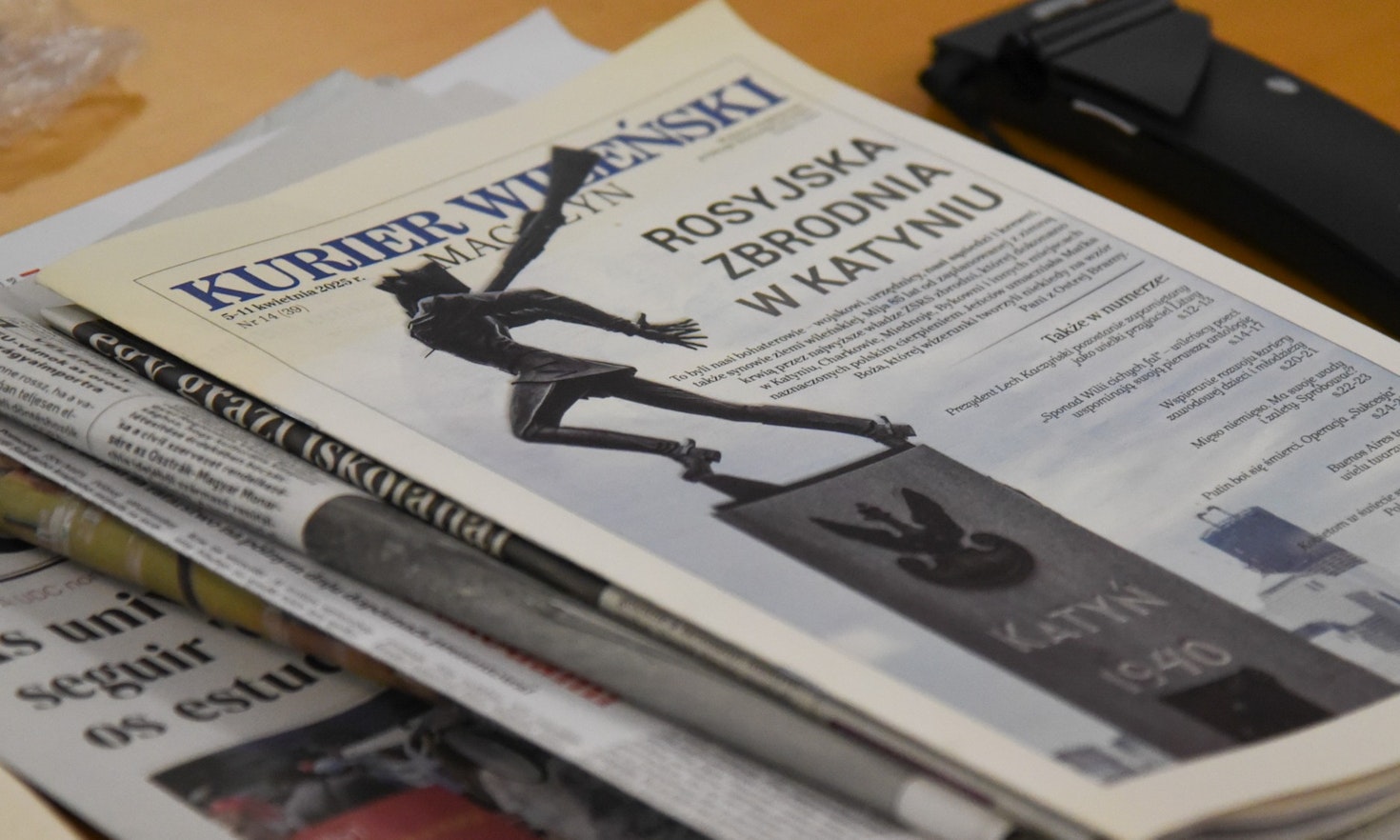
Polish-language media in Lithuania occupy a distinct place in the country’s media landscape, as their development has been shaped not only by Lithuania’s media policy but also by support from the Polish kin-state.
This analysis focuses on a group of outlets that together form the core of the Polish-language media space in Lithuania: Kurier Wileński, Radio Znad Wilii and its online portal ZW.lt, Wilnoteka, BM TV and TVP Wilno. Although they differ in format and organisational structure, ranging from newspapers and radio stations to online platforms, video projects and television, they all serve the Polish minority in Lithuania. Thus, they operate within the same information environment and form the most visible segment of the Polish minority’s media ecosystem. They compete for audiences, resources and public relevance while serving a community whose media consumption extends well beyond these outlets. Their role is shaped not only by local political and social developments but also by the broader regional information environment, where narratives disseminated by Russian and Belarusian state-controlled or state-sponsored media remain increasingly present and compete for public attention.
For years, these outlets operated within a relatively stable framework in which Warsaw served as the key guarantor of financial continuity and institutional survival, while Vilnius was often viewed with a greater degree of uncertainty and scepticism. In 2026, however, this long-standing arrangement was disrupted by a decision that few media managers or stakeholders in the sector had anticipated. The Polish government reduced its financial support for media operating in Lithuania, although the cuts were not applied uniformly and some outlets emerged as beneficiaries of the new funding arrangements. The decision quickly triggered concern among parts of the Lithuanian Polish-language media sector, with several representatives warning that the changes could undermine the sustainability of their outlets that considerably relied on support from the kin-state.
These developments should not be interpreted as evidence of a broader structural change in the system supporting Polish-language media in Lithuania. As before, these outlets continue to rely heavily on the limited resources available through various funding programmes, while questions about the effectiveness and priorities of existing support mechanisms remain. Nevertheless, the current situation revealed the extent to which external funding decisions can shape the sector’s development. Although the Lithuanian Media Support Fund (Lithuanian: Medijų rėmimo fondas) continues to play an important role, it was the financial decisions taken in Warsaw that had the most immediate and visible impact on the operation of Polish-language media in Lithuania.
Public funding for Polish-language media in Lithuania
The Lithuanian state provides modest support for minority media through the Media Support Fund. Although the Fund’s overall budget is limited, Polish-language media continued to receive support through programmes dedicated to minority media.
Among the beneficiaries was Kurier Wileński which received €29,595 in operational funding and an additional €10,000 for the project “Lithuania which unites all” (Lithuanian: Lietuva – kuri jungia visus). BM TV was awarded €9,839 for its activities. Radio Znad Wilii secured €10,000 for “Lithuania's Kaleidoscope” (Lithuanian: Lietuvos kaleidoskopas), a project producing daily five-minute news bulletins in Polish. In turn, Wilnoteka received €10,000 for its project Vilniana PL.LT 26.
Taken together, these allocations amounted to €69,434 in visible support for four Polish-language media outlets. While this funding is far from sufficient to ensure their long-term financial sustainability, it demonstrates that Polish-language media remained present within Lithuania’s system of minority media support despite broader budget constraints.
The most unusual case was Radio Znad Wilii. In the operational funding programme, the station received the highest expert evaluation score, 95 points, yet was awarded no funding. At the same time, it secured €10,000 from the Fund for a specific news project. As a result, the highest-rated applicant in one funding stream received no operational support while remaining a beneficiary in another.
Warsaw cuts funding
If Lithuania’s support for domestic Polish-language media in 2026 can be described as limited but relatively stable, the picture looks different on the Polish side. The results of the Senat–Polonia 2026 competition reveal a significant reduction in support for several media outlets operating in Lithuania. This raises questions about the future sustainability of some outlets that have significantly relied on funding from the Polish kin-state.
The most profound example is Radio Znad Wilii and its news portal ZW.lt. In 2025, the Polish Senate allocated PLN 750,000 (roughly EUR 175,000) to a joint media package covering both outlets. A year later, funding was awarded separately: PLN 197,750 for Radio Znad Wilii and PLN 120,720 for ZW.lt. In 2026, these two platforms received PLN 318,470. The reduction, amounting to roughly 58 per cent, was large enough to change the financial conditions under which both outlets operate.
Wilnoteka experienced a similar outcome. Its project received PLN 150,000, despite applying for PLN 500,000. Although the portal remained among the recipients of Polish funding, the allocation covered only a fraction of the resources that its management considered necessary for implementation.
The situation of BM TV appears even more uncertain. Publicly available records show that in 2025 the outlet was included in a broader Senate-funded project supporting media activities in Lithuania. In the documentation of the 2026 media competition, however, no comparable allocation can be identified. While the absence of funding cannot be established with absolute certainty on the basis of published documents alone, there is no visible evidence that BM TV benefited from the Senate’s media support programme in 2026.
Overall, these cases suggest that the issue was not the complete withdrawal of Polish support but rather a substantial redistribution and reduction of available resources. For some outlets, Warsaw remained an important source of funding. For others, however, the 2026 decisions introduced a level of financial uncertainty that had not been characteristic of the sector in previous years.
Towards restructuring of TVP Wilno
The changes affecting TVP Wilno differed from those experienced by other Polish-language media in Lithuania. Rather than simply reducing financial support, Polish decision-makers opted to restructure the broadcaster's operational model. During a meeting of the Senate Committee on Emigration Affairs and Communication with Poles Abroad on 7 January 2026, TVP announced that TVP Wilno's annual budget would be reduced from PLN 36 million to PLN 20 million, a decrease of approximately 44 per cent. According to the broadcaster, the objective was not to discontinue the project but to align its costs more closely with its production output and redefine its editorial priorities.
The restructuring was justified primarily on economic grounds. Explaining the decision before the Senate committee, Michał Broniatowski, Director of TVP's Foreign Media Centre, argued that TVP Wilno generated only around 10.5 hours of original programming during the analysed week, compared with 63 hours on Belsat and 67 hours on TVP World, despite operating with a substantially larger budget than its production volume appeared to justify. From the broadcaster's perspective, the cost of producing original content in Vilnius had become disproportionate to the channel's output. This reasoning reflected a broader shift in how Polish public media assessed projects aimed at audiences abroad. Rather than treating TVP Wilno primarily as an element of Poland's support for its kin-state community, the discussion increasingly focused on measurable outputs, production costs and organisational efficiency. As a consequence, the channel's schedule was reoriented towards news and current affairs, while much of its original programming was discontinued.
The restructuring nevertheless exposed a broader policy dilemma. For the Polish authorities, reducing costs and improving efficiency appeared consistent with wider budgetary pressures affecting Telewizja Polska. For many representatives of the Polish minority in Lithuania, however, TVP Wilno fulfilled a role that extended beyond conventional broadcasting metrics. As we previously claimed, the debate therefore evolved into a broader question of whether minority media supported by a kin-state should be evaluated primarily through financial efficiency or through their social, cultural and strategic significance.
Kurier Wileński as an exception
Against the backdrop of funding reductions affecting several Polish-language media outlets in Lithuania, the position of Kurier Wileński in 2026 stands out as a notable exception. The portal kurierwilenski.lt received PLN 344,260, while the daily newspaper Kurier Wileński was awarded PLN 337,900 and PLN 325,300 through two separate allocations. In addition, the newspaper’s weekend magazine received PLN 282,900 in two further tranches. Thus, the online portal, newspaper and magazine secured more than PLN 1.57 million in support. These figures challenge the notion that Warsaw reduced funding across the entire Polish-language media sector in Lithuania. The available resources did not disappear. Rather, they were distributed differently. While some outlets received support well below their declared needs and others lost visible access to funding altogether, Kurier Wileński remained a major beneficiary of Poland’s media support policy.
This suggests that the changes introduced in 2026 were not simply about reducing expenditure but also about redefining priorities. The outcome was a visible redistribution of resources within a relatively small media market. As funding levels diverged, so too did the relative positions of individual outlets.
At the same time, the case of Kurier Wileński raises broader questions about the criteria used to allocate support. The newspaper remains one of the most recognisable Polish-language media brands in Lithuania and occupies an important place in the history of the Polish community. Yet it operates in a media environment that has changed significantly over the past two decades, with audiences increasingly shifting towards digital, audiovisual and social media formats. Whether existing funding mechanisms sufficiently encourage adaptation to these changes remains open to debate. The 2026 allocations indicate that established institutions with a strong historical position continue to enjoy significant support, even as the media landscape becomes increasingly shaped by new formats, changing audience habits and growing competition for attention.
Conclusion
The funding decisions taken in 2026 in Warsaw demonstrated the continued vulnerability of the Polish-language media sector in Lithuania. Most of these outlets remain heavily dependent on public funding distributed through annual or project-based mechanisms. As a result, strategic planning often gives way to short-term adaptation to changing funding priorities, whether in Vilnius or Warsaw.
The developments addressed above also show that the issue is no longer simply one of financial support. The more fundamental question concerns the role that Polish-language media are expected to play in Lithuania’s contemporary information environment. If they are viewed merely as cultural institutions serving a national minority, existing support mechanisms may prove sufficient. If, however, they are also expected to contribute to media pluralism, information resilience and democratic participation, a more stable and strategically oriented model of support may be required. Such an approach would also require a broader discussion about the criteria used to allocate resources, including the balance between preserving established institutions and supporting media outlets that are able to respond effectively to changing audience habits, technological developments and the evolving demands of the information environment. Whether such a reassessment is taking place in Warsaw remains an open question.
Note: This article gives the views of the author(s) and does not represent the position of the European Association of Daily Newspapers in Minority and Regional Languages (MIDAS) or Eurac Research.
Vitold Jančis
Vitold Jančis is a multimedia journalist focused on political, social, and economic developments in the Baltic region. He has contributed to Deutsche Welle, Radio Liberty, Novaya Gazeta-Baltija, and RU.DELFI.lt. An expert in social media disinformation and recipient of international journalism grants, he is fluent in Lithuanian, Polish, Russian, and English.

Kiryl Kascian
Dr. Kiryl Kascian is a head of the Centre for Communication Influences and Propaganda Research, Vilnius University. He holds a doctoral degree in law from the University of Bremen. His research interests include communication influences, political communication, interethnic relations, electoral behavior, minority rights, and constitutionalism, and he has extensively published and provided his expertise internationally on these topics.
Discover
Making research visible.
Find the connected experts, projects, publications, and research areas behind this blog post.


This content is licensed under a Creative Commons Attribution 4.0 International license except for third-party materials or where otherwise noted.








 My cookie preferences