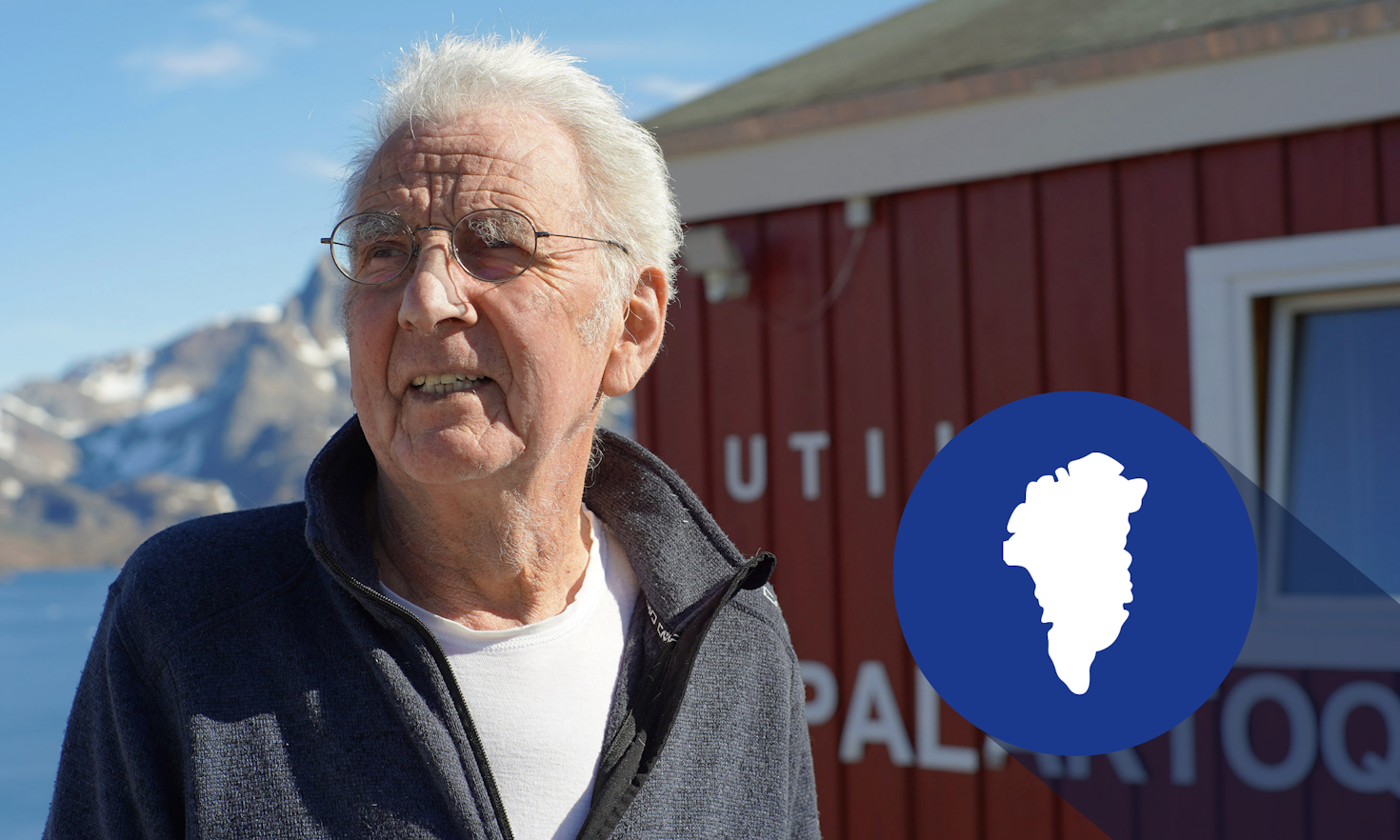
At the margins of a lecture about current developments on the Arctic island, Robert Peroni, who has lived in Greenland for 40 years, shared personal insights. Günther Rautz caught up with him for an exchange on his life’s work, the “Red House”, and the new geopolitical challenges.
Günther Rautz: Forty years ago, you came to Greenland as an extreme athlete as part of an expedition, which changed the course of your life.
Robert Peroni: Yes, that’s true — and it completely changed my life, (he says with a laugh). My second home became Tasiilaq, the main town on Greenland’s east coast. About 2,000 people live there, on a thin strip of ice-free land between the massive inland ice and the Arctic Ocean. Just behind the town, the ice sheet can be up to three kilometers thick.
Rautz: Let’s talk about your life project, the Red House. How did it all begin?
Peroni: I started the Red House more than 30 years ago with the idea of creating jobs and new opportunities for people in Tasiilaq, because the local culture was really in a difficult situation. The traditional nomadic way of life — based on hunting marine mammals like seals, whales, and polar bears, and also fishing — was losing its foundations. That was partly because of animal- and environmental-protection campaigns, trade boycotts, and increasingly also because of climate change.
When I first came there, tourism didn’t really exist at all. Today, the Red House provides work for around 65 local Inuit, and it has become a place where visitors from the West and Greenlanders can meet, exchange ideas, and get to know each other.
“We – the Red House Team – mediate with much joy the differences and similarities of the Greenlandic and European lifestyles with all their facets. Thus we like to contribute to intercultural understanding and acceptance to the good of both cultures in a rapidly changing modern society.”
Robert Peroni
Rautz: What would you say are the biggest cultural differences?
Peroni: Sixty years ago, the people in East Greenland were still living in conditions that were, in many ways, comparable to the Stone Age. Their lives were based on hunting seals and polar bears. They lived in turf huts, hunted with spears, and used bone knives as tools. Their clothing was made from the skins of the animals they hunted — seals and polar bears.
What fascinated me most was the relationship between people and nature. I quickly made friends with Greenlanders and met people who think very differently from us in the Western world. For me, it was incredibly interesting to encounter a society that is almost the opposite of ours. In many ways, what we see as positive in the West can be viewed negatively there — and vice versa.
Rautz: How did communication work at the beginning? Greenland's official language is based on the West Greenlandic idiom but how is the situation in the Eastern part?
Peroni: Greenland was colonized by Denmark starting in 1733, and a lot of damage was done during that time. There were very difficult chapters in this history — including the removal of children from their families and forced sterilizations, which still happened in the decades after the Second World War. One of the biggest problems today is alcohol. Alcohol was originally unknown to the Greenlanders before it was introduced from outside. At the same time, Greenlanders have to deal with enormous global changes. Their traditional identity as a hunting culture is increasingly being questioned. When people can no longer live from hunting or contribute to their family in the traditional way, it creates a deep crisis of identity.
In the past, a hunter who could no longer provide for his family sometimes felt he had no place in the community anymore. That sense of worthlessness can still exist today, and it is one of the reasons why the suicide rate in Greenland remains very high.
“East Greenland needs a sustainable future for the people who live there under extreme conditions. The Red House, as a place of encounter and at the same time a shelter for those in need, wants to continue to guarantee this.”
Robert Peroni
Rautz: That brings me back to the Red House. So it’s also a social project?
Peroni: Over the years, the Red House has grown into a small hotel with about 20 beds, because more and more tourists have started coming to Greenland. Through that, I’m able to provide jobs for some local people and help them reintegrate into society.
When the first visitors came to East Greenland, there were maybe 12 tourists in total, and they were welcomed almost like close friends. But as time went on, more and more visitors arrived, and at some point it could feel like too much for the Greenlanders. One person once said to me, “Too many of your friends are coming.”
Today we’ve found a good balance. I try to promote a form of sustainable tourism that respects both the land and the local people. I involve Greenlanders as well as guests, and the income we generate is reinvested in social projects — for example, programs that support people struggling with alcohol.
Rautz: Before we finish, how do you assess the current political situation from the perspective of the Greenlanders?
Peroni: Greenland received extensive autonomy from Denmark in 1979. After Denmark joined the European Community in 1973, a special status was meant to protect Greenlanders’ fishing revenues from the European single market. In 1985, Greenland even left the EU territory and has since been classified as an Overseas Country and Territory in its relationship with the EU.
In 2008, about 76% of Greenlanders voted for further expanding their autonomy. Many political leaders see independence from Denmark as a possible long-term goal, but not something that will happen immediately.
What is very clear, however, is that the people of Greenland value their freedom and self-determination very highly. Recent territorial ambitions expressed by U.S. President Donald Trump have only strengthened that feeling.
Instead of geopolitical pressure or threats, what Greenland really needs is international cooperation. The Arctic island is strategically very important, but the priority should be helping the Inuit adapt to global warming in a dignified way and ensuring that Greenland’s natural resources — its minerals, as well as gas and oil reserves — are developed responsibly.
Note: This article gives the views of the author and does not represent the position of the European Association for Daily Newspapers in Minority and Regional Languages (MIDAS) or Eurac Research.

Robert Peroni
Forty years ago, the South Tyrolean extreme athlete Robert Peroni came to Greenland on an expedition that changed his entire life. Today, the 82-year-old lives in Greenland and visits South Tyrol several times a year. In 2023, Robert Peroni founded “The Red House Greenland Foundation”, a charitable foundation. The foundation aims to ensure the continued existence of the Red House in Tasiilaq in East Greenland and thus offer the local population future prospects in this remote region. The protection and development of the natural and cultural heritage of the East Greenland region and the improvement of the quality of life of the local population within the Red House’s sphere of influence are the primary objectives.

Günther Rautz
Günther Rautz is the Head of the Institute for Minority Rights at Eurac Research in South Tyrol, where he has worked since 1997. He focuses his research on minority protection and human rights in Europe and internationally, including advisory work for the Tibetan community in exile. He has contributed to reports for the Council of Europe and the OSCE, and has co-authored commentaries on the Framework Convention for the Protection of National Minorities. He also helped to draft recommendations for the 'Minority Safepack Initiative', a European Citizens' Initiative. Until 2017, he served as General Secretary of the European Association of Daily Newspapers in Minority and Regional Languages (MIDAS), promoting media in minority and regional languages.
Discover
Making research visible.
Find the connected experts, projects, publications, and research areas behind this blog post.
This content is licensed under a Creative Commons Attribution 4.0 International license except for third-party materials or where otherwise noted.