
What happens to the human body when an avalanche buries it?
Environmental variables and the Triple H Syndrome
One memory prevails among those who have survived being buried by an avalanche: they did everything they could to avoid being engulfed by the mass of the snow, and once buried, they struggled to clear the snow from around and even inside their mouths. Some recall moving their heads back and forth to create a pocket of air, others describe pushing their tongues past their lips, or at least trying to, before realizing in terror that their tongue couldn’t even extend beyond a millimeter...
Before a gradual numbness which accompanies the victim into unconsciousness, the first sensation they experience is an overwhelming hunger for air.
Breathing becomes strenuous, the heart rate rises, and the need for air intensifies in a vicious cycle that proves fatal for roughly two-thirds of victims. This is the estimated proportion of those who succumb to asphyxiation within the first 35 minutes of burial.
The reasons why some individuals survive longer than others – sometimes by tens of minutes –are still not entirely clear. Gaining a better understanding of these factors could lead to more effective measures to protect those at risk of avalanches, including ski mountaineers as well as mountain workers involved in environmental surveys or infrastructure maintenance.
Two-thirds of avalanche victims die from asphyxiation within the first 35 minutes of being buried.
The fact is that what happens to the human body when it is buried by an avalanche depends on several factors that act simultaneously. On one hand, there are the environmental conditions; on the other, there are three bodily responses that, although better understood clinically when considered individually, interact in ways that complicate the situation.
And, of course, studies to analyze these environmental and clinical interactions are not common: they are very difficult to organize under standard and repeatable conditions, and must contend with ethical limits to avoid putting participants at too much risk.
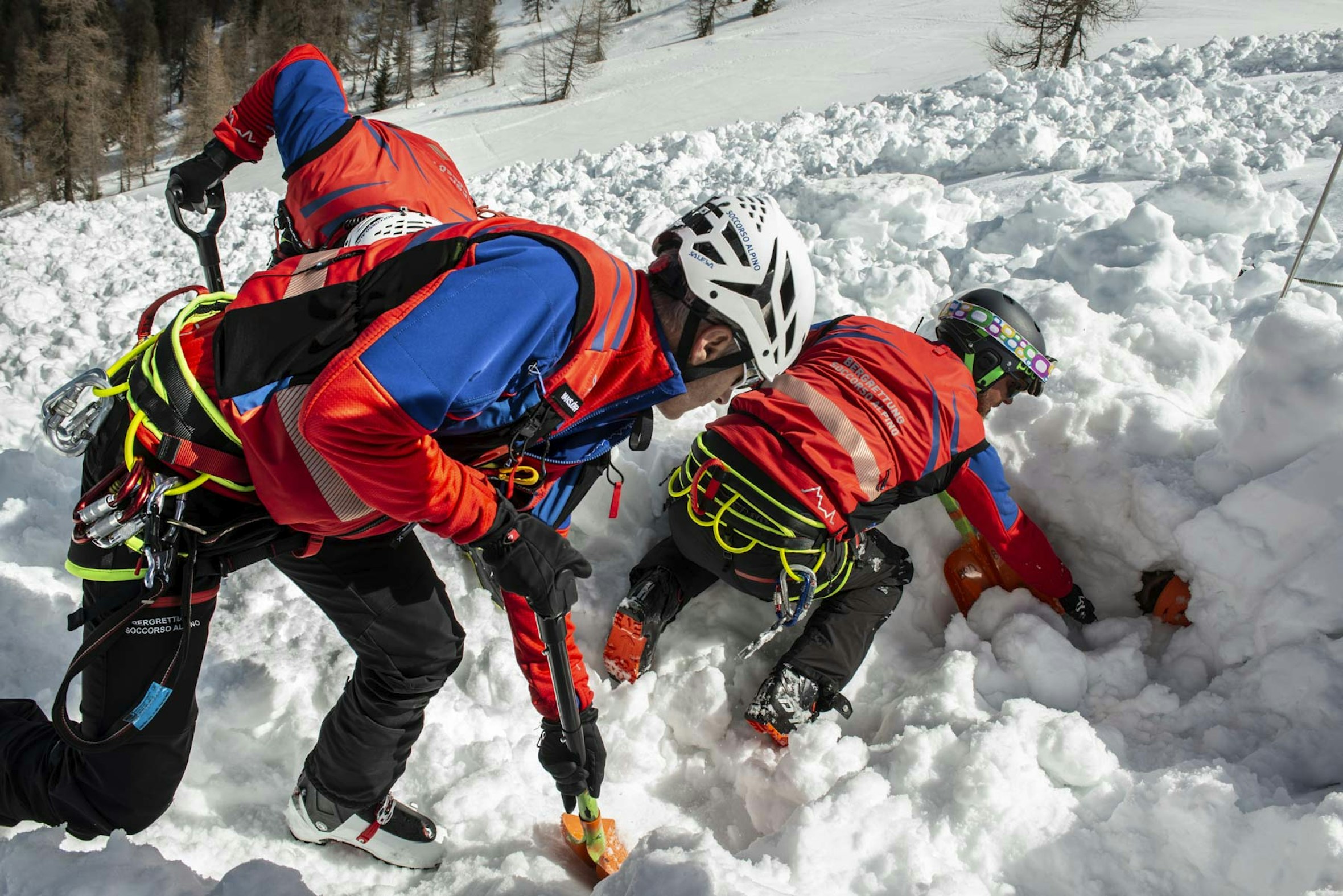
Plan de Corones, a drill organized in a real avalanche by Alpine Rescue, Guardia di Finanza, and the Institute for Emergency Mountain Medicine of Eurac Research
Credit: Eurac Research | Ivo CorràWhat is the Triple H Syndrome?
Avalanche victims are exposed to hypoxia, hypercapnia, and hypothermia. Hypoxia occurs when there are low levels of oxygen in the body; during the Covid-19 pandemic, many learned that an oxygen saturation below 90-92 percent is a red flag. Hypercapnia refers to high levels of carbon dioxide in the body, caused when a person breathes in the gases they exhale. Hypothermia is an internal temperature below 35°C. In a body buried in snow, these clinical conditions coexist, and their interaction has been titled the Triple H Syndrome. This syndrome was first described by physician and researcher Hermann Brugger in 2001, and derives from the three terms described. Each of these clinical conditions has been extensively studied individually. For example, hypoxia is well known thanks to numerous studies on voluntary apnea – the sport in which divers submerge themselves while trying to hold their breath for as long as possible – as well as research conducted on individuals traveling to high altitudes. Accidental hypothermia is familiar in emergency medicine from various contexts: homeless individuals living outside during harsh winters, mountain or open-sea accidents in low temperatures, and similar cases.
If oxygen deprivation comes first, followed by cooling – which is what happens to a body buried under an avalanche – then hypothermia has little to no neuroprotective effect.
What distinguishes avalanche victims is that these three conditions may occur simultaneously in their bodies, influencing one another, which means that knowledge gained from studying them individually may no longer be valid. For example, under normal circumstances, hypothermia protects the body by slowing down all vital functions and metabolic (i.e., energy) demands, allowing the body to consume less – essentially putting itself in standby mode while waiting to be rewarmed. Specifically, various studies have shown that brain metabolism slows by five percent for every degree Celsius decrease in brain temperature. However, in avalanche victims, this protective function is compromised: despite that hypothermia slows metabolism, it appears that hypercapnia is the main cause of cardiovascular instability, which in turn is the primary reason for reduced brain oxygenation. In other words, hypercapnia and hypoxia worsen the damaging effects of hypothermia, outweighing its benefits.
Another example: avalanche hypothermia victims are usually younger and in good health compared to victims of accidental hypothermia in urban areas, who are typically homeless. Yet data shows that the homeless individuals have a higher chance of surviving accidental hypothermia than avalanche victims if they experience hypothermic cardiac arrest far from a hospital and are treated with extracorporeal rewarming – 57 percent versus 12 percent. The survival rate is lower for victims who were completely submerged in cold water, including their heads –19 percent –but still higher than the 12 percent for avalanche victims. Why? The hypothesis is that hypoxia and hypercapnia play a role. Survival seems to depend on whether hypothermia occurs before hypoxia – that is, if the body cools first and then oxygen deprived. If hypoxia occurs before hypothermia, which is what could happen to a body buried in an avalanche, oxygen deprivation comes first and cooling follows, hypothermia has little to no neuroprotective effect.
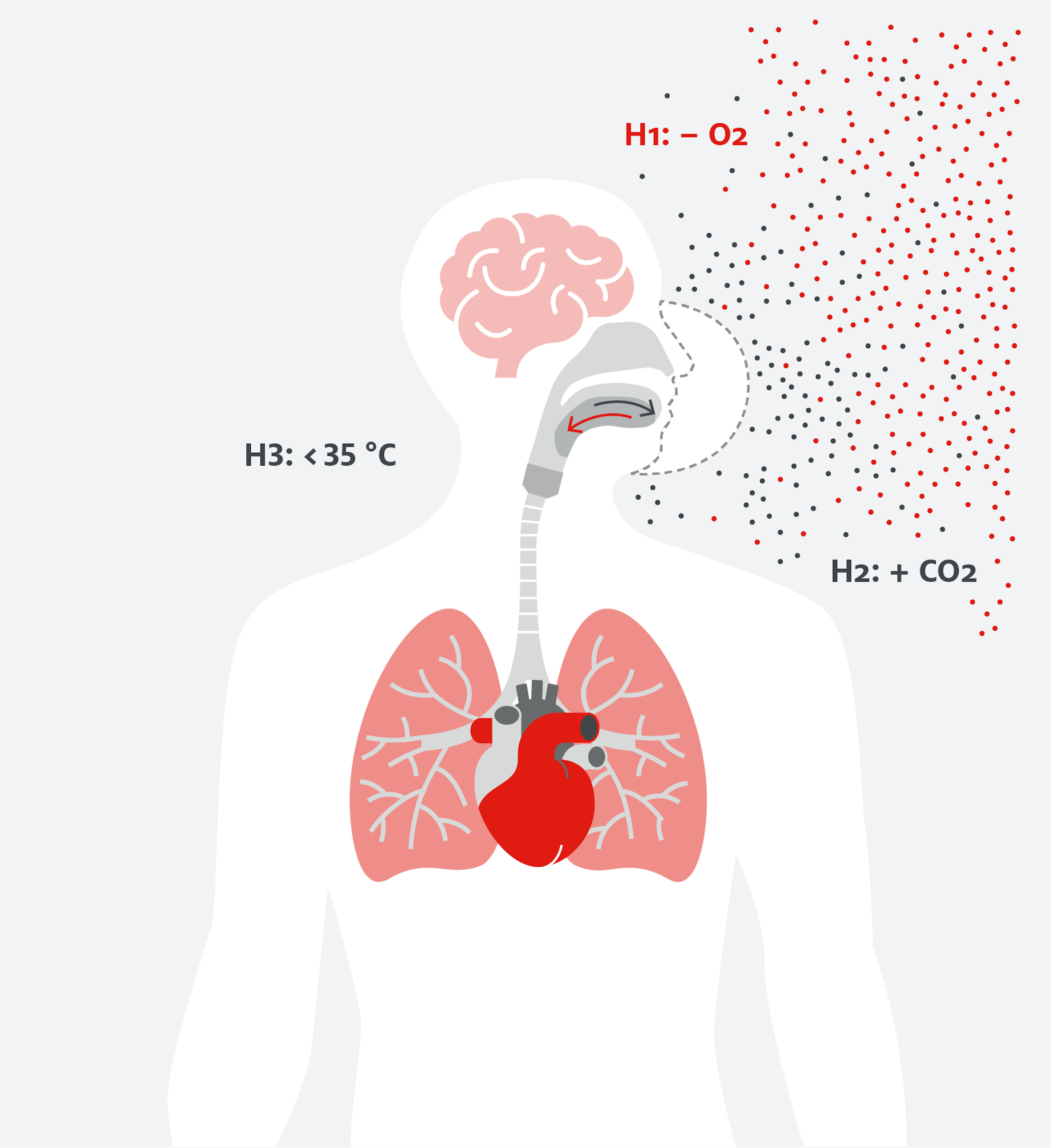
The Triple H syndrome represents the interaction between hypoxia, hypercapnia, and hypothermia that occur in avalanche victims. It affects the respiratory system, the cardiovascular system, and the brain.
Credit: Eurac Research | Silke De Vivo
The other Triple H Syndrome
What happens to a body when it is buried by an avalanche depends greatly on environmental conditions: the way in which it is buried, the type of snow, and the burial time. The time spent buried is a crucial variable as revealed through a recent study conducted by Eurac Research, based on data from the Swiss WSL Institute for Snow and Avalanche Research confirming that rescues carried out within the first ten minutes are the key to survival.
The degree of burial is also important: if the airways are open, hypoxia will be less severe. As shown by a comparative analysis of data collected in Switzerland and Austria between 2005 and 2013 on 633 victims buried in what is called a “critical” manner (i.e., with the chest and head under the snow), if there is an air pocket in front of the mouth, hypoxia is delayed for a time proportional to the size of the pocket: the larger it is, the longer the oxygenation lasts. In conditions of hypothermia, with a slowed metabolism, but with the possibility of breathing “through” the snow, a body could survive for hours, unconscious, as demonstrated in the case of a skier who was rescued after 23 hours under an avalanche in the South Tyrolean Alps in 2023 (see the informative article and the scientific paper).
The density of the snow also plays a role: wetter snow “cements” and obstructs the passage of air, while drier, powdery snow allows a bit of oxygen to filter through and enables the exhaled gases to disperse. A study comparing Swiss and Canadian data showed that, under the same conditions, in areas with denser snow, like in Western Canada, victims are more likely to suffer a hypoxic cardiac arrest due to insufficient oxygen supply and excessive CO2 buildup.
In 2023, Eurac Research organized the world's first study in which around thirty participants were completely buried under the snow.Video: Eurac Research
Confirmations in this regard were sought from the first study in the world where around thirty participants were fully buried under the snow, conducted by the Eurac Research team stationed in Dolomites during March 2023. Throughout the trials, the research team continuously monitored the oxygen saturation, various cardiovascular parameters, and the frequency and depth of the volunteers’ breathing. The team also checked the snow density in collaboration with the Swiss WSL Institute for Snow and Avalanche Research and studied the ratio between oxygen and carbon dioxide during breathing in the snow.
Trauma as its own aspect, is relevant and fatal in up to 18 percent of cases, its characteristics are similar to those of traumas occurring in other contexts.
 technical documentation
The scientific publication








 My cookie preferences