
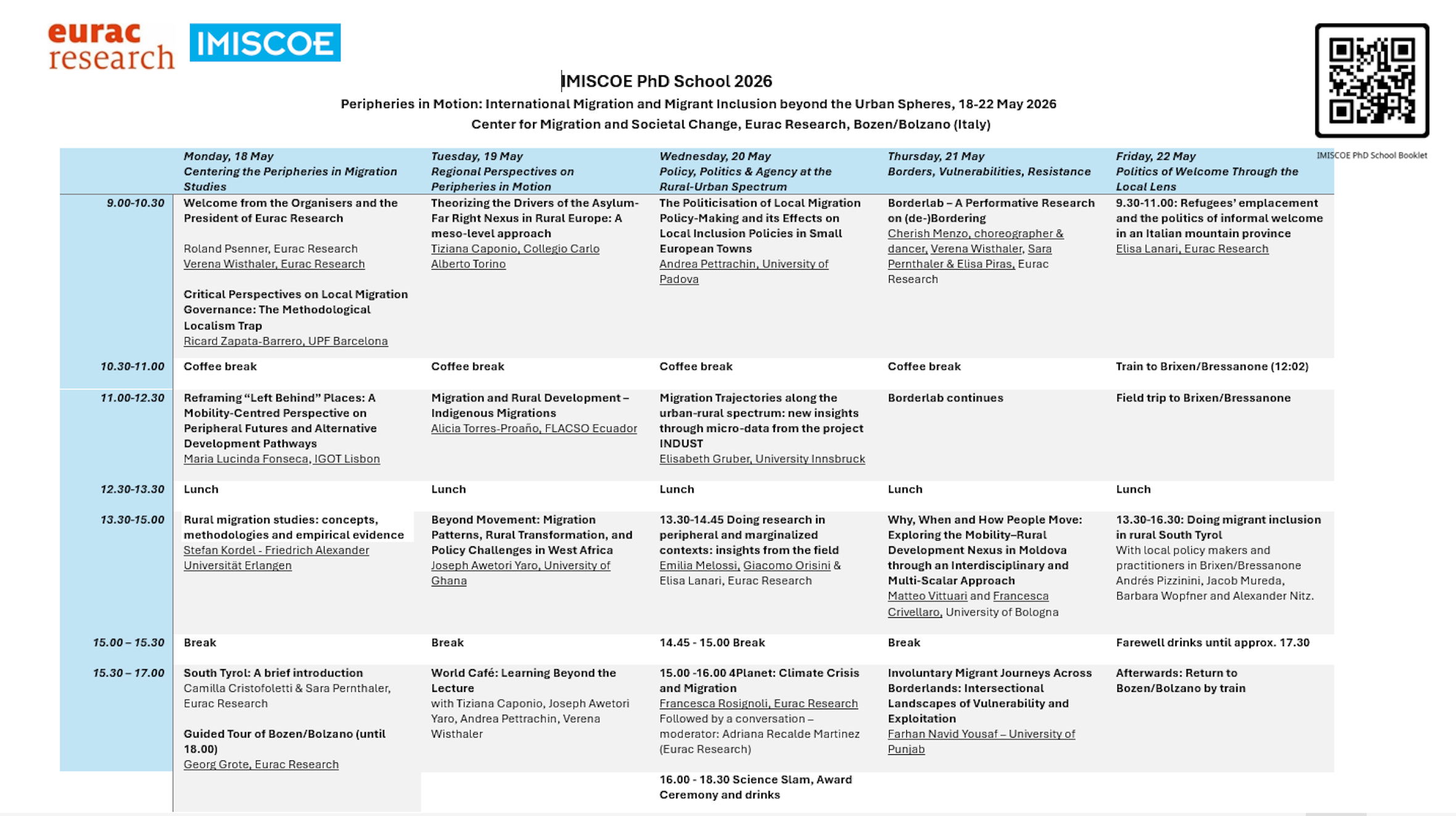
From May 18 to May 22 the Center for Migration and Societal Changes hosts the IMISCOE PhD School 2026
Institutes & CentersCenter for Migration and Societal Change - News - Kick-off IMISCOE PhD School 2026


The 2026 IMISCOE PhD School explores international migration dynamics beyond the urban context and shed light on the nexus between space and place. A significant amount of migration happens outside urban centers, in and out of rural and remote contexts, hinterlands, and border areas. The space outside the urban centers is multiple and heterogeneous, ranging from politically and/or economically peripheral and marginal places, characterized by low population density, less dense infrastructure, and a focus on close-knit communities to areas which are geographically peripheral yet economically advanced, with great innovative potential. Peripheral locations worldwide experience unique yet very diverse challenges and opportunities in migration governance, inclusion, and socio-demographic transformations.
This PhD School critically reflects on the notion of periphery and its implications for migration dynamics. It will cover theoretical, empirical and practical approaches to migration beyond urban centers. Lectures and seminars by top migration scholars will be complemented by interactive role plays and hands-on workshops. This IMISCOE PhD School also aims to provide not only interdisciplinary scientific excellence in teaching and training, but also a space for peer-to-peer interactions, exchanges, learning and networking. We recognize that access to academic training is shaped by structural inequalities, and we are committed to fostering an inclusive and equitable learning environment. This PhD School aims to create a space where diverse voices, experiences, and perspectives are not only welcomed but actively valued.
The PhD School addresses the complex intersections of place, governance, identity, economy, and mobility in peripheral regions through six major themes:
- Theorizing the Peripheries in Migration Studies
- Peripheral Migration Governance in a comparative and global perspective
- Demographic Change and Community Revitalization
- Labour, Economy, and Innovation in the Periphery
- Intersectionality and Belonging in Peripheral Areas
- Climate Change, Environmental Crisis, and “Left-Behindedness”
The Program








 My cookie preferences