


Fivefold
A wearable device offers greater safety prospects for avalanche victims, with one caveat.
March 2023, avalanche simulation in the Dolomites at an altitude of approximately 2000 m. Over fifty centimeters of snow covering 24 volunteers lying face down. Half of them have a device integrated into their backpacks that draws air from the snow surrounding their backpacks and pumps it into the upper chest area. The other half have similar backpacks, but with a non-functioning (sham) device. Of the “control group,” four of the 12 volunteers asked for the experiment to be stopped because they did not feel well, and seven remained buried for a median duration of 6.4 minutes before their oxygen saturation fell below 80 percent and the experiment was stopped as required by protocol. No trial in the group equipped with the functioning device was stopped due to oxygen saturation dropping below 80 percent: the median burial time was 35 minutes, the maximum duration planned for the experiment. (In one case, the test was stopped earlier, but not because of hypoxemia.) In other words, in a real-life situation, emergency services or the victim’s companions would likely have had more than five times as much time to respond, and potential cardiac arrest would occur much later.
When the Norwegian company that manufactures the Safeback SBX device which is already on the market, approached Eurac Research to have it independently tested, it was clear that the international research team led by physician and researcher Giacomo Strapazzon would publish the results of the study in any case, regardless of the outcome.
For the researchers, the experiment posed a significant challenge, as many participants were completely buried in snow, raising concerns that over two-thirds might require urgent excavation. The volunteer group – composed entirely of enthusiastic ski mountaineers, roughly half of them women – ranged from 23 to 54 years in age. Despite the demanding conditions, the study was conducted under strict monitoring and safety protocols, and everything proceeded smoothly.


A participant is buried face down under about 50 centimeters of snow.
Credit: Eurac Research | Marina BaldoAhead of the coming winter season, after careful analysis and verification, the results of these extreme tests are being published and offer reassurance for all mountain enthusiasts.
“No device can replace precautionary measures,” explain Frederik Eisendle and Giacomo Strapazzon, lead authors of the study and members of the Eurac Research team. “Prevention remains the most important tool for saving lives in the mountains. However, our clinical trial shows that this device is highly effective in prolonging survival under the snow and can gain valuable time for rescue operations.”
“Considering that asphyxiation is fatal for about two-thirds of critically-buried avalanche victims and death occurs on average within the first 35 minutes, the fact that none of the people involved in the test fell below the 80 percent saturation threshold during this time is truly remarkable,” the physicians continue.
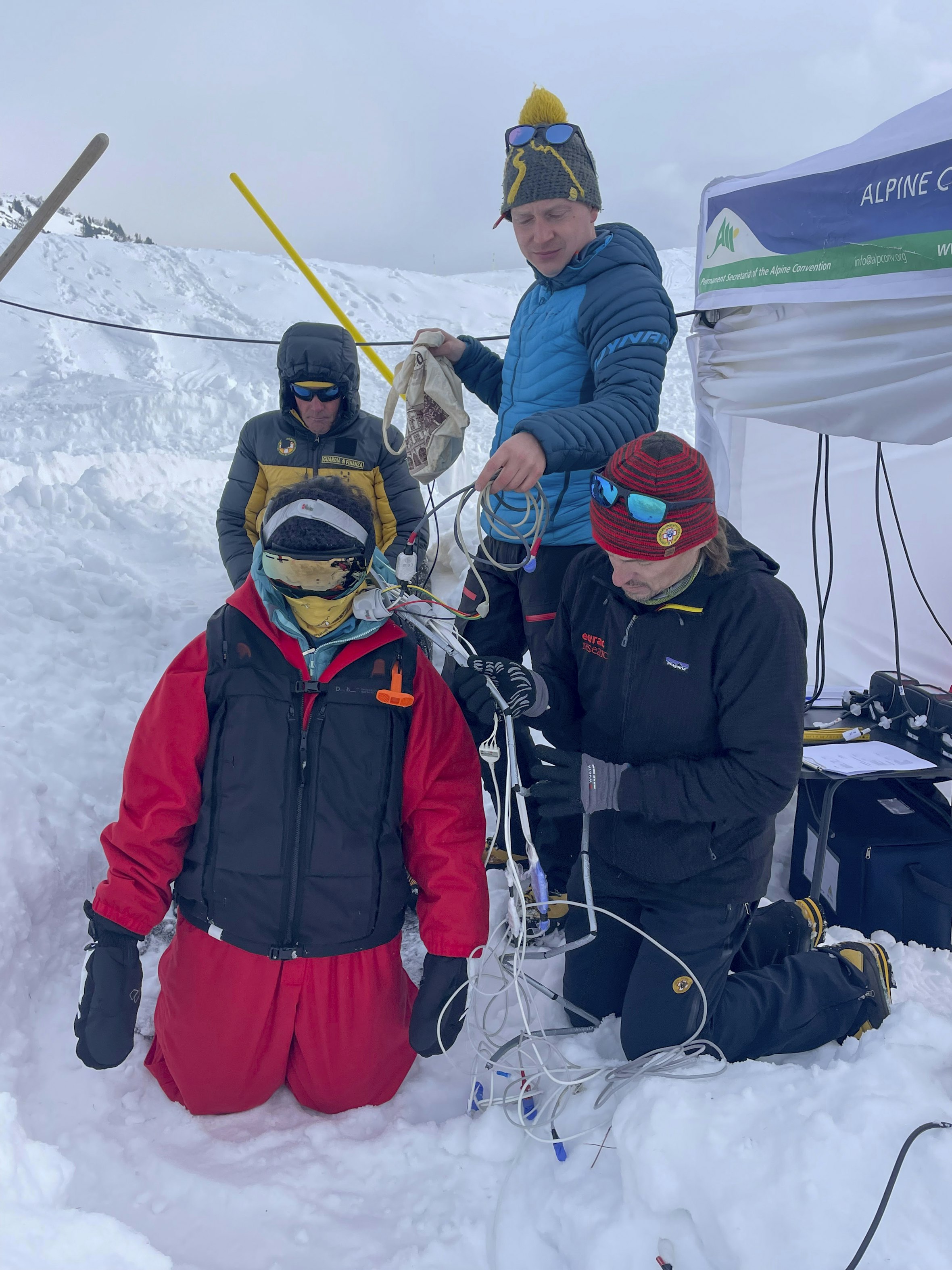
Participant ready for burial. Giacomo Strapazzon (kneeling) and Frederik Eisendle (blue jacket) both are researchers and doctors who led the study.
Credit: Eurac Research | Maurizio GretterThe tests were conducted by Eurac Research in collaboration with the University of Bergen, the Haukeland University Hospital (Norway), the Norwegian Air Ambulance Foundation, the Italian national search and rescue organization Corpo Nazionale del Soccorso Alpino e Speleologico (CNSAS), the WSL Institute for Snow and Avalanche Research SLF (Switzerland), the University Hospital Cologne (Germany), the Medical University of Innsbruck (Austria), and the University of Padua (Italy). Logistical support was provided by the Scuola Alpina Guardia di Finanza (SAGF)and the staff of the Rolle Pass ski lifts.
The device exploits the natural porosity of snow—a principle first demonstrated by the same research group—to deliver oxygen-rich air to the nose and mouth via an electric pump. Once activated by a handle on the backpack, the Safeback SBX supplies up to 150 liters of air per minute for as long as 90 minutes. This airflow allows even a small air pocket to sustain a buried person with patent airways for over 35 minutes, despite the accumulation of exhaled carbon dioxide.








 My cookie preferences