


What goes wrong in public services when disability and gender identity intersect
A conversation about concrete experiences and structural issues
What obstacles might women or non-binary people with a disabilities encounter upon entering a public service facility in Italy?
Carla M Reale: The first thing that comes to mind is sexual and reproductive health services. In Italy, family planning clinics and gynecological services are largely inaccessible to both groups. These settings clearly reveal one of the most evident forms of discrimination at the intersection of gender and disability, both in the barriers people face and, in the quality and effectiveness of care they receive.
Elia Z Covolan: You know, obstacles are even encountered before accessing services. An important and well-known aspect of inclusivity is structural accessibility: the barriers that prevent access to a space, such as a lack of reserved parking spaces, steps or steep ramps, non-functioning elevators, and so on. There are regulations governing these aspects, but that doesn’t mean things always work as intended. A second aspect to consider concerns accessibility to information and communication: is the person with a disability using the service able to find their way around and ask for information independently?

Il problema non sono solo le scale: se il banco informazioni è alto, una persona in sedia a ruote farà fatica a comunicare con la persona allo sportello.
Credit: Adobe Stock | narong | All rights reservedGive me some examples.
Covolan: From a visual standpoint, I think of situations where signage doesn’t take into account the needs of color blind people. One example is when color is used as the sole means of conveying information: color blind people can interpret traffic lights based on the position of the light, since they cannot rely on colors. Text and backgrounds with low contrast can also be problematic, as can non-functional color combinations; for example, red text on a black background is unreadable for many people. Informational material must adhere to layout criteria such as being left-justified and having line spacing and font size that allow for easy reading. The layout style I call “Bible-style” which is the same as that used in newspapers is often used to save space by compacting justified text into columns, but it creates many problems. These are established social practices that do not change, and unfortunately complicate life for people with disabilities. For the web, however, there are general accessibility guidelines, the WCAG, which fortunately are becoming increasingly widespread and respected.
“In Italy, sexual and reproductive health services reveal one of the most evident forms of discrimination at the intersection of gender and disability”.
Carla Maria Reale, legal scholar
These are obstacles that a man with a disability would also encounter. Let’s return to the original case with its specific details.
Covolan: Certainly. To start off then, a question: are gynecological chairs adapted for women in wheelchairs
Reale: Very rarely. And then there is the issue of training and the approach of staff. At the root there are two problems. On the one hand, disability is too often reduced to pathology, and medical practitioners often adopt an approach that does not center the person’s needs and their capacity to choose, even more so when the person has a disability and, due to widespread stereotypes, these people are often subjected to a certain infantilization. On the other hand, the gender dimension is clearly underrepresented in medical studies. When these dimensions intersect, the obstacles grow exponentially.
An example: it is almost taken for granted that a person with a disability does not have a sexually active life, and therefore there is a lack of accessible pathways for the prevention of sexually transmitted infections or, more simply, adequate informational materials, for example in easy-to-read language. If the person also belongs to the LGBTIQ+ community, this information will often be poorly suited to describing specific experiences and needs. There are exceptions that give me hope, such as the LISEA counseling service on sexuality and relationships by Lebenshilfe here in South Tyrol or gynecological clinics for women with disabilities, for example the “Dd – Women with disabilities” service at the Sant’Anna hospital of the City of Health and Science, established in Turin in 2008, but there are few of them, today in Italy we only have about four of these clinics.
“Even if we are not talking about intentional discrimination, after a while you get tired of having to be the one providing the tools so that medical staff can do their job”
Elia Zeno Covolan, visual designer and accessibility expert
What does this actually mean for women or non-binary people with disabilities?
Covolan: Sometimes it means being forced to come out. A concrete case: if you are a trans man and, in the public registry, you are recorded as male, you will no longer receive screening invitations for Pap Tests. You have to try to contact the relevant offices yourself, being bounced between different departments. Each time the medical staff is caught off guard, and you are forced to explain and re-explain why these check-ups also concern you. If this person also has a disability, given the inaccessibility of these services, the likelihood of actually being taken into care is extremely low because there are too many obstacles to overcome. Even if we are not talking about intentional discrimination, after a while the frustration is significant. After a while you get tired of having to be the one providing the tools so that medical staff can do their job.
Even if we are not talking about intentional discrimination, after a while the frustration is significant. After a while you get tired of having to be the one providing the tools so that medical staff can do their job.
“Every unexpected body that does not fit into a bodily or mental model that we consider “normal” is not taken into account”
Carla Maria Reale, legal scholar
But if there is no intentionality, couldn’t some time be invested upfront to find a technical solution to eliminate at least part of these bottlenecks? It is true that these are statistically limited numbers, but once resolved, time would no longer be lost every time a case arises. Or am I wrong?
Covolan: Of course! To return to the issue of prevention, it would be enough to add boxes to tick. Let me give you another simple example concerning the tax code, which is an alphanumeric sequence calculated on the basis of name, surname, place and date of birth, and also sex. If I change my registered gender, or even if I get married and change my surname, my tax code changes, with all the problems you can imagine. It would be enough to use a unique sequential number, as with car license plates…
Reale: However, we must not forget that there is a very strong structural issue that links ableism, sexism and heteronormativity. Every unexpected body, every unexpected need that does not fit into a bodily or mental model that we consider “normal” and therefore healthy is not taken into account. In the same way, identities that fall outside heterosexuality and cisgenderism are not considered. That’s not by chance: until recently they were even pathologized. In this sense, a profound process of change in the underlying mechanisms that generate inequalities must be initiated, otherwise even the simplest issues will not be resolved.
Can you suggest a small positive step?
Reale: Always involve people when talking about them. Even if it is just about understanding which words to use to refer to them. We will certainly do this for the SEEDS project, which has just started, through which we aim to align local legislation and policies with international and supranational standards.
Covolan: Do you see this lanyard, green with small sunflowers? Here it is still not very widespread, it was invented in the UKand indicates that the person wearing it has an invisible disability. Yes, this too is a form of coming out, but one that I choose and that is precisely meant to avoid explanations or misunderstandings.
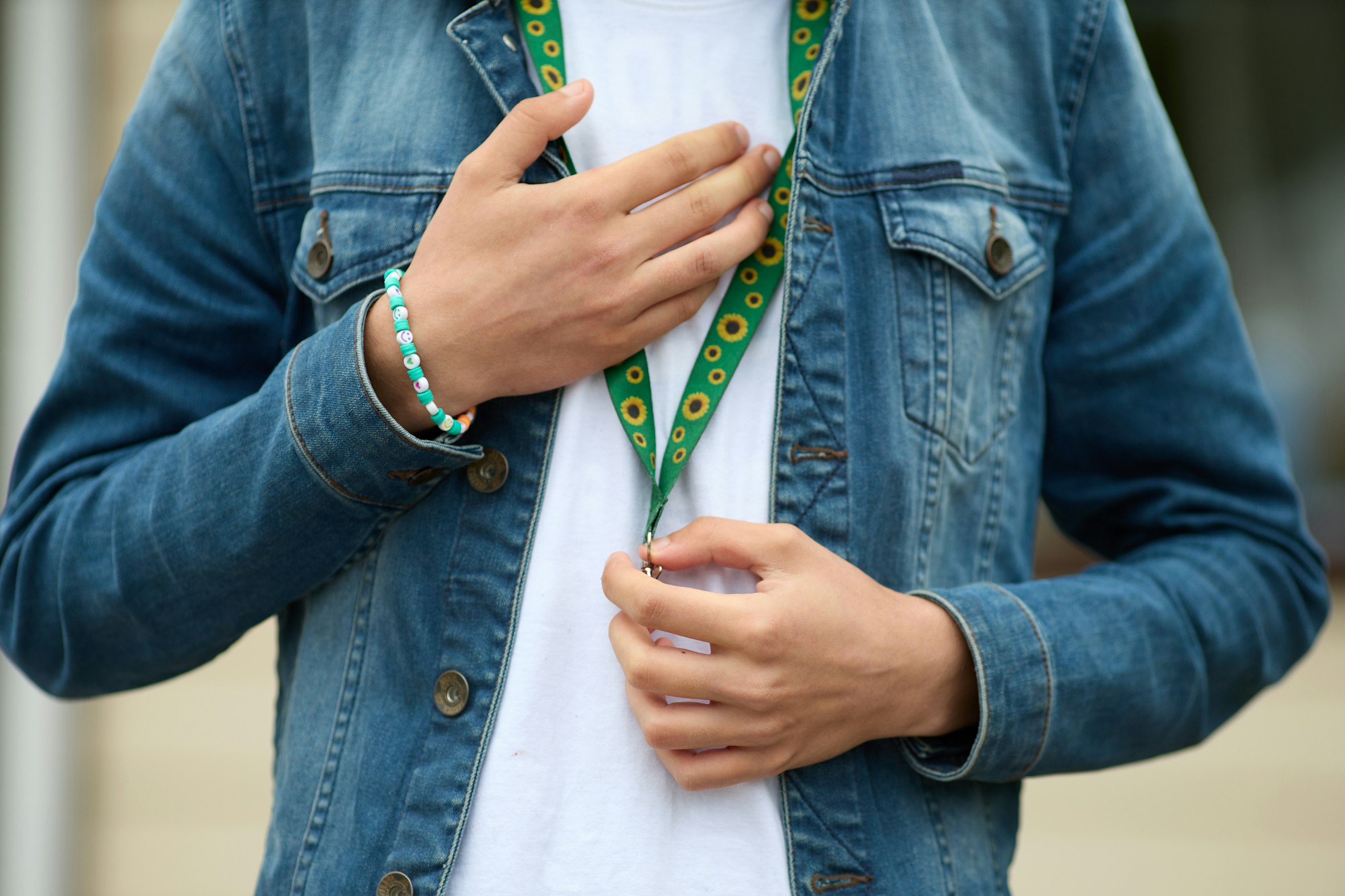
Hidden disabilities lanyard: the badge holder or keychain lanyard that discreetly indicates that the person wearing it has a disability, even if it is not visible.
Credit: Adobe Stock | vetre | All rights reserved







 My cookie preferences