


Solar power is no longer just about roofs
Nine laboratories dedicated to the future of solar power
Standing in front of a wall displaying samples of photovoltaic panels in various shapes and colors, architect and researcher Jennifer Adami has no trouble capturing the audience’s attention, even after the lunch break. She tells a story about each piece: “Here, for example, we proposed this photovoltaic glass for a project involving work on the roof of the Ancona Courthouse. We worked with the building’s design team to jointly identify a solution compatible with both the structure and the energy requirements. The photovoltaic cells, clearly visible within the panel’s double-pane glass, were designed not only to generate energy but also to provide shade for the building’s interior rooms.”


There are still no European statistics that break down the figures for integrated photovoltaics – known in the industry as BIPV (Building Integrated Photovoltaics) – from the rest of the installed capacity, but the European Commission considers it a strategic segment with great potential.
“Building-integrated photovoltaics is – if you will – the luxury niche of the photovoltaic sector,” explains Wolfram Sparber, director of the Institute for Renewable Energy at Eurac Research. “The costs of customized solutions are obviously higher, but when it comes to retrofitting historic or architecturally significant buildings, this is the way forward – and there’s no shortage of opportunities in Italy.”
This was confirmed in a study by the International Energy Agency, which identifies Italy – along with the Netherlands – as the most active country in the field of BIPV-related intellectual property and also as the market with the highest cumulative BIPV capacity among the countries analyzed, with over 2.5 GWp installed – likely due to the historical incentives of the Conto Energia program with its BIPV bonus.
One collaboration that exemplifies Eurac Research's approach is its partnership with the company behind the innovative photovoltaic glass roof of the Vatican Museums in Rome.
The PV Integration Lab is dedicated to building-integrated photovoltaics. Its facilities include a full-scale 20-square-meter roof model, installed outdoors, which can be tilted up to 60° from the horizontal plane and oriented in any direction. This allows researchers to simulate different roof pitches and measure the modules’ output, irradiance, temperature, and efficiency.The activities of the PV Integration Lab are intertwined with those of the PV Prototyping Lab which was established in the summer of 2024. Its goal is to bridge the gap between research and application: here, small-scale photovoltaic modules are produced while experimenting with materials, cell technologies, and interconnection architectures.
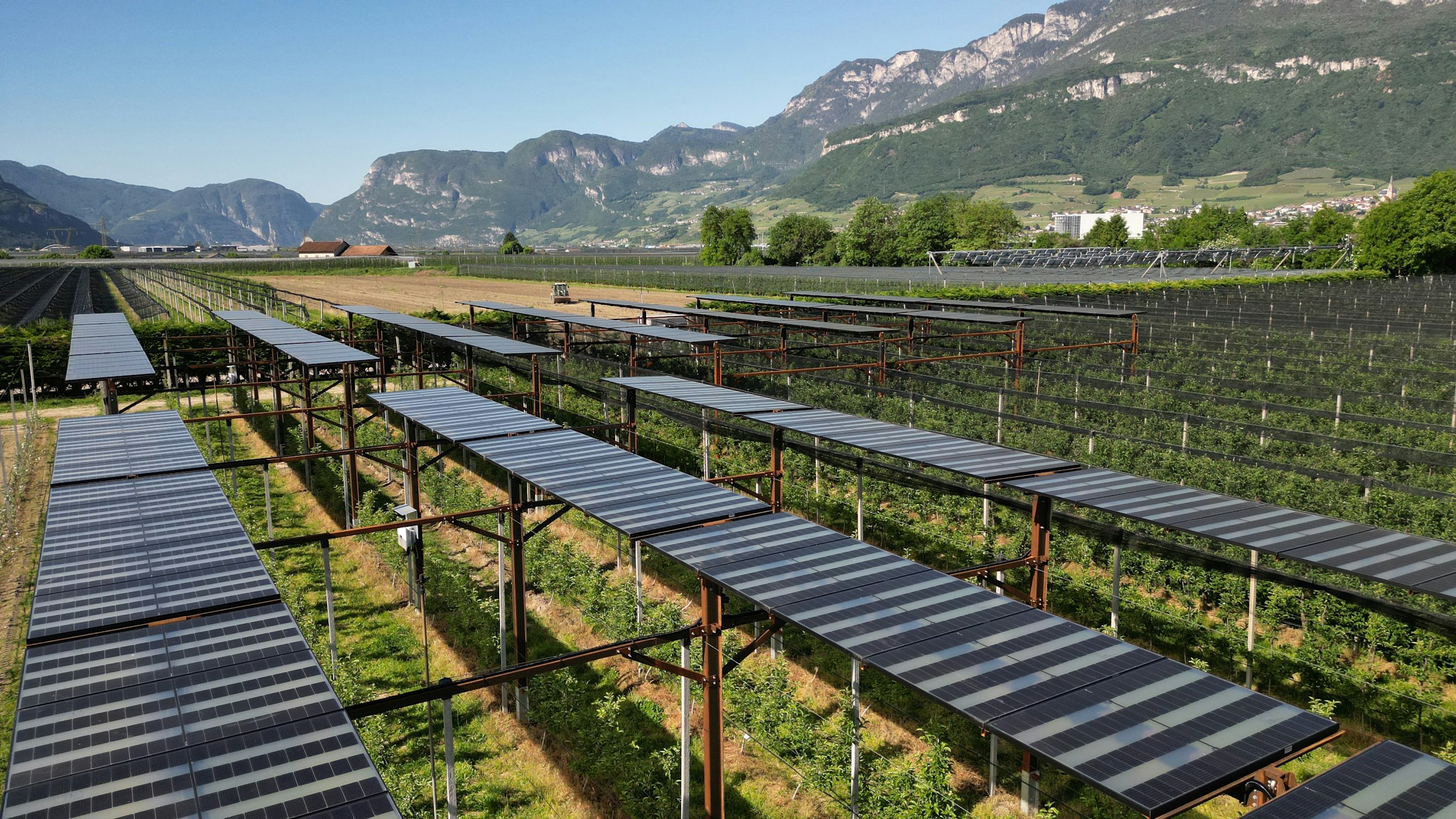
Agrivoltaic infrastructure in Auer/Ora
Credit: Eurac Research | Martin TelserOnce upon a time, there was the photovoltaic panel
Another display wall, another array of colorful models, another range of applications. For example, a small panel encapsulated in a pink plastic material, apparently ideal for agrivoltaics because the pink color captures and harnesses the sun’s green and blue rays, while allowing the red rays – which promote photosynthesis in the plants growing beneath – to pass through.
“Fifteen years ago, when we first started working in photovoltaics, there were individual panels, and we were studying how to maximize their output. Today, the market has diversified significantly. It ranges from traditional residential systems to industrial ones, from customized installations to large energy operators, including agrivoltaics and research on energy storage systems. We strive to cover the entire supply chain to offer maximum support to companies,” Sparber continues. “That’s why we’ve also evolved as an institute: compared to the past, we now have more technical and operational roles than purely research-oriented ones. Although this doesn’t mean we’re giving up on experimentation.”
One example is the experimental agrivoltaic system installed last year in Aur/Ora, in the countryside south of Bolzano, funded by the Symbiosyst project and built in collaboration with the Laimburg Research Centre: a state-of-the-art system with a peak power of 72 kilowatts, designed to integrate agriculture with renewable energy production. It is connected to the power grid to collect essential data and advance research in this field.
Even the longest-standing laboratories, such as the Solare PV Lab or the Accelerated Life Testing Lab, have been gradually upgraded, especially thanks to investments secured through research projects. For example, the recent PerSpire project – within the framework of which the previously mentioned company visit took place – made it possible to upgrade the solar simulator, the electroluminescence equipment, and the climate chamber.
“We’ve already had cases where companies tested panels with a 25-year warranty, but our tests revealed that they didn’t have that lifespan at all”
Wolfram Sparber, director of the Institute for Renewable Energy at Eurac Research
In these laboratories, companies can test the performance of their products and subject them to certified Accredia testing. Not only that, but companies that build very large installations by purchasing and assembling panels can request that sample batches be tested to verify the warranties provided by manufacturers – an excellent bargaining chip during commercial negotiations. “We’ve already had cases where companies tested panels with a 25-year warranty, but our tests revealed that they didn’t have that lifespan at all,” recalls Sparber. “Let’s say that niche markets, such as integrated photovoltaics, are currently the most promising for our corporate partnerships, but we are also ready for large-scale photovoltaic development. It will all depend on the decisions made by policymakers.”

A mechanical arm for handling all sizes of solar panels. This equipment was purchased through the PerSpire project.
Credit: Eurac Research | Andrea De GiovanniThe Growth of Solar Power and Europe’s Choices
Spain is often cited as a model case where photovoltaics have rapidly evolved from a supplementary source to a pillar of the electricity system. And in fact, according to the state-owned company Red Eléctrica, installed capacity in 2025 stood at 41.5 gigawatts, nearly 27 percent higher than the previous year. The think tank Ember has calculated that at least 22 percent of Spain’s electricity generation comes from solar PV, but according to the same source, Italy’s figures are also rising: in 2025, Italy was well below the European average for total low-emission sources (49 percent versus an average of 71 percent), but solar power reached 17 percent. The data from Terna, the Italian company that operates the electricity transmission grids, are slightly more conservative: solar accounts for 16.5 percent of total energy produced, with an installed capacity of 40 gigawatts – a capacity that has more than doubled compared to ten years ago.
In a few years, we’ll be inundated with tons of decommissioned panels, and we need to be prepared.”
Luis Fialho, group leader of the research group dedicated to photovoltaic systems
But where do all these panels come from?
“China holds a monopoly on production, and in the private sector, I imagine it will remain that way for a long time. The prices are too competitive,” explains Luis Fialho, head of the research group dedicated to photovoltaic systems. “But a few weeks ago, the European Commission decided to restrict the use of inverters produced by countries considered high-risk – such as China, Russia, and Iran – in projects funded by the EU. Starting this fall, we’ll have to reorganize our research – it’s also an opportunity for European manufacturers. The potential is there.” And as I listen to him, I see a representative from 3Sun Gigafactory – a massive Catania-based company which is part of the Enel Group – walking past behind him.
What lies ahead?
On the sun-warmed asphalt, in the outdoor area of the NOI Techpark, the group heads to a welcome cocktail reception in the shade of some panels at the PV Operation & Maintenance Lab. They exchange promises to call, send additional materials, and collaborate.
I ask Luis Fialho what he sees as the major issues for the sector’s future. He has no doubts: “The integration of energy storage systems and the second life of decommissioned panels. In a few years, we’ll be inundated with tons of decommissioned panels, and we need to be prepared.”
“After twenty years, production drops by an average of 20 percent, and large plants in particular need to maintain maximum power at all times,” echoes Alexander Astigarraga, coordinator of the PerSpire project that organized the event. “Do you see my colleague over there? She’s the head of Solar Materials, a German company that specializes in recycling.”
New industry sectors, new partnerships, and new challenges lie ahead. By opening up its laboratories and expertise to a wider range of companies, Eurac Research aims to support everyone involved in designing, manufacturing, installing, testing, and reimagining photovoltaics for the future.








 My cookie preferences