Allowing the soil to breathe more freely
A new study provides a precise picture of the metabolism of microorganisms in alpine meadow soils.
As soil microorganisms break down organic material, they release large amounts of CO₂. A new study by Eurac Research shows that the level of soil respiration depends not on the number of microorganisms, but on how active they are. The study found out which microorganisms are active in alpine meadow soils, what conditions they need, and how they affect soil respiration. This was done using a new method based on genetic analysis. The results show how climate change can affect soils and whole ecosystems.
The hidden life beneath our feet
A single gram of soil can contain a billion bacteria. Together with fungi and other microorganisms in the soil, these bacteria decompose dead plant parts, animal remains, and root exudates – the fluids emitted through the roots of plants. This metabolizing of the dead organic material and releases CO₂. This process, known as soil respiration, is a central component of the global carbon cycle. But how exactly does this CO₂ release occur? And what influences it? Until now, the number of microorganisms (or microbes for short) was considered the decisive factor. More microbes, more respiration – that was the equation. “It has always been assumed that microbes in the soil multiply very quickly, even exponentially, under certain conditions,” explains microbiologist Magdalena Nagler. “This was thought to determine higher soil respiration, in other words, more CO₂ being released from the soil.” However, Nagler's study shows that this assumption falls short. The decisive factor is how active the microbes actually are.
Counting cells is not enough
In an experiment on alpine meadows in South Tyrol, Nagler combined CO₂ measurements with genetic analyses of soil microbes. She specifically isolated DNA from intact, living cells to ensure that she did not accidentally count the DNA of dead organisms – a common pitfall in previous research. “The problem is that DNA can still be present even if the microorganism is no longer there,” explains Nagler. “When a microorganism dies, it disintegrates, and its DNA is released. It is then no longer inside a cell, but remains in the soil, where it can survive for a long time.” Nagler removed this extracellular part of the environmental DNA from the soil samples and examined only the intracellular DNA of the microbes. The result: even with similar numbers of microbes, the measured CO₂ values differed significantly depending on how active the microbes were. Nagler used this data to calculate a “gene-specific respiration rate” – how much CO₂ is released per specific gene segment. And it was precisely this value that proved to be decisive.
Soil respiration – a digestive process
The soil breathes: microorganisms such as bacteria and fungi and roots absorb oxygen and release carbon dioxide. Then what happens?
Microorganisms such as fungi and bacteria, as well as animals living in the soil, decompose organic material like the remains of plants, animals, fungi, and bacteria, as well as root excretions. This material contains sugar, cellulose, and proteins, which serve as a source of energy and building material for microorganisms. They “eat” the organic material and break it down chemically, converting it into energy with the help of oxygen. The waste that is produced and escapes into the air is carbon dioxide.
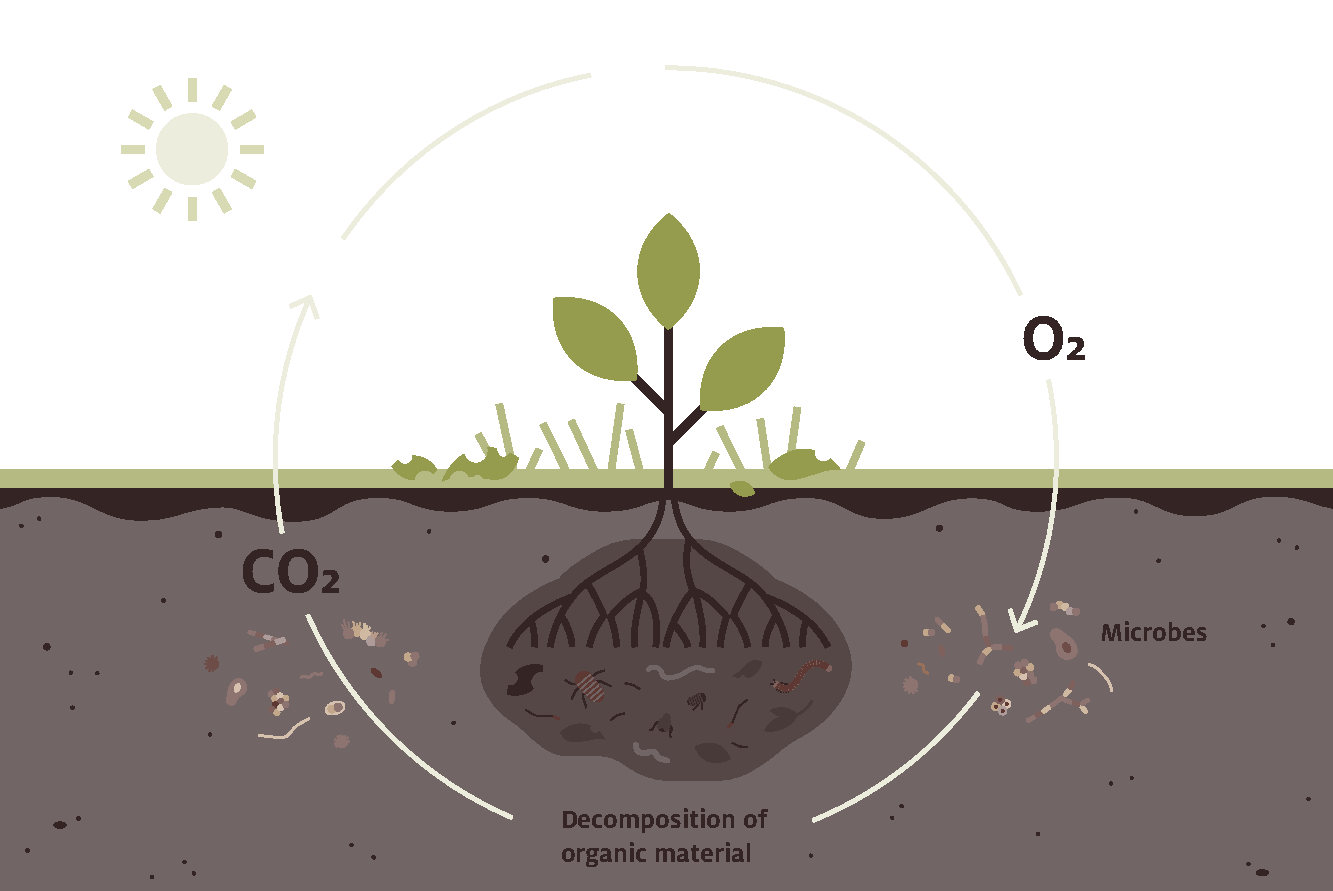
In summary: Soil respiration is the visible result of the decomposition of organic matter by soil organisms. During this process, oxygen is absorbed, the substance is metabolized (oxidized), and CO₂ is released. It is therefore nothing more than a biological “digestion process”. This biological process is called “soil respiration,” although it is not the soil itself that breathes, but the microorganisms, animals, and roots living in it.
Dormancy and awakening
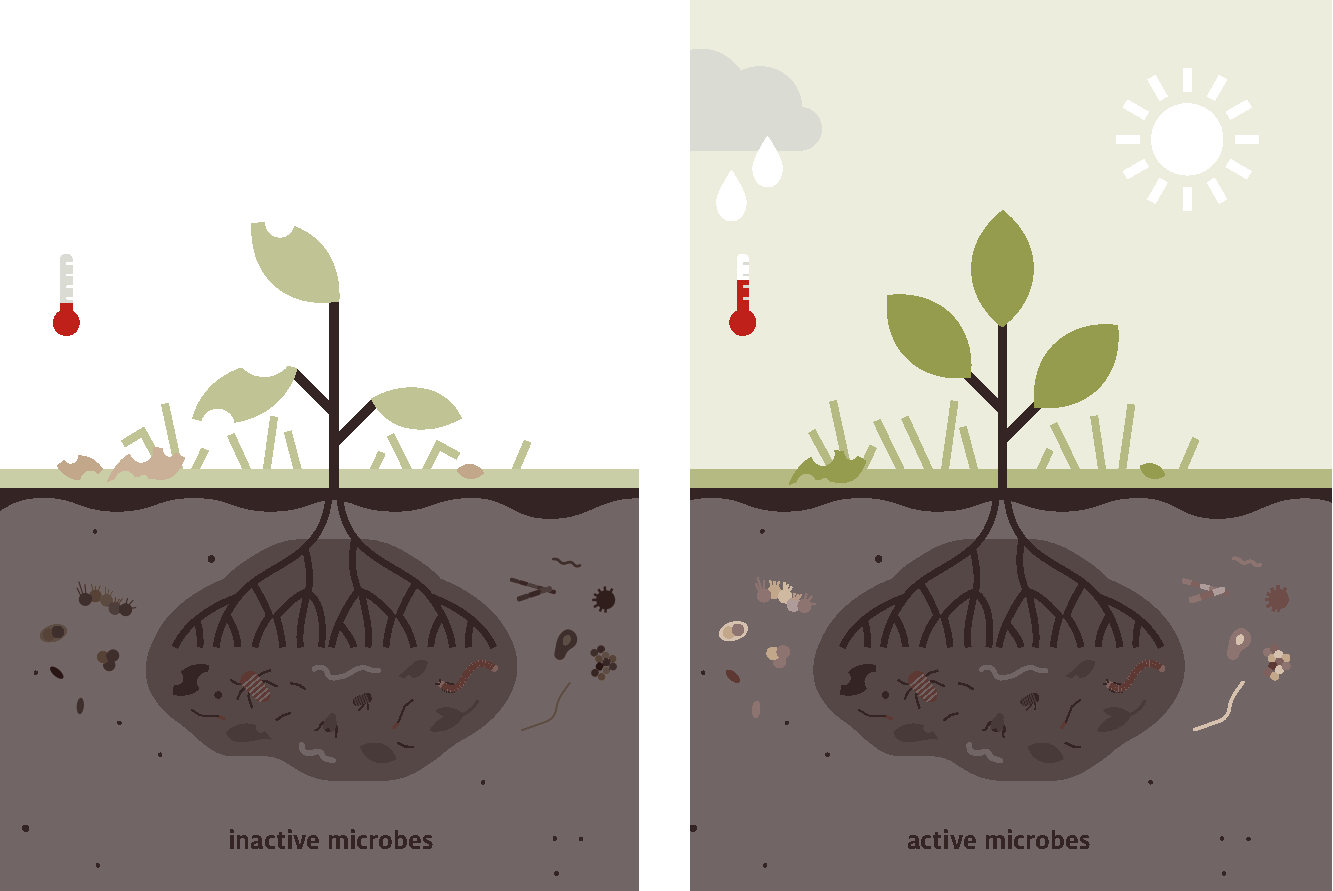
What Nagler was able to show in her research was that microbes in the soil fall into a state called dormancy for short periods of time. They are present but when “sleeping” demonstrate little metabolic activity if conditions are unfavorable. As soon as sufficient moisture, warmth, and sunlight are available, they “awaken,” become active, and begin to breathe. What is striking is that sites with steep slopes showed significantly higher microbial activity than flat meadows. This is due to stronger solar radiation. Factors such as the pH value or the carbon-nitrogen ratio in the soil also influenced respiration – not by changing the types of microbes, but by changing the levels of activity within the same community.
"Dormancy" and awakening

Microbes in the soil can fall into a state called dormancy when conditions are unfavorable. As soon as sufficient moisture, warmth, and sunlight are available, they “awaken,” become active, and begin to breathe.
Basis for improved climate models
The study not only represents a methodological advance, its findings are also important for better understanding the effects of climate change on carbon fluxes in the soils of mountainous areas – where there are many different microclimatic conditions within very small areas. Due to this particularity, it can be challenging for researchers to develop large-scale climate models. However, by including microbial dynamics, predictions of soil carbon emissions can be improved and the effects of global warming on soils and ecosystems be better assessed. Specifically, how dry periods or heat waves affect CO₂ emissions. Nagler’s experiment also revealed thar even short bursts of moisture, such as after rain, led to sudden CO₂ emissions: a phenomenon known as the Birch Effect. Thanks to the study, the occurrence can now be better understood.
Conclusion: Activity is crucial
Magdalena Nagler’s study brings a new and previously underestimated perspective to soil research: it is not only the number of microbes present that counts for CO₂ release, but above all how active they actually are. If we understand what triggers the switch between dormancy and activity in microbes, we will also better understand how soils respond to climate change. So, should we slow down microbial activity to reduce emissions? “We definitely should not begin by inhibiting soil respiration to reduce CO2. Soil respiration is useful; it is a sign of healthy soil and is crucial for the growth of plants and trees – the basis of our food,” explains Nagler.
The ALSORES project
Field and laboratory research
For her ALSORES research project, Magdalena Nagler selected six sites in alpine meadows, distributed across three high-altitude and three low-altitude locations (at 1,500 and 2,000 meters above sea level). At each site, she inserted eight pairs of plastic tubes into the ground – one tube from which she removed vegetation and roots and the other left intact. This was to distinguish between the respiration of microbes in the soil and the influence of the roots and vegetation in the respiration. She visited all sites six times and measured the soil respiration rate to ascertain how much CO2 was released during the April to August cultivation season. During this time, Magdalena took over 400 soil samples back to the laboratory.
For the DNA analyses, she washed the samples in three steps to remove the extracellular environmental DNA and determine only the DNA from intact microbes. This gave her an accurate overview of both the number and type of microbes present in the soil.
In an incubation experiment, she exposed the soil samples to various stress situations: she dried them using an extractor – a warm light source which not only mimicked drought stress but also drove out all creatures the soil. At the same time, she repeatedly measured soil respiration – with and without the soil inhabitants. This allowed her to see how much the creatures that live in the soil contribute to its respiration and to what extent they influence microorganisms. In the next step, she watered the samples again – simulating a drought followed by rain – and observed the Birch Effect, when a large amount of CO2 is released in a short period of time. Throughout the experiment, she measured soil respiration and investigated the relationship with the activity of microbes in the soil. At the end of the experiment, she simulated a heatwave – this time without drought conditions and observed how soil respiration increased with rising temperatures. By combining the measured respiration rates with DNA analyses and comparing the samples in the field and laboratory under different conditions, Nagler was able to paint a precise picture of the activities of the microorganisms in the soil.
Link to the scientific publication 'Gene-copy normalized heterotrophic soil respiration as a field proxy for the soil microbiomes' dormancy and carbon use efficiency – A proof-of-concept': https://www.sciencedirect.com/science/article/pii/S0929139326004890
The ALSORES project was carried out under the leadership of Magdalena Nagler from the Institute for Alpine Environment at Eurac Research in collaboration with the University of Innsbruck. The project was funded by the European Union’s Horizon 2020 program as part of a Marie Skłodowska-Curie Fellowship.