
magazineGraphic Article
What are food forests (and how to measure their positive impacts)
Graphic article – How an uncultivated meadow can become a resource for the community
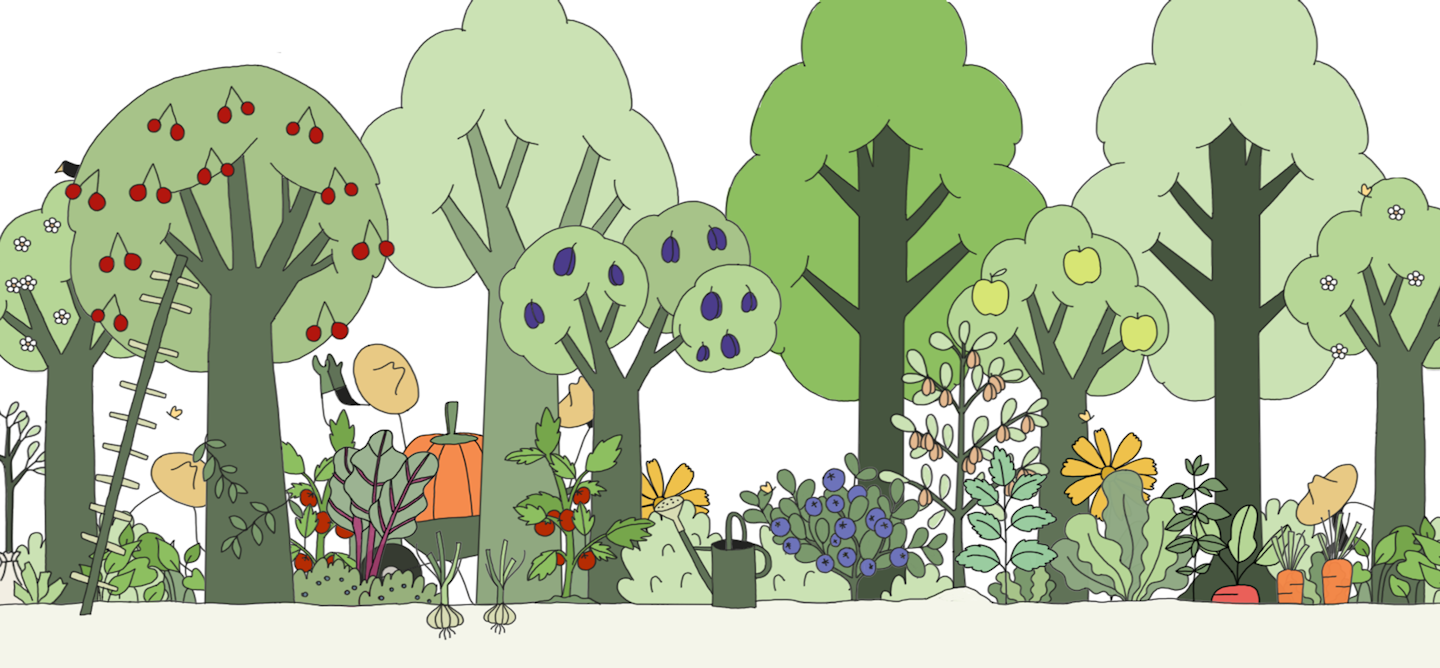
But food forests are often much more than that, they can also be productive forests in the city, where residents can stroll and find relief from the summer heat. Or a place to imagine and reflect on how we produce our food. An edible forest can serve as a hub for recreation and education on topics such as biodiversity, ecology, and soil. In some cases, food forests enhance the local area and enrich the tourism offering.
Often, the creation of a food forest goes hand in hand with the formation of a community that cares for it and derives food and other benefits from it. When these are the predominant characteristics, spaces such as these can become a community food forest.
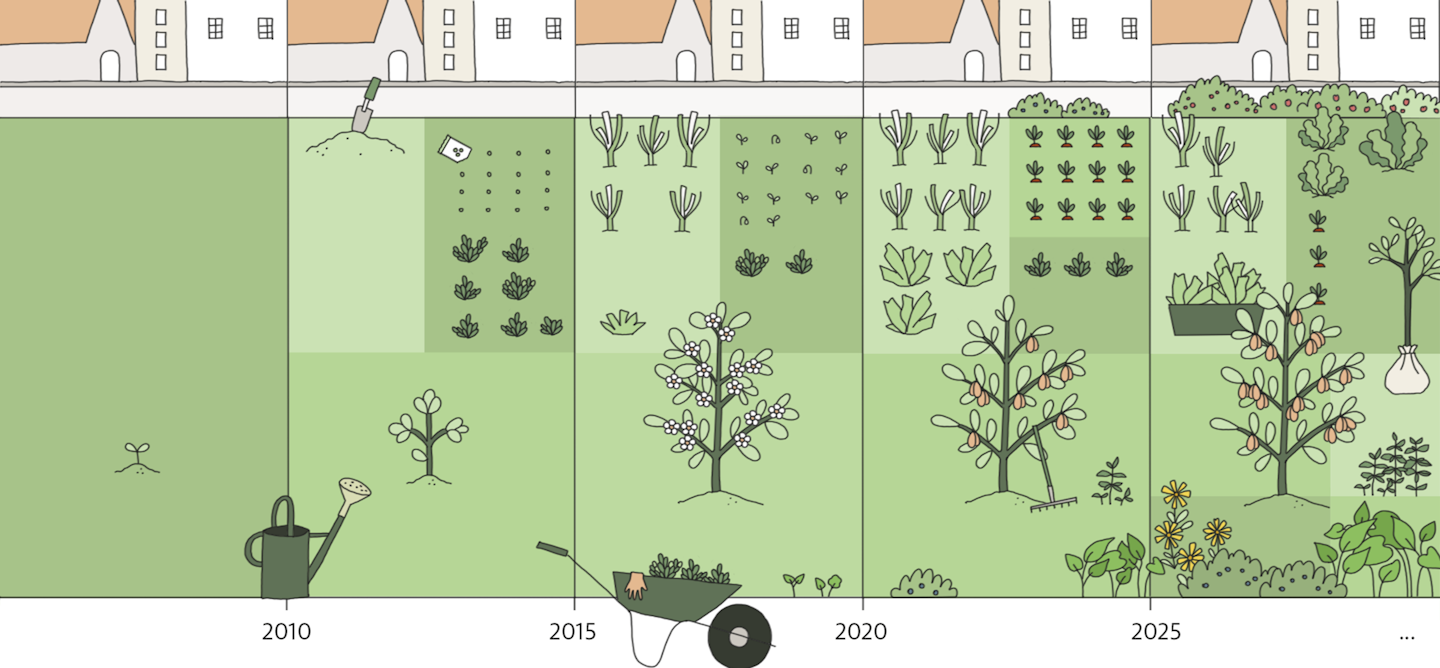
The community food forest
A community food forest is designed, developed, and managed collectively by a well-defined community. Typically, these initiatives are located on public, municipal, or shared land, where participatory management is practiced, involving volunteers, local associations, and citizens.
A food forest of this kind offers far more than access to fresh produce. It provides nutritious free or affordable food to local communities, while also functioning as a living laboratory where schools, citizens, researchers, and organizations can come together to learn, experiment, and connect. In doing so, these spaces become catalysts for social inclusion, environmental awareness, and stronger community ties.
As part of the FOOD FOREST project, funded by EIT Food, Eurac Research is monitoring the early development of two community food forests established in 2025 in radically different contexts. One is located in Artajona, a small municipality in Spain’s Navarra region; the other grows within the urban fabric of Tallinn, the capital of Estonia.
“Area size, planted species, climate conditions, and the challenges each site faces could not be more different,” explain Rocco Pace and Irene Bertolami, members of the Eurac Research team working on the project. “The forest in the Navarra region lies just outside the Artajona village, in an agricultural area that is already highly productive. The major concern there is drought – so much so that a water reservoir has already been built nearby. Tallinn, by contrast, presents almost the opposite conditions: the ground remains snow-free only from May to September, and the forest is embedded in a residential neighborhood. For this reason, the project in Estonia is focused on cultivating blackberries and other hardy berries.”
Both are food forests managed by the local community, which has already learned a great deal since the early stages of implementation. One surprising example: Tallinn’s urban soil is quite fertile. The Spanish agroforest has built a stage within its grounds to host events for children and the elderly and is planning a pedestrian path connecting it to the nearby village. The Estonian example has involved the nearby neighborhood school in its activities.
The EIT FOOD FOREST project. Food forests for all tastes
How to build a food forest
Every food forest begins with a piece of land like an urban meadow, abandoned field, or a mountainside where a storm has swept away the trees and then it needs a community, association, or organization willing to care for it.
Creating a food forest is a gradual process that combines ecology, agriculture, and participatory design. After an essential initial phase of soil preparation and mulching, small and large trees, shrubs, climbing plants, herbs, and ground-cover species are planted according to the principles of permaculture – a design approach that works with natural ecosystems rather than against them. The aim is to create a resilient and self-sustaining environment in which each species contributes to the health and balance of the whole system.
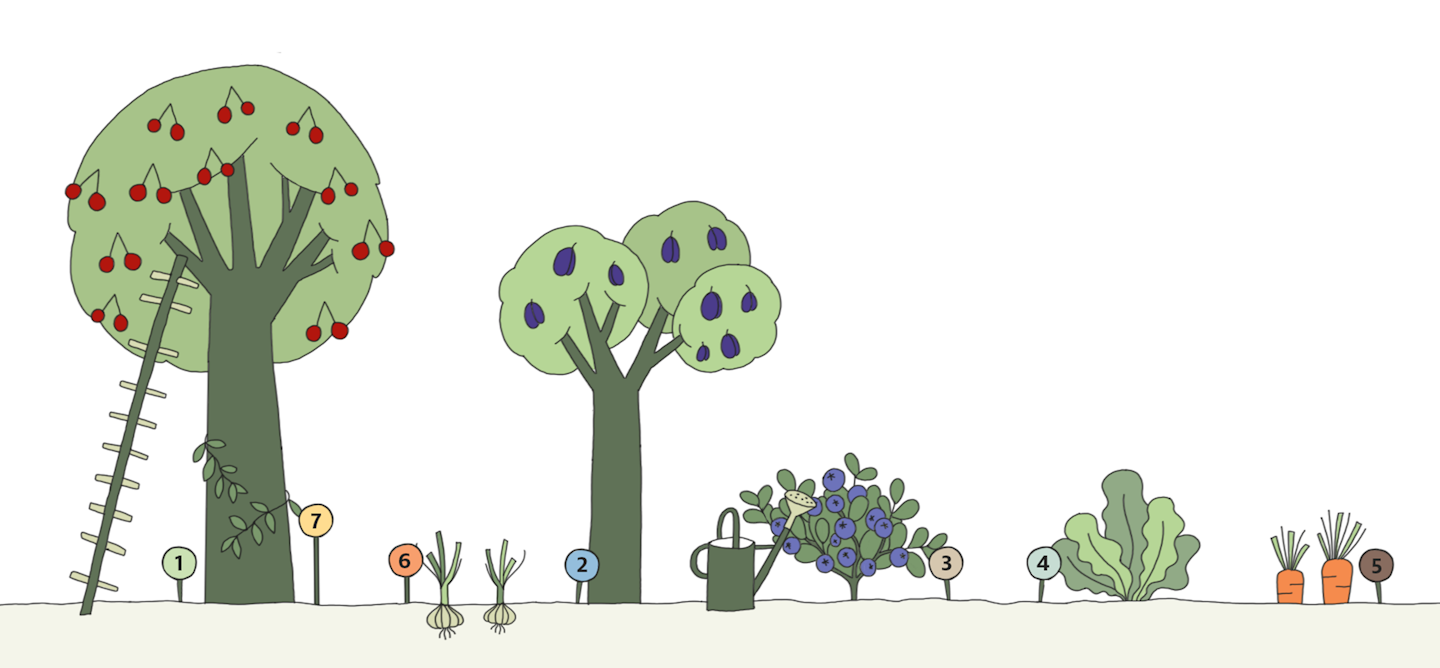
The planting process is organized around seven interconnected layers of vegetation, which together mimic the structure and dynamics of a natural forest. Over time, these layers begin to interact and support one another, creating a self-regenerating ecosystem capable of increasing biodiversity, improving soil health, and producing food in a resilient and sustainable way:
- Canopy layer – large fruit, nut, or timber trees forming the uppermost level of the system
- Sub-canopy layer – smaller fruit trees and nitrogen-fixing species that naturally enrich the soil
- Shrub layer – berry-producing and medicinal shrubs
- Herbaceous layer – aromatic herbs, medicinal plants, and perennial species
- Ground-cover layer – edible and protective plants that help retain moisture and prevent soil erosion
- Rhizosphere or root layer – perennial root and tuber crops beneath the soil
- Vertical or vine layer – edible climbing plants and vines that grow through and alongside the other layers
The division into layers allows a food forest to mimic the dynamics of a young natural forest. Rather than functioning as a monoculture, a food forest evolves as a complex and living ecosystem composed of trees of different ages and sizes, shaded and sunlit areas, herbs, shrubs, and climbing plants. Together, these elements create a rich diversity of ecological niches capable of supporting insects, birds, microorganisms, and plant life.
Ideally, a mature food forest – much like a natural forest – requires very limited agricultural intervention. Irrigation, fertilization, plowing, and the use of herbicides or pesticides can gradually be reduced or eliminated altogether, as natural processes begin to maintain soil fertility and plant health autonomously.
“Of course, this balance is achieved over time,” explains Rocco Pace, researcher specializing in urban greenery and ecological modeling. “In the early years, irrigation, phytosanitary treatments, and mechanical tillage may still be necessary. But as the ecosystem matures, these interventions can progressively decrease until they disappear entirely. This is what distinguishes a food forest from conventional agricultural land, where such interventions are required every year.”
Each layer hosts a wide variety of species that are introduced and diversified over time. Some crops may be rotated seasonally, while others become permanent elements of the forest and remain throughout its lifespan.
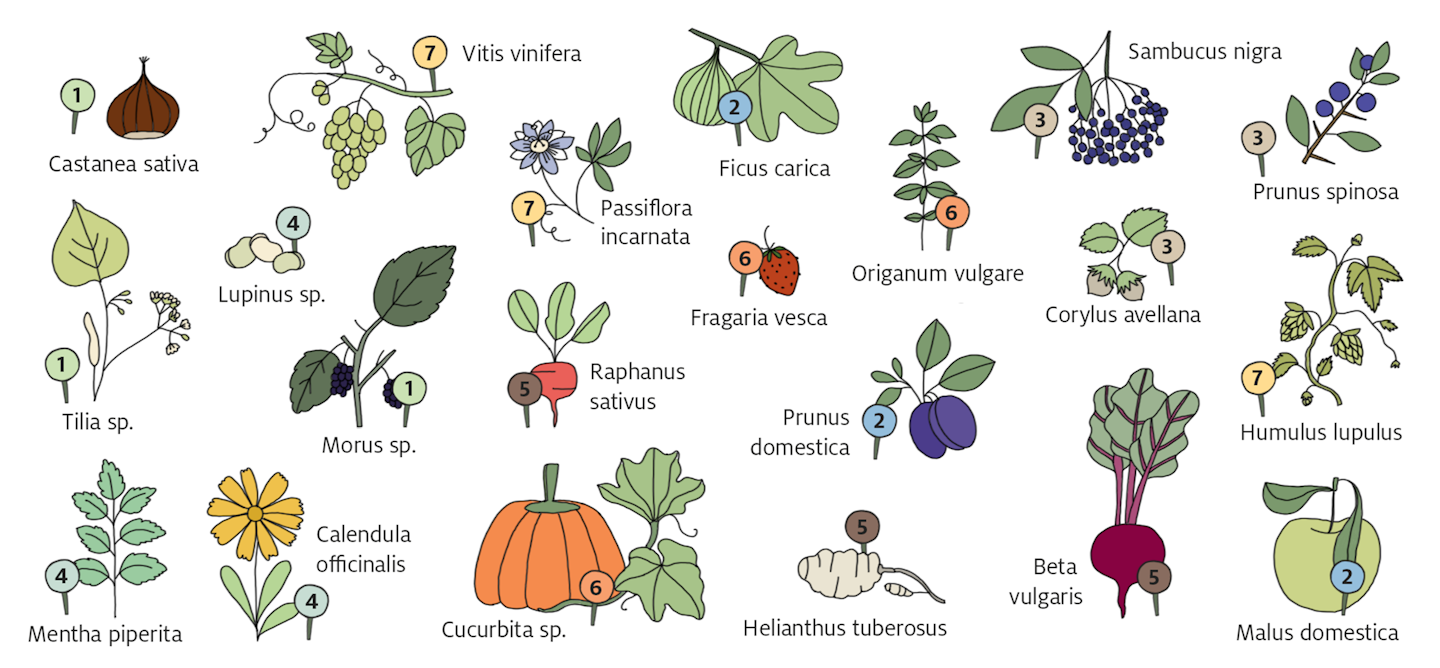
In the illustration, we have outlined a selection of species – organized according to the seven vegetation layers – that could potentially be cultivated in an edible forest designed for the city of Bolzano
How can we measure the positive effects of a food forest?
Given that it is such a multifaceted place, it goes without saying that the beneficial effects a food forest can generate at the environmental, economic, and social levels are diverse. Among the most common impacts are CO2 sequestration, but also improved microclimate, increased soil fertility, and greater ecological knowledge, reduced stress for residents, less noise, better air quality, greater food security, and a deeper interaction with nature.
How can such diverse effects be measured?
As part of the EIT FOOD FOREST project, the Eurac Research team is assessing the impacts of the community food forests in Artajona and Tallinn through an integrated set of research methods. To evaluate their environmental impact, the researchers use Life Cycle Assessment (LCA), a methodology that examines the entire life cycle of a project – from its creation and early development to the resources, materials, and processes involved. “Within the project, we focused especially on the initial stages of the food forest – its establishment and early growth,” explains Rocco Pace. “Measuring environmental impact is important because it helps reveal which choices are actually more sustainable.” The assessment considers a wide range of practical decisions. Should mulch be sourced as wood chips from a distant supplier, or produced from organic waste materials provided locally by the municipality? How much labor and machinery are required to prepare the soil? Where do the plants come from, and how far have they traveled?
“The idea of evaluating environmental impact directly influences the design process,” Pace continues. “We need to identify all the actions and resources involved in building a food forest and then understand how to optimize them by favoring solutions that are more circular and less resource intensive.”
In the future, these findings could also make it possible to compare the environmental performance of food forests with other forms of urban greening or more conventional agricultural production systems.
At the same time, social impacts can be assessed through the Social Return on Investment (SROI) methodology, which assigns an economic value to the social, environmental, and community benefits generated by a project. “This approach is developed together with the community and all the stakeholders involved – whether directly or indirectly.” explains Irene Bertolami. “Once we identify the potential impacts of the food forest, we examine how these are perceived by the surrounding community and how much value people attribute to them. This allows us to evaluate the project’s broader social value.”
Finally, the microclimatic benefits become more noticeable over time, as the food forest reaches a certain maturity: the seven layers that compose it become well-established and easily identifiable, the canopy closes in, and a small oasis of well-being with effects that extend to the rest of the neighborhood, benefiting both biodiversity and residents is created.









 My cookie preferences