


What happens to mountain waters when glaciers and permafrost disappear?
The small settlement of Tel/ Töll lies 500 meters above sea level along the banks of the Adige/Etsch River, at the entrance to the Venosta/Vinschgau valley. The village is surrounded by apple orchards and sits at the foot of mountains that reach altitudes of around 3,000 meters. In the village, there is neither industry and nor has there been any recent change in land use. Yet, over the past years, levels of heavy metals in the stretch of the Adige/Etsch near the site have been increasing. And the problem does not concern the village alone – it originates much higher upstream.
“When in 2021 the Provincial Agency for the Environment and Climate Protection of Bolzano/Bozen released the results of water sample analyses from the village, it immediately began investigating the cause and subsequently involved us,” says Stefano Brighenti, who at the time worked at the University of Bolzano/Bozen and is now an expert at the Eco Research center. “Our hypothesis was that glacier loss was involved.”
In 2007, a separate study detected an increase in heavy metals such as nickel in Lake Rasass, an Alpine lake in South Tyrol. The authors attributed this rise to the thawing of permafrost. What was not yet known, however, was whether the phenomenon could extend down to the valley floor.
To understand the rise in nickel levels in the Adige/Etsch river, Brighenti and his research group conducted a series of analyses and published their first findings in 2025. “By comparing nickel levels measured in water from 61 sites along the Adige/Etsch river and one of its tributaries, we found that between 2011 and 2023, these values increased roughly fourfold,” Brighenti explains. “We also observed that concentrations rose as we approached glaciers and permafrost zones. Through statistical analyses, we were able to attribute this phenomenon to glacier retreat and permafrost loss caused by climate warming.”


As Brighenti explains, contamination of high-altitude waters by heavy metals depends both on the loss of glaciers and permafrost as wells as on local geology. “Ice acts as a barrier in which chemical reactions are inhibited. When its volume decreases, water from rain and melting snow penetrates deeper into the ground and passes through areas rich in rock material recently fragmented by glaciers and permafrost. Under these conditions, the interaction between water, oxygen, and mineral surfaces intensifies, increasing acidity and promoting the release of heavy metals from these rocks. The result is that high-altitude spring waters contain higher concentrations of these substances.”
An even more recent study, with Brighenti as first author, revealed that the problem is more widespread than previously thought. The researchers analyzed water from 80 high-altitude springs across several massifs in the central–eastern Alps, finding that in valleys with certain common rock types, springs influenced by permafrost and glaciers showed high levels of heavy metals. In 36% of cases, concentrations exceeded the limits for drinking water set by European and Italian regulations. Moreover, while earlier research had focused mainly on rock glaciers and, to a lesser extent, glaciers, Brighenti’s work shows that the phenomenon also affects springs fed by other Alpine structures such as recently formed moraines and talus slopes.
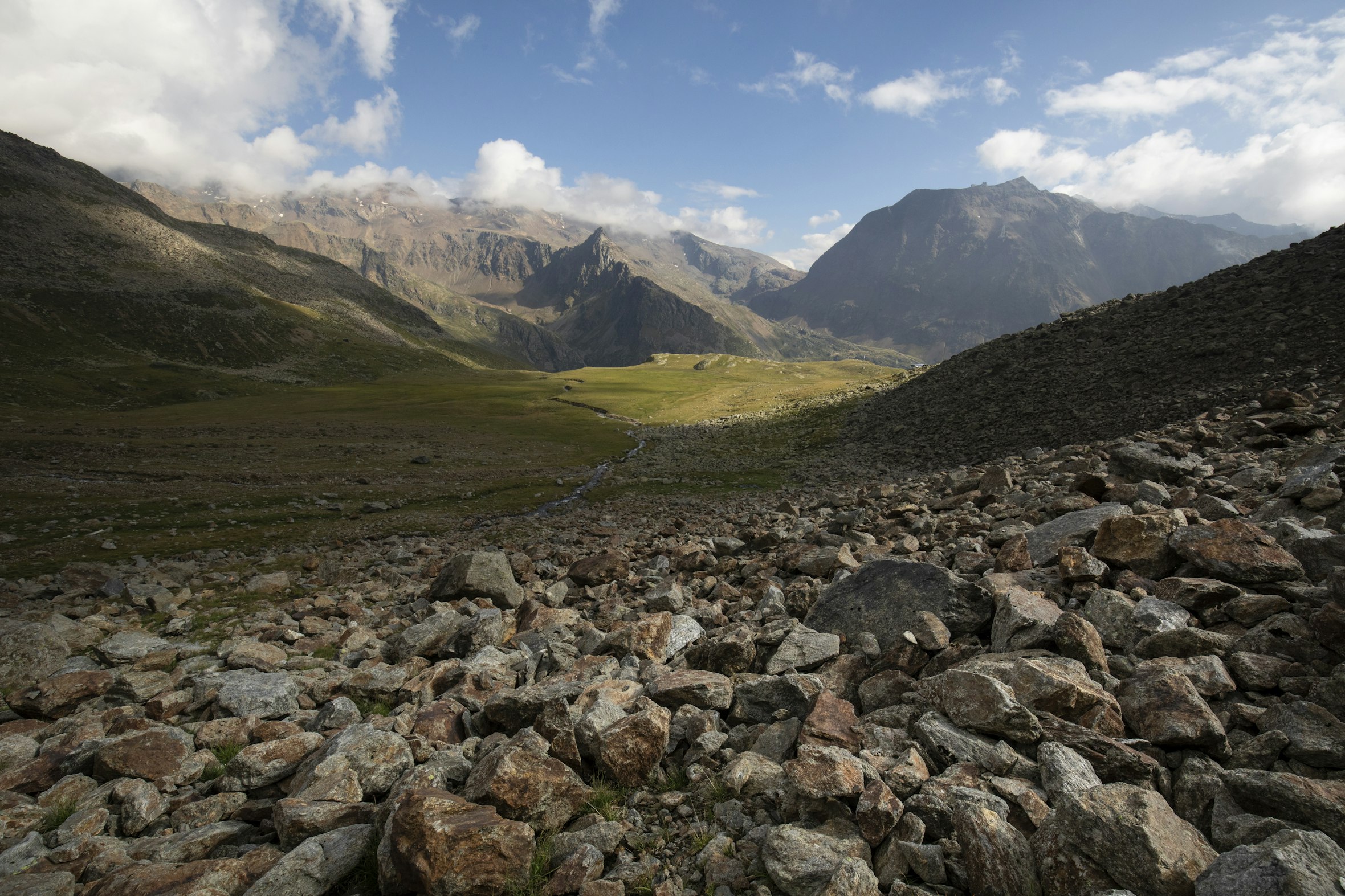
The Lazaun rock glacier. A rock glacier is a rock debris mass containing ice. When the ice melts, water comes into contact with rocks which can promote the release of metals, contributing to contamination of downstream water sources.
Credit: Eurac Research | Andrea De Giovanni“Our research shows that where the cryosphere is degrading, water sources are very likely to be contaminated,” says Chiara Crippa, co-author of the study and researcher at the Eurac Research Institute for Earth Observation. The study found that in areas with sulfide-rich rocks, the only springs with good-quality water are those originating from non-glacial, non-permafrost-influenced structures, typically emerging from slopes rich in soil and vegetation.
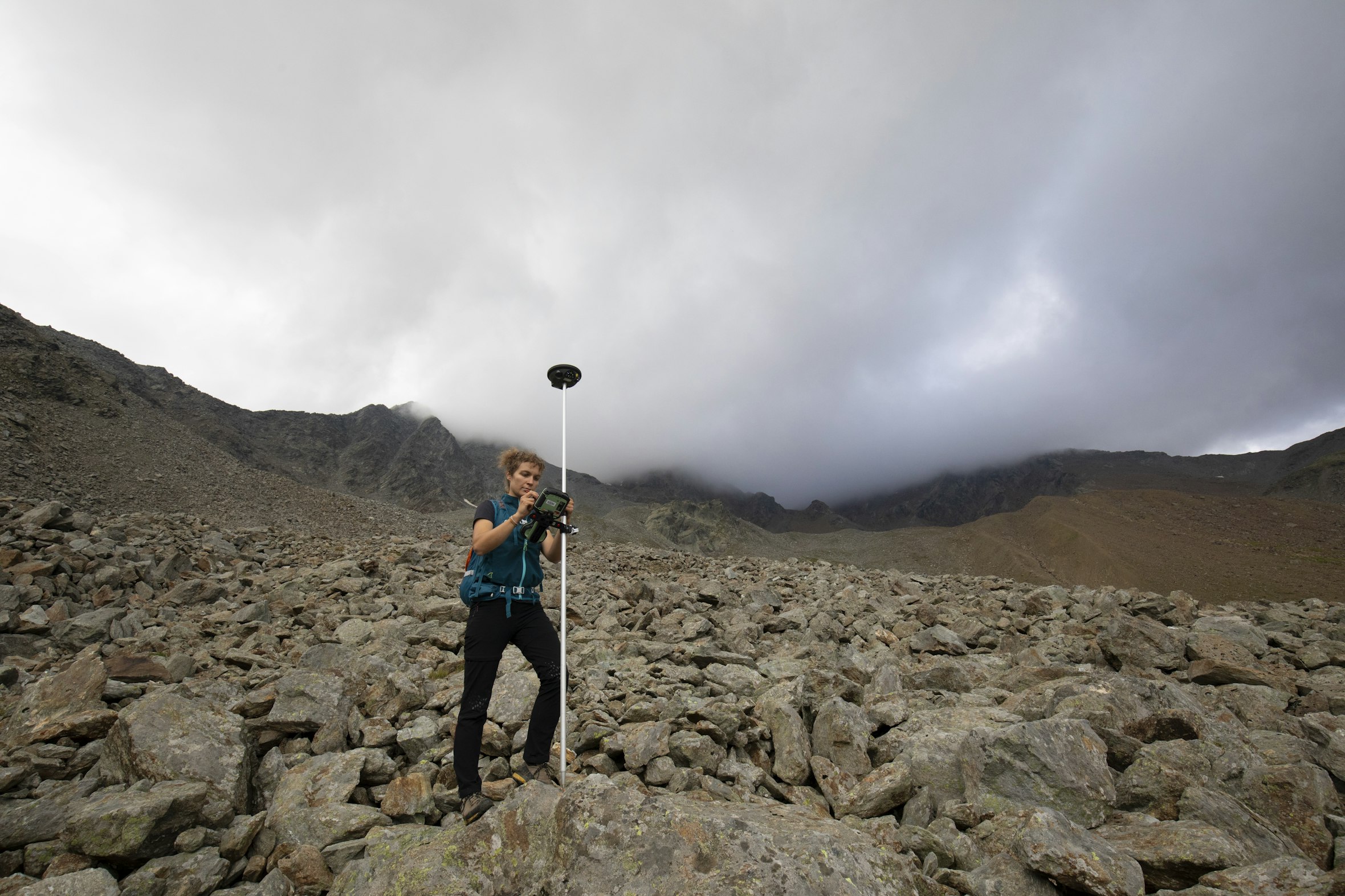
Chiara Crippa records GPS points on the Lazaun rock glacier. By repeating this process year after year, researchers can monitor the evolution of the landform.
Credit: Eurac Research | Andrea De GiovanniThe climate crisis could further exacerbate water contamination. Rising global temperatures are accelerating permafrost degradation and glacier retreat, increasing the release of heavy metals into Alpine waters. “The Alpine structures we studied act both as water reserves and as sources of contamination,” Brighenti warns. “We must prepare for a future with increasingly scarce mountain water and, in many areas, increasingly polluted water with growing ecological, social, and economic impacts, even in downvalley regions.”
Study details









 My cookie preferences