
When everything seems wrong – but actually isn’t
How a protocol for measuring liquid water in snow was developed
Carlo, Riccardo and Nicola are almost unrecognizable. Bundled up in hats, scarves, and long sleeves, they are crouched at the bottom of a snow pit near the Senales/Schnals glacier, under the glaring sun at an altitude of 3,000 meters. They look at each other for a moment through the very dark lenses of their glasses, stand up, and Carlo slaps the edge of the pit in frustration. All around there is silence – in the sky you can hear only the distant rumble of a rescue helicopter. “It’s impossible, we did everything right…” – “We have to try again!”


Trying again means bending back down over the homemade instrument at their feet and starting once more to figure out how to make the numbers add up. Carlo Marin and Riccardo Barella are two remote sensing specialists. They mainly study snow. And, in doing so, they are able to contribute to policies for adapting to climate change: the more precisely we can calculate when and how much snow will melt in the mountains, the better downstream water resources can be managed.
“There’s a property of snow that is very useful to know but equally difficult to determine,” Marin explains. “During the colder periods, the snow on the ground is frozen. In spring, when the days warm up, the snow begins to melt slowly, but at first the liquid water inside the snow cannot be seen with the naked eye. Technically we call it ‘free water.’ If there are no impermeable barriers, it does not exceed four to six percent of the total volume. Calculating it helps us understand how the melt will progress – and when that melted snow will start flowing downhill.”
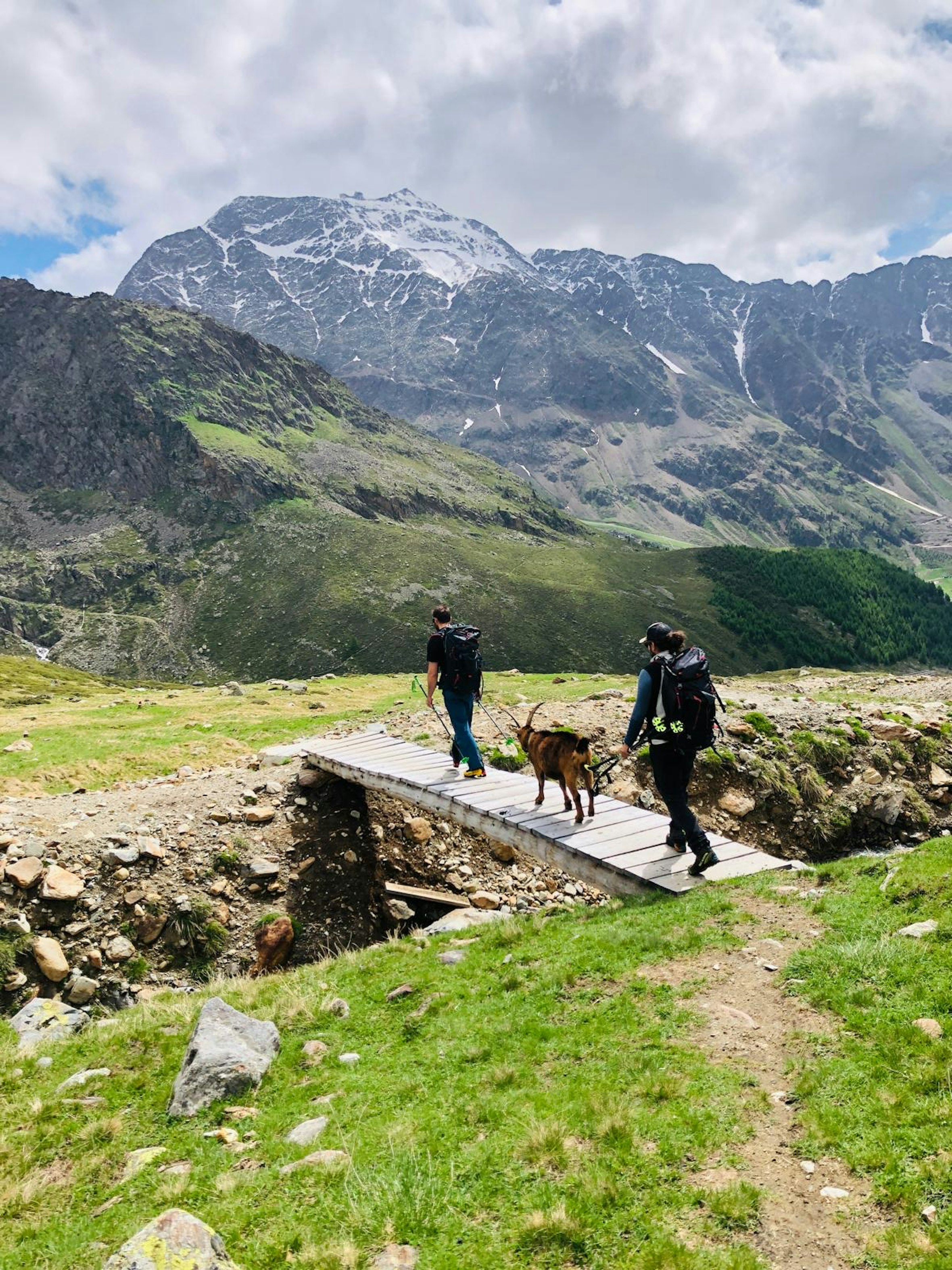
It was quite a struggle to get to the measurement site… but at least in great company.
Credit: Eurac Research | Katharina ScheidtA bit of the calorimeter’s history
A calorimeter is an instrument used to measure the amount of heat exchanged between two substances during a physical or chemical process. According to the laws of thermodynamics, when two substances at different temperatures come into contact in an isolated system, the heat released by the warmer part equals the heat absorbed by the colder one. By applying this principle, the exchanged energy can be calculated. It is used, for example, in the food industry to measure calories in food.
In the late 1930s a Japanese research team led by Zyungo Yosida thought of using this principle to calculate how much free water was present in snow. “By placing a certain amount of snow inside a container and adding a specific amount of hot water at a specific temperature, we could in theory know what temperature the final mixture should reach if the snow were completely frozen. If the temperature is lower, that will mean that there is liquid water in the snow and, by difference, we will be able to calculate its mass,” Yosida reasoned.
The idea was good – the result disappointing. Yosida had not fully accounted for heat losses from the container, although he had guessed at the problem. The calorimeter was shelved.
Forty years later, an American research team revived the calorimeter for the same purpose but used it in reverse – freezing the liquid portion of the water instead. To do this they relied on silicone oils – some of which were later found to be carcinogenic – and had to cool them to extremely low temperatures, down to −60 °C. This so-called “cold” calorimeter technique proved highly impractical, especially for field measurements.
But there was nothing better available, so it remained the reference method.
Until recently, when Carlo Marin and Riccardo Barella took it up again. They were on a mission. In turns stubborn, enthusiastic, discouraged, and then motivated again.
Testing on the glacier
“Of course I immediately thought about the calorimeter,” Marin recalls. “But I knew it would be a challenge.” Riccardo Barella’s reaction was immediate: he tightened the elastic around his ponytail, rolled up his sleeves, and said, “Come on, let’s go.”


So the two of them took a food thermos, a kettle, a scale, thermometers, and shovels, and began running tests following in the footsteps of the Japanese researcher. First near home – at least they could heat the water with an electric kettle. Then they moved onto the Schnals/Senales glacier. “It was late spring because that’s when free water forms. The ski lifts were closed and the sun was beating down. We hiked up carrying all the equipment, either on foot or with climbing skins on our skis… it was exhausting,” Marin recalls with a laugh. Helping them was a young colleague, Nicola Ciapponi, who never backed down when there was digging to be done. They excavated several pits up to two meters deep from which they could collect snow and set up their improvised laboratory.
“One time it was the wind that threw off our measurements, another time the scale wasn’t perfectly level. And we spent a lot of time evaluating how much heat transfer between the water and the container interfered with the results. There was always something to fix,” Marin continues. “There were moments of discouragement. We found ourselves staring at those walls of snow thinking: ‘We’re doing everything wrong.’ Then there came the moment when we realized we had figured it out and were ready to describe a precise protocol.”
When their measurements began to match the estimates obtained theoretically, they shifted into high gear. They repeated the tests many times to be sure and then began writing down every single step point by point – a detailed protocol that would allow anyone to replicate exactly the same experiment.
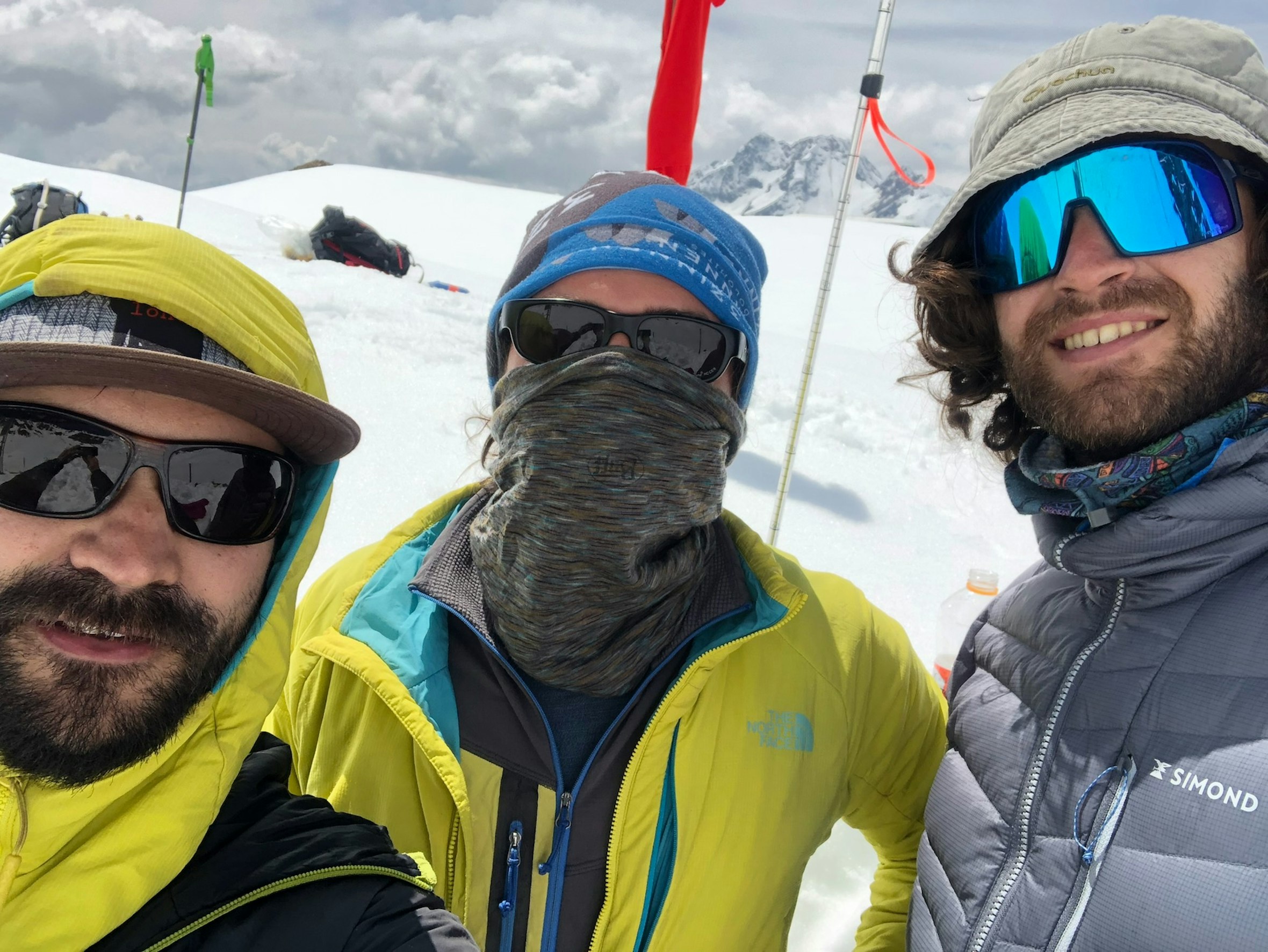
Carlo Marin, Nicola Ciapponi and Riccardo Barella bursting with enthusiasm
Credit: Eurac ResearchThe difficult path to sharing – and the rehabilitation of the calorimeter
Marin and Barella were bursting with enthusiasm when they proposed their protocol to a scientific journal for publication. However, things did not go entirely smoothly: by then most researchers had labeled the calorimeter a complicated instrument, and the two scientists had to work really hard once again to demonstrate their improvements. But, now they are doubly satisfied. “We didn’t invent anything new, but by organizing the procedure we opened a path for deepening knowledge of snow,” Marin explains. “In particular, we will use this technique to validate data from satellites equipped with radar sensors. That way we will be able to use satellite images to monitor snow cover in the Alps more effectively.”
The paper









 My cookie preferences