Futures Summit South Tyrol 2026: reclaiming the future from the forces that quietly shape it
The future rarely arrives open. Long before anyone debates it, it has been narrowed: by inherited assumptions, by dominant actors, and by the metrics we choose, which end up quietly dictating the very tomorrow they claim to measure. That was one of the key takeaways of the Futures Summit South Tyrol 2026 held on June 11 and 12 at Eurac Research and Haselburg/Castel Flavon in Bozen-Bolzano.
Hosted by Eurac Research’s Center for Advanced Studies, the summit brought together leading futures scholars, policymakers and representatives of international organizations such as UNESCO, UN Tourism, and the European Commission, alongside regional stakeholders, civil society leaders, and researchers from across adjacent disciplines. Over two conference days, alternating between keynote talks and discussions, the summit sought to answer how the future can become something to actively shape rather than passively accept.
Day 1 focused on dismantling this future capture through critical, participatory, and sensory methods, offering a vital reminder that imagination itself can be co-opted. The true priority, speakers argued, is accountability rather than mere creativity.
Day 2 shifted to the environments where long-term thinking either thrives or erodes: our institutions. Presenters made the case that foresight only survives political shifts when it is deeply embedded and tangibly felt, rather than treated as a one-off exercise. Finally, South Tyrol - and its tourism industry in particular - served as a living testbed. As a fundamentally human-centric sector, tourism now finds itself at the forefront of a governance challenge far larger than itself.
The following summaries trace the arc of the program, moving from Day 1’s deconstruction of the future to Day 2’s focus on long-term governance.
Day 1: Unframing the future
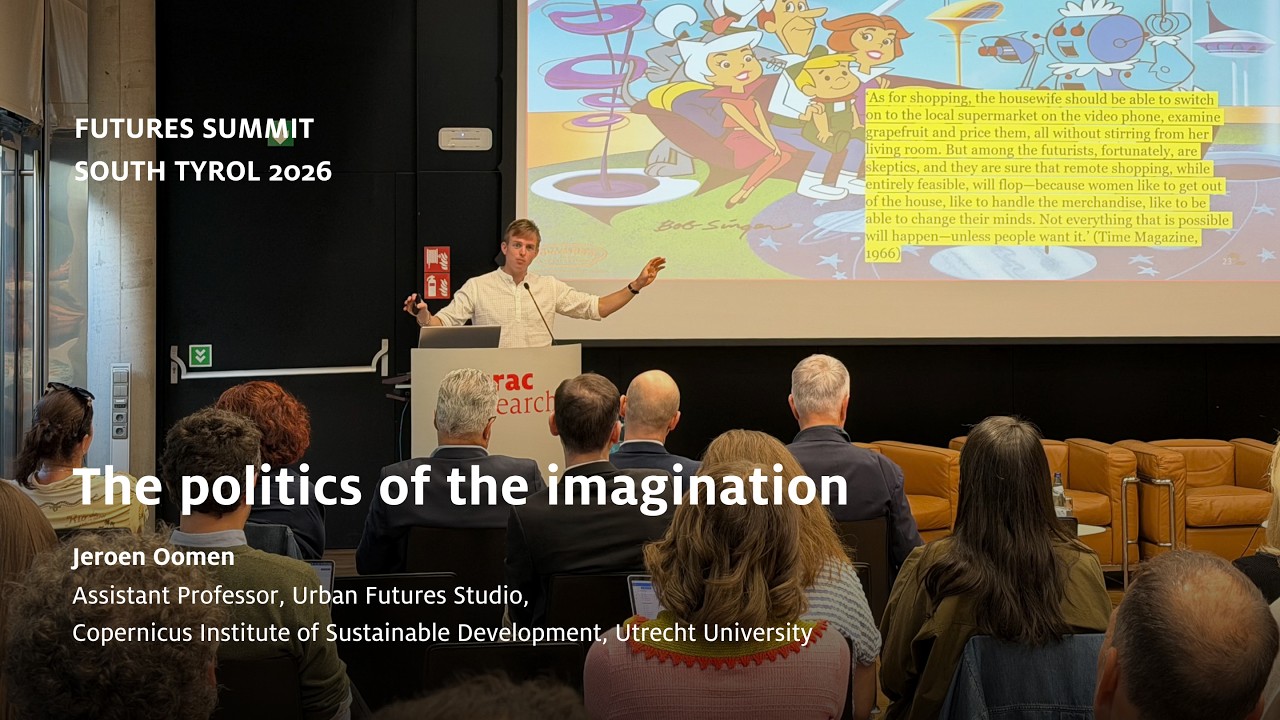
Jeroen Oomen, "The politics of the imagination" – Oomen argued that dominant narratives about the future hold power not because they are inherently true, but because society collectively acts as if they are. Drawing on Karl Rove’s infamous "reality-based community" quote and Mark Carney’s World Economic Forum address, he illustrated how a "dramaturgical regime" restricts our view of what is realistic or desirable. Environmental politics, in particular, remains trapped by a collective inability to conceive of a world meaningfully different from the present.
“The system's power comes not from its truth, but from everyone's willingness to perform as if it is true.” - Jeroen Oomen
Luigi Mosca, "Future-making as emancipatory inquiry" – Mosca framed future-making as a value-laden, normative negotiation of preferred outcomes. He argued that institutional leaders must actively empower marginalized voices through a continuous cycle of imagining, testing, stabilizing, and refining – citing the decentralized model of the Milano Cortina Olympics as a live example. For a cautionary tale, he pointed to Rio Tinto’s destruction of a 40,000-year-old Aboriginal site, where rigid, outdated laws left no room to pivot when new information came to light.
“Future-making, broadly speaking, is the work of making sense of possible and probable futures and negotiating and giving forms to the preferred ones.” - Luigi Mosca
Idil Gaziulusoy, "Experiential, embodied, sensory" – Presenting three case studies – a multispecies design for the Aalto University campus, an Australian coal-pit-to-lake transition, and EU cellular-agriculture tastings – Gaziulusoy showed how creative, critical futuring can disrupt dominant narratives, yet remains highly vulnerable to co-optation. She identified three specific traps: institutional capture (repressive tolerance), political-economic capture (naivety regarding land, capital, and law), and affective capture (where a beautifully staged concept bypasses critical deliberation). Ultimately, she argued, the goal must be structural accountability, not just more creative output.
“A democratic experiential futures process should not simply make a future attractive. It should help participants notice how attraction is being produced. It should invite discomfort, refusal, ambivalence and critique.” - Idil Gaziulusoy
Laura Pereira, "Imagining the impossible" – While modern society is fluent in dystopian imagery, it struggles to visualize desirable futures. Pereira introduced the Nature Futures Framework and various decolonial visioning initiatives (including ecological peace initiatives in Korea’s DMZ, African futurism, and coral reef preservation in Malawi) that center pluralistic values for nature over a single, Western endpoint of "sustainability." True transformation requires relinquishing the frameworks that lock us into status-quo thinking; the linear Western "futures cone" should be balanced by circular and ancestral concepts of time.
“It's about building this imaginative muscle. The capacity to actually think through what preferable alternative futures, in the plural, could be. Because it’s quite easy to imagine where things start to go wrong.” - Laura Pereira
Rocco Scolozzi, "Beyond captured futures" – Applying Causal Layered Analysis to four alpine case studies near Bozen-Bolzano, Scolozzi traced how specific futures become locked in through institutional symptoms, feedback loops, worldviews (viewing the mountain as a resource versus a heritage site), and cultural myths (the playground versus the fortress). He proposed a more resilient alternative: the open hybrid village, where visitors act as temporary citizens. Because metrics naturally reinforce the worldviews that created them, the most potent political act is to identify the metaphor we are currently living in and intervene before alternatives are dismissed as naive.
“What we measure is not evidence of a worldview. It reinforces the worldview. If we measure only visitor flows, we will design for flows.” - Rocco Scolozzi
Fireside chat (Roland Benedikter with Roberto Paura and Mara di Berardo) – Set against the backdrop of Haselburg Castle with views over Bozen-Bolzano and the surrounding mountain peaks, this evening session explored how our relationship with the future has shifted over the past decade. The conversation generated three core insights:
- Futures remain tethered to human imagination, which poses both an opportunity and a risk in an increasingly image-driven media landscape.
- Political and social resistance intensifies the moment transformation becomes concrete; assuming that communities will change through simple persuasion is an idealization.
- The futures process is cyclical rather than linear, constantly moving from critical diagnosis to concrete action, and back to critical reassessment.
Day 2: Governing the long-term
Clare Stark, "Futures of anticipatory governance" – Stark reframed the current era of "polycrisis" as one of polytunity, outlining UNESCO’s mission to help governments pivot from short-term electoral cycles to long-term anticipatory capacity. This effort is driven by futures-literacy labs across 50 countries, a network of 37 institutional chairs, and an upcoming Global Anticipatory Policy Coalition. Pointing to legislative models – such as future-generations bills in Wales and Australia, Chile’s neuro-rights commission, and youth-led scenario planning in Kenya – she emphasized that foresight outlives political transitions only when it is legally and structurally institutionalized.
“We need to really democratize the futures. So we want everybody to have this capability. We find that the futures and futures literacy is really a global good that should be accessible to all.” - Clare Stark
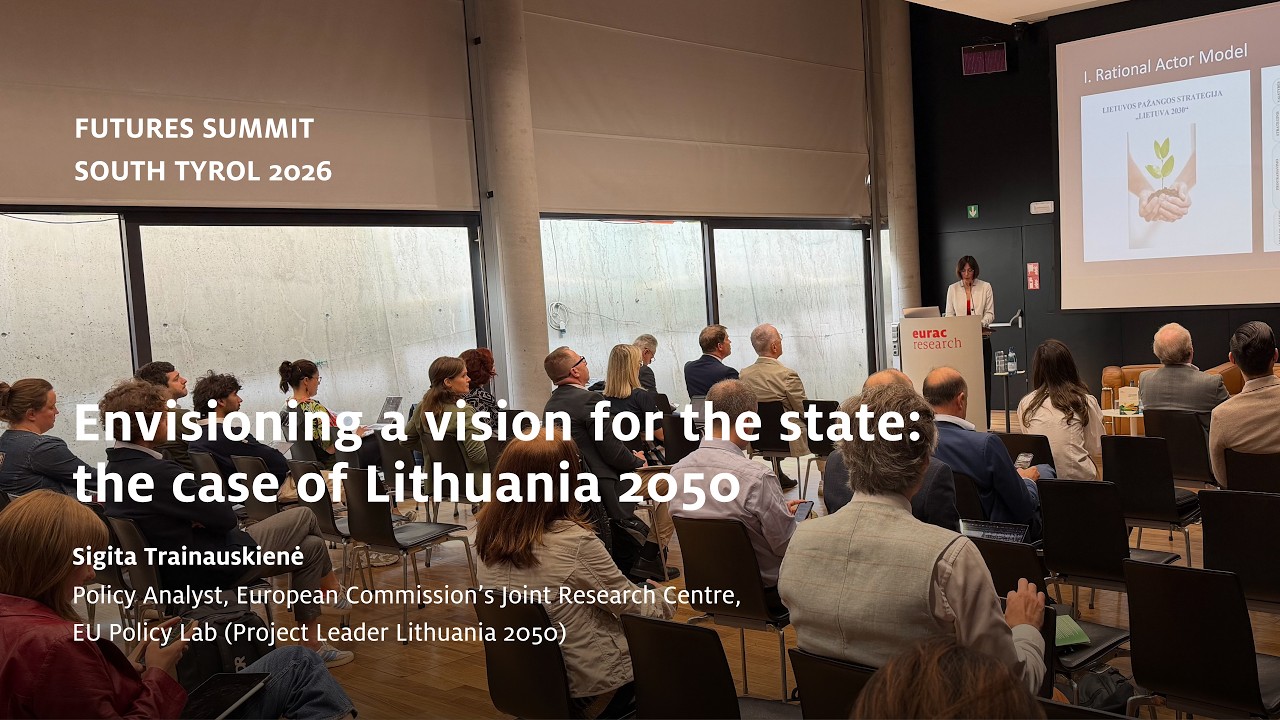
Sigita Trainauskienė, "Lithuania 2050" – Trainauskienė detailed the execution of Lithuania's three-year, 2,500-person national visioning process, which has since been formally adopted as state strategy. She evaluated the project through various political and organizational lenses, offering three practical takeaways: engage every political party so the vision survives changes in government; keep strategic goals broad enough that incoming administrations can determine their own implementation tactics; and overcome short-term apathy ("I won't be here in 2050") by anchoring discussions in the lives of participants' grandchildren.
"When you approach that question that it's about the future of your kids, about your grandchildren, then people somehow were able to distance themselves from their current political agenda.” - Sigita Trainauskiené
Roundtable, "Institutionalizing the future" (Clare Stark, Rocco Scolozzi, Sigita Trainauskienė, moderated by Harald Pechlaner) – The panelists agreed that building an institutional structure is only the first step; the deeper challenge lies in shifting cultural, cognitive, and normative mindsets toward the long term. They argued for preserving human deliberation even as AI increasingly automates scenario-building and horizon scanning. The panel also advocated for sensory and artistic methods that allow policymakers to internalize future scenarios, while Scolozzi proposed permanent, randomly selected citizen assemblies to close the psychological gap between today's decisions and their century-long consequences.
Spotlight, Dirk Glaesser, "Shaping the post-2030+ agenda" – Glaesser provided an insider perspective on how tourism originally landed in the UN Sustainable Development Goals (SDGs) more by coincidence than deliberate strategy. To break through bureaucratic silos, the sector had to produce its own empirical evidence – such as indexing global visa regulations to dismantle transactional travel barriers. He argued for a major shift in measurement: focusing solely on Western international arrivals overlooks the projected 37 billion domestic and same-day trips expected by 2030. Consequently, tourism is evolving from a distinct economic sector into a foundational element of modern lifestyle. Throughout this transition, Glaesser noted, "perfect is the enemy of the good," emphasizing the need to validate existing industry standards to demonstrate real-world progress.
“We are the most important economic sector with a human-to-human interaction. We are not exporting cars, we are not storing these cars when we can't sell them. This is a human-to-human activity.” - Dirk Glaesser
Panel, "Tourism post-2030 futures" (Dirk Glaesser, Anna Scuttari, Michael Walzer, moderated by Harald Pechlaner) – The panel converged on the idea that tourism is transitioning from an industry into a lifestyle, blurring the lines between leisure and travel, and making the very term "tourist" outdated.
• Dirk Glaesser positioned tourism at the center of a macro-governance challenge that extends far beyond the industry itself.
• Michael Walzer shared insights from Tyrol’s state-funded Future Lab, which tests weak-signal prototypes (such as an e-sports camp) against a backdrop of declining snow reliability and regional complacency.
• Anna Scuttari identified local workforces as the overlooked stakeholder in the traditional guest-resident binary, while cautioning against a subtle form of cultural colonialism occurring in small rural villages.
Looking ahead
Perhaps the summit's most useful takeaway fits in a single question, posed by Rocco Scolozzi at the end of his talk: What metaphor are you living in? Before planning, before investing, before designing policy, that is where the work of reclaiming the future begins. It is a question no discipline can answer alone, which is why the summit deliberately brought UNESCO, UN Tourism, academia, business, civil society and regional government to the same table. And it is a question we will keep asking.
The next edition of the Futures Summit follows soon.
To receive updates on upcoming research, projects, and events from the Center for Advanced Studies, please subscribe to our newsletter: HERE
Video recordings


Contact Information
Eurac Research
Center for Advanced Studies
Drususallee 1 / Viale Druso 1
39100 Bozen / Bolzano
T +39 0471 055 800
advanced.studies@eurac.edu