
A new study in Sustainable Futures measures how lifestyle-based emission reductions interact with national climate plans and the EU's Paris commitments, and finds that dietary change and reduced aviation could make a structural difference.
Institutes & CentersInstitute for Renewable Energy - Overall energy system modelling and e-mobility - News - Sufficiency and climate targets: quantifying a gap that policy cannot afford to ignore


Cutting emissions is often presented as a story about technology like better batteries, cleaner grids, and more efficient buildings. But a growing body of research points to another lever that climate policy has been slow to quantify changes in how people eat, travel and consume.
A new study, developed within the framework of the H2020 FULFILL research project, and published in Sustainable Futures takes a close look at just how much these lifestyle-based changes could contribute, and connects the findings directly to Europe's official climate commitments.
The study, developed by Eurac Research together with Politecnico di Milano, examines six concrete sufficiency measures, including dietary change and reduced air travel, and estimates how much greenhouse gas emissions they could cut across five EU countries: Denmark, France, Germany, Italy and Latvia and EU as a whole. The results are compared against each country's national climate plan as well as the EU's overall commitment under the Paris Agreement.
What makes this study different from previous work is precisely that comparison. Rather than quantifying the potential of sufficiency in the abstract, the researchers ask a more policy-relevant question: how much of the gap between where we are headed and where we need to be could these measures realistically close?
To account for uncertainty, the team used two different baselines and two ways of measuring impact, producing a range of estimates rather than a single figure. This approach makes the results more reliable and more useful for policymakers navigating real-world decisions.
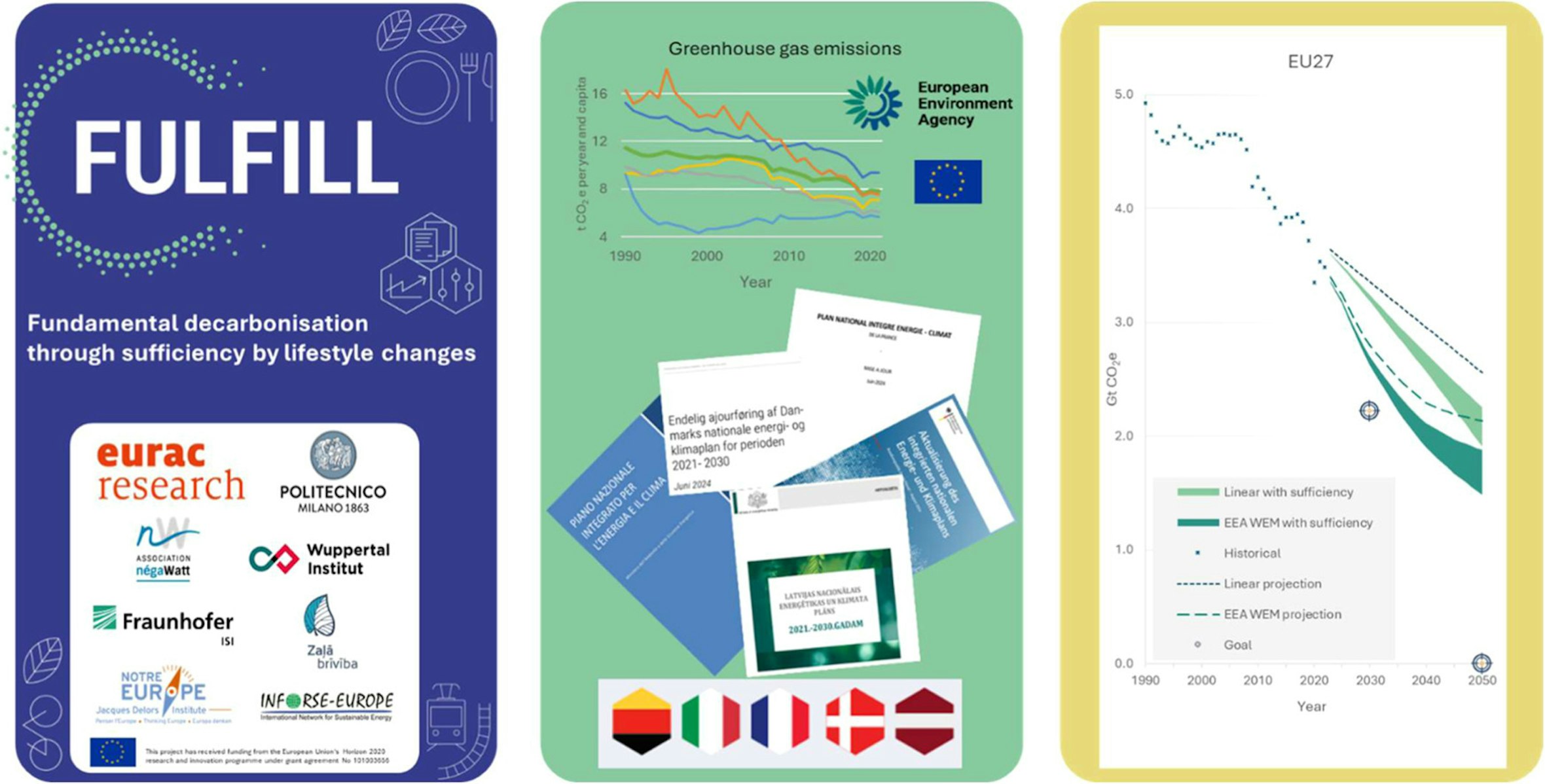
Two measures stand out across the board: changing diets, particularly reducing meat consumption, and flying less. Both deliver substantial emission reductions, and both remain effective even as other sectors become cleaner through technology. This is significant, because aviation and food systems are among the hardest areas to decarbonise through technology alone.
"Our goal was to give this a policy context: not just to say sufficiency matters, but to show where and by how much it can make a difference in the plans that governments are already working with. The numbers show that what we eat and how much we fly are not marginal factors, they are among the most powerful levers we have on the demand side," said Erwin M. Schau, senior researcher at Eurac Research's Institute for Renewable Energy and lead author of the study.
“Especially the dietary aspect is of relevance. In fact, through large scale application of renewables and energy efficiency we can strongly decarbonize our actual energy system and reduce our dependency on fossil fuels. But how we eat has a strong impact on how much land we need, how much water we use, how much methane is produced in the stomachs of the cows we eat. And already slight changes (so not eliminating but reducing) can have a relevant impact” adds Wolfram Sparber, the Head of Institute for Renewable Energy at Eurac Research and co-author of the study.
The research used the MARIO economic modelling framework, developed and applied by Politecnico di Milano, while Eurac Research led the work of anchoring the results to EU and national climate planning instruments.


This project has received funding from the European Union’s Horizon 2020 research and innovation programme under grant agreement No 101003656. The sole responsibility for the content of this article lies with the authors. It does not necessarily reflect the opinion of the European Union. Neither the European Climate, Infrastructure and Environment Executive Agency (CINEA) nor the European Commission are responsible for any use that may be made of the information contained therein.








 My cookie preferences