


A cup of sunshine
How melting snow forms suncups — and why satellites notice
Known as suncups, these depressions are typically cup-shaped and form naturally on melting snow. Remote sensing expert Carlo Marin is drawn to them by them because they can have a major impact on optical and radar data collected from satellites and aircraft, altering how incoming energy is scattered. Yet despite their influence on remote sensing measurements, they have never been systematically measured in the field.
How did it all start?
Carlo Marin: I was analyzing satellite radar data and noticed an unusual pattern in the reflected signal (see the video in this article for an explanation of how radar satellites work). I was looking at data tracking mountain snowpacks and, at a certain point in the year, I expected to see the reflected energy gradually decrease. Instead, the signal suddenly spiked.
“In my opinion, Japanese research groups studying snow know a great deal that we are unaware of because they rarely publish in English.”
Carlo Marin, expert in remote sensing and snow
Did you immediately understand what was going on?
Marin: A few years ago, I hypothesized in a scientific article that this unusual trend was linked to the roughness of the snow surface. At the time, I discussed it with many experts in the field, but without much success: attention was focused almost exclusively on melting processes and the amount of water released into downstream rivers. It was an aspect that interested few. The turning point came when I found an ally in a colleague who had studied in Japan, one of the world’s “temples” of snow research.
What did Japan have to do with it?
Marin: Yes, yes, in my opinion, Japanese research groups studying snow know a great deal that we are unaware of because they rarely publish in English. A colleague and friend of mine first introduced me to a concept I didn’t know about and that seemed to attract little interest here in Europe: suncups. On high-altitude snowpack, above about 2,500 meters – in other words, snow that persists even into July – when solar radiation begins to have a strong effect, the snow develops these very regular waves, much like the surface of a calm sea. So, together with my group, and especially with Riccardo Barella, we began to study them.
How?
Marin: We developed an inexpensive, portable kit consisting of a digital camera and a rigid black PVC foam board panel. The panel is positioned so that the snowpack’s profile stands out against the black background, then a photo is taken. So far, nothing new. The real innovation lies in the specific geometric markers we printed on the panel. An automatic recognition software we developed at Eurac Research, based on artificial intelligence that Riccardo trained using countless examples collected in the field, both in our valleys in South Tyrol and at Weissfluejoch, Switzerland’s oldest monitoring site.
Our software uses these reference points to automatically extract the snow surface profile and calculate its roughness parameters. We then use these measurements as a ground reference to validate the satellite data.
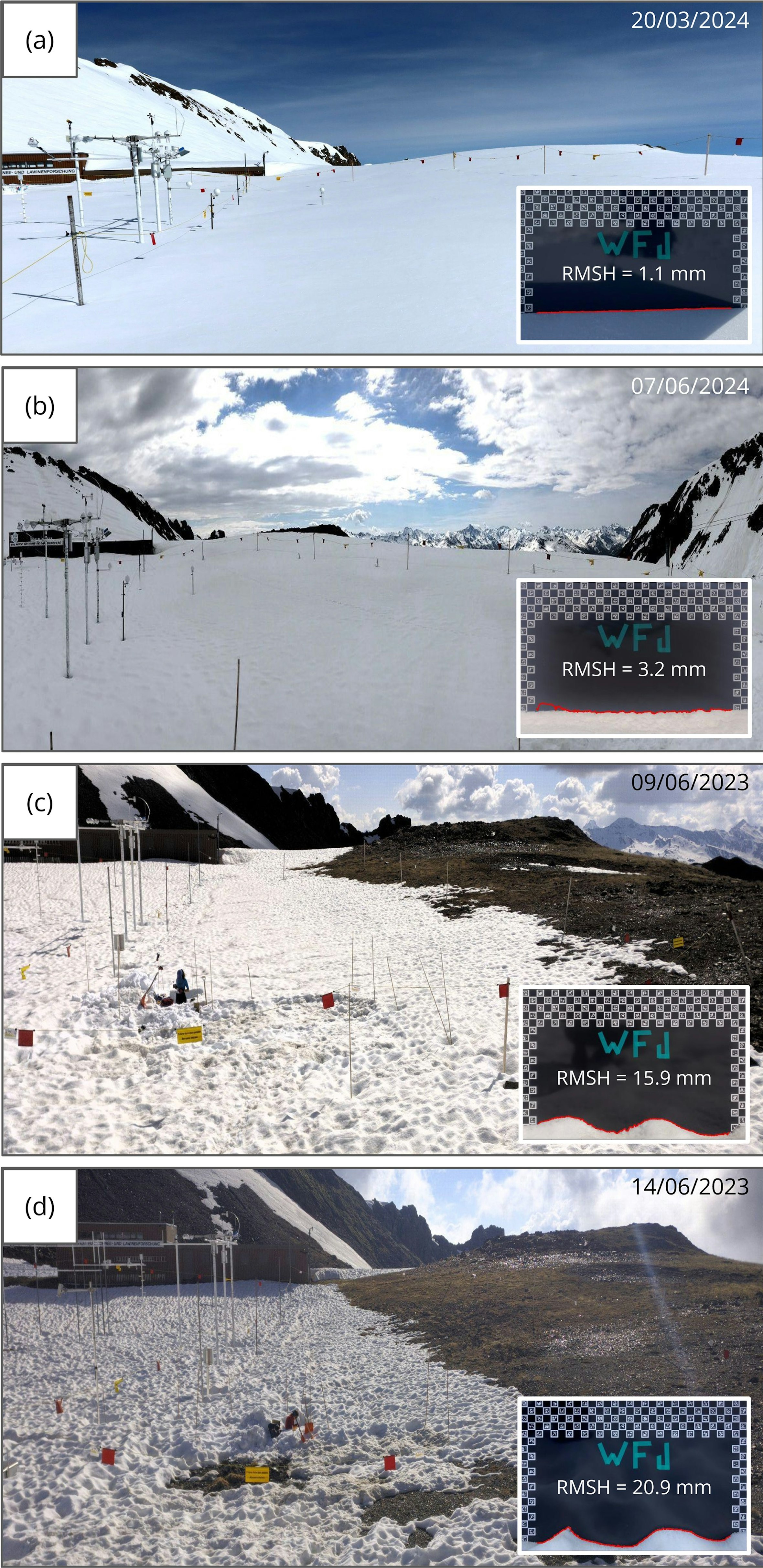
Figure from the paper https://tc.copernicus.org/articles/19/5579/2025/
Credit: Francesca Carletti, Mathias Bavay | All rights reservedWhy measure suncups?
Marin: Because they provide an additional feature that can be detected by satellites and used to better understand when snowmelt is likely to reach its peak. Although suncups are not widely known, that does not make them any less important.
“Suncups are the way snow contorts itself in a desperate attempt to resist its fate and not disappear during the summer.”
Carlo Marin, remote sensing and snow expert


In the Andes, at altitudes often exceeding 4,000 meters, ice pinnacles that resemble penitents are not uncommon. Charles Darwin* spotted these so-called “penitentes” in the mid-19th century while crossing the Andes on his way to Mendoza, near the Piuquenes Pass between Chile and Argentina, and described them in his book “A Naturalist’s Voyage Round the World.” “Like suncups,” explains Carlo Marin, “penitentes also form during the thawing period and are very dramatic and difficult to navigate if you need to take measurements in the field.”
Credit: Adobe Stock | Chris | All rights reservedWhat purpose do suncups serve in the snow?
Marin: Well, that’s a good question – and no one has the answer yet. That’s exactly what I hope snow physicists will eventually discover. At the moment, there are several hypotheses, and our work has already inspired follow-up studies, particularly on the role these structures may play in changes in albedo during the melting season.
Personally, though, I prefer a more literary, almost romantic interpretation: Suncups are the way snow contorts itself in a desperate attempt to resist its fate and not disappear during the summer.
Carlo Marin
Further reading









 My cookie preferences