


In English, can it rain if there’s no subject?
The advantages of valency grammar in multilingual teaching
Valency grammar was invented by French linguist Lucien Tesnière in the 1930s. In Italy, it was studied and applied by Francesco Sabatini, but it is not very widespread. How did it win you over?
Silvia Parduzzi: It was love at first sight – already at university. I tried it out in the classroom and… wow! I’ve always been passionate about grammar, and I immediately saw that this method didn’t just work for me – it sparked something in the children too. Their lively discussions around a single verb are simply wonderful.
What makes this method special is that there’s no absolute truth handed down from the teacher. There’s rarely just one “correct” answer. Instead, we explore possibilities together and then check them in the Sabatini-Coletti dictionary (named after Francesco Sabatini), which conveniently lists verb valences in brackets.
What is valency grammar?
But how? Grammar is grammar, with its fixed rules...
Parduzzi: A verb needs different elements depending on the context, and children understand this right away. It’s an approach based on discovery and reasoning. I prepare round red cards with verbs written on them. Then, in class, we use clothes pegs to attach all the possible elements that can connect to the verb, and together we explore what role each one plays.
“I immediately realized that with this method, my enthusiasm for grammar is also passed on to the children.”
Silvia Parduzzi, teacher
Marta Guarda: Starting by thinking about the meaning of a sentence and the connections between words rather than explaining the grammatical components is an effective way to grab attention. But in my opinion, the great added value of valency grammar is its democratic nature. Once you learn the mechanism, it becomes natural to make comparisons with other contexts and other languages. It’s an inclusive method.
Does it really work like that in practice?
Parduzzi: Absolutely. When we discovered these interesting zero-valent verbs in class – the atmospheric verbs like piove (it’s raining) – a child raised their hand and said, “But teacher, in German they’re not zero-valent; in German there’s es, which could be the subject.” From there, a very natural and spontaneous conversation about comparing languages began. The children started with German and English, which they study at school, and then naturally moved on to the various languages spoken at home.
"The great added value of valency grammar is its democratic nature."
Marta Guarda, linguist
You and your colleagues have collaborated on a project to support multilingual teaching.
Guarda: We created learning units filled with activities designed for classroom use which teachers can download for free. One unit focuses specifically on valency grammar and includes fun, engaging activities like a board game, a verb fashion show, and origami fortune telling. A key part of our approach is inclusion, which is why we involved families in the process.
Parduzzi: The children took charge by themselves: after learning how valency grammar works, they explained it to their families at home and then asked for help to expand comparisons between the languages they speak at home and learn at school. While testing this approach, we worked with families who spoke Portuguese, Arabic, Polish, and Albanian. I don’t speak any of those languages, but the children and their families collaborated enthusiastically and effectively.
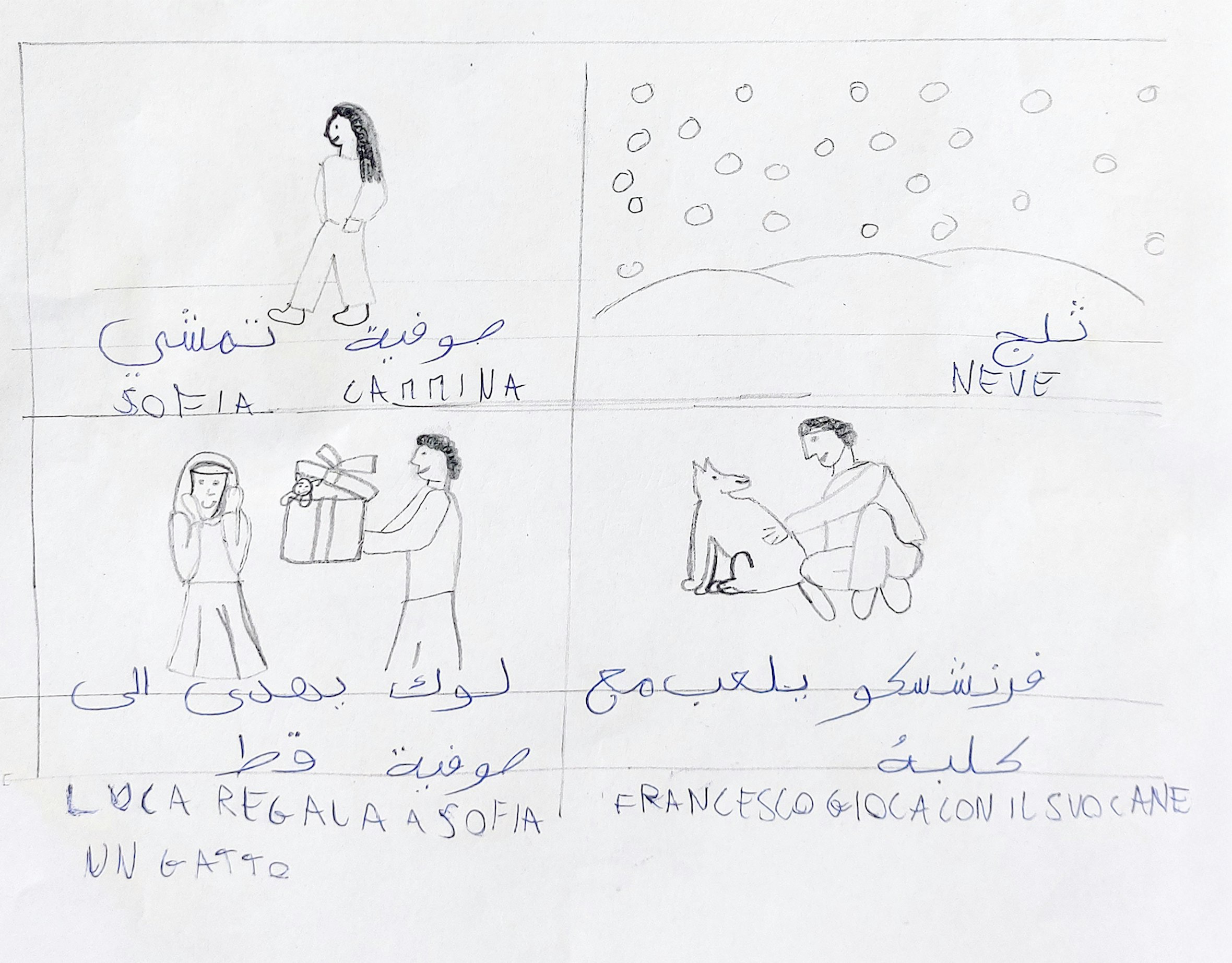
After explaining how valency grammar works at home, the children asked for help in extending the comparisons between the languages they learn at school and those spoken at home. Here is an example of similarity: in the Italian sentence Sofia cammina, the verb camminare is monovalent, just as it is in Arabic. In fact, the verb tamshi, which means to walk in Arabic and requires only one argument is represented in this case by the subject Sufia.
Credit: Eurac Research“If we open schools to the knowledge that each individual brings, everyone will feel valued and may be more willing to engage in different initiatives, because they will feel recognized as legitimate voices.”
Marta Guarda, linguist
Could say this experiment had a positive impact on relationships with families beyond just the specific exercise?
Parduzzi: I remember a mother who kept asking me, “Can I teach Arabic to my child? Won’t it interfere with their cursive writing?” This activity showed us that every language a child knows is an incredible resource – it actually helps with learning the languages studied at school. Because of this, parents who were perhaps less involved – sometimes because Italian was more challenging for them – felt truly acknowledged and took the task very seriously.
Guarda: For some time now, in countries with a colonial past, there’s been growing discussion about epistemic justice: forms of justice that recognize and give voice to the knowledge, including languages, of colonized peoples. If we broaden this idea to include all marginalized groups, we can apply the concept here as well and when schools open themselves to the knowledge everyone brings, each person feels valued and is more likely to participate in different initiatives, knowing they are recognized as legitimate participants.
“Once children understand how it works, memorizing a label is secondary.”
Silvia Parduzzi, teacher
If the advantages are so obvious, why hasn’t valency grammar replaced traditional methods?
Guarda: It’s natural for teachers to replicate the ways they were taught and socialized. In this case, adopting valency grammar requires a major shift in perspective.
Parduzzi: E What’s more, valency grammar can sometimes be challenging for us teachers because it’s not fixed or absolute. It’s harder to work with a method that is open to multiple interpretations depending on the context.
Guarda: However, those who decide to explore this path usually don’t go back. A German colleague of yours initially found it complicated, but then she had a lightbulb moment – with this reasoning-based approach, children understood German grammar much more easily, almost intuitively.
So there are no limits?
Parduzzi: Apart from the fact that dedicated textbooks are still harder to find – though they have become more common in recent years – I sometimes have a different concern. With this method, I don’t teach labels, or rather, the specific names of individual complements. When these children move on to middle school, will they be able to learn all the labels that students who studied with the traditional method have already internalized? Then I reassure myself – once they understand how grammar works, memorizing labels becomes a secondary issue.








 My cookie preferences