



Snow
Developements and effects in South Tyrol and the Alps
- 1.What is snow?
- 2.When does it snow?
- 3.How is snow cover measured?
- 4.Have snow depths changed in South Tyrol?
- 5.What’s the situation in the rest of the Alps?
- 6.How’s climate change going to affect snow?
- 7.How do extreme snow events fit into this picture?
- 8.How important is natural snow for winter tourism and the ski industry?
- 9.What are the consequences of climate change for ski areas?
- 10.What are the implications of the changes in snowfall and snow cover for the water cycle?
- 11.What is the role of snow and climatic changes for glaciers?
- 12.What can be done to mitigate these changes?
- 13.Less snow, changes in the hydrological cycle: Adaptation measures
Contents


The snowpack is a complex structure, its layers tell the story of the winter from the first to the most recent snowfall.
Credit: David Newman | All rights reserved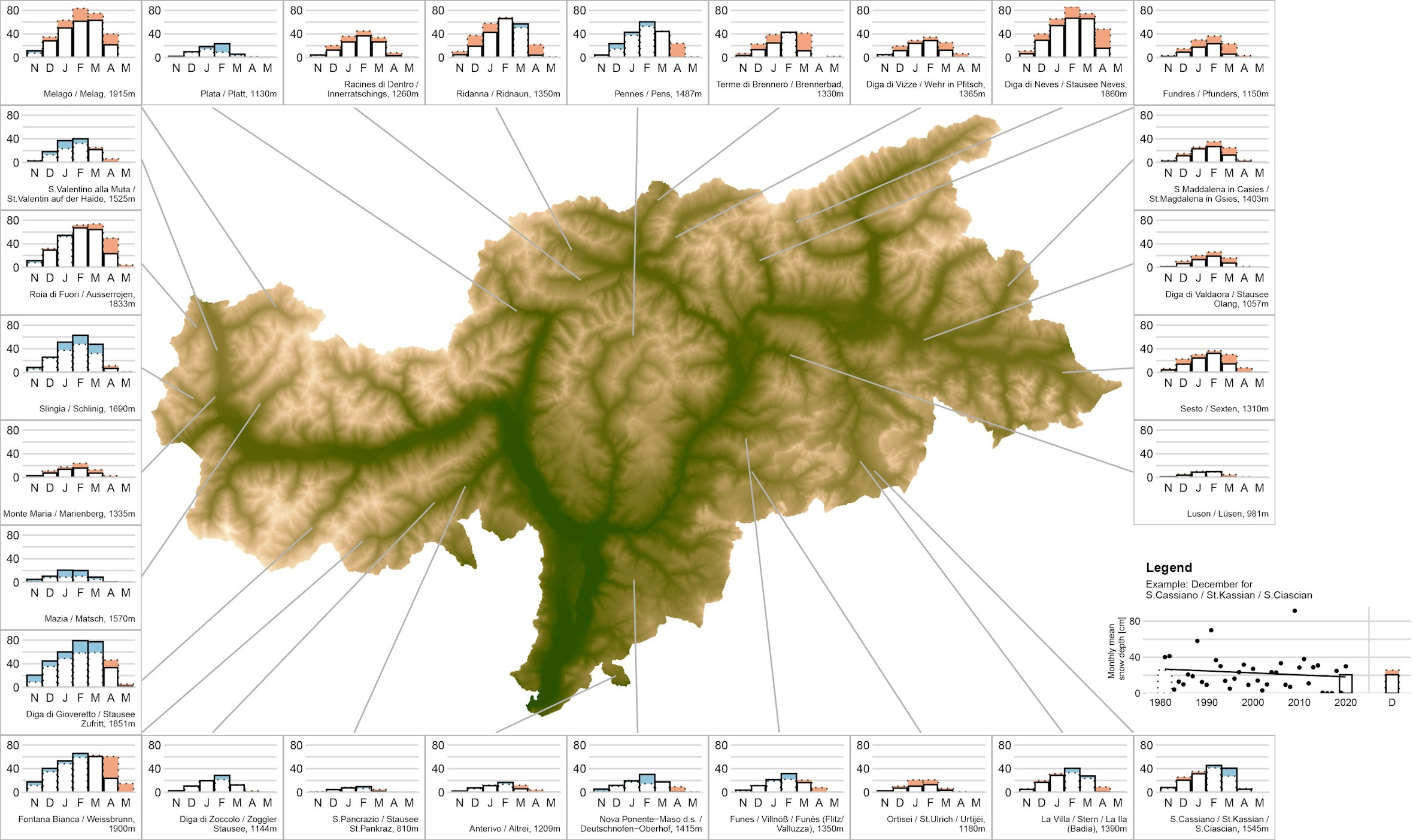
Trend analysis of snow depth for all sites in South Tyrol that have more or less complete records for the last four decades (1981-2020). The change in snow depth is determined via a linear regression analysis of monthly mean snow depth by year. Negative trends in red, positive trends in blue.
Credit: Eurac Research | Michael Matiu
Average area that is snow covered (snow cover fraction) in winter (December to February) and spring (March to May) for the present (2000-2020) and projected changes for the future (2071-2100). Present observations are based on 20 years of satellite observations, and future conditions based on an ensemble of regional climate models, which have been bias corrected using observations. The maps have a horizontal resolution of 12km, which corresponds to the resolution of the current generation of regional climate models.
Credit: Eurac Research | Michael Matiu
Snow masses will continue to occur in the future, despite overall decreasing snow amounts and because of climate change, heavy snowfalls could even become more extreme.
Credit: Andreas Buchwald | andreas-buchwald.com | All rights reserved
If the snow doesn't fall from the sky, it comes from a cannon: 90% of the slopes in South Tyrol can be covered with snow in this way. However, the water and energy consumption is high.
Credit: ©Sonja Birkelbach - stock.adobe.com | All rights reservedTechnical snow
Improvement potential
- Use water more efficiently
- Use weather and snow-model forecasts to allocate resources more efficiently. The EU-project PROSNOW developed a tool for this (https://prosnow.org)
Snowfarming (snow depots, which store snow from the previous season)
Water reservoirs and dams
Improvement potential
- Increasing water-use-efficiency in agriculture. Large margins of improvements exist for irrigation.
- Diversifying the usage of dams: not only to produce electricity, but also to manage floods and droughts.
 Science that inspires
Scientific publications
Imprint
Michael Matiu, Institute for Earth Observation,
with the help of Giacomo Bertoldi, Claudia Notarnicola, and Marc Zebisch
Editors: Barbara Baumgartner, Valentina Bergonzi
Illustrations: Oscar Diodoro
Graphics: Elisabeth Aster
Translation: Rachel Wolffe
This project has received funding from the European Union’s Horizon 2020 research and innovation programme under the Marie Skłodowska-Curie grant agreement No 795310.








 My cookie preferences